Contrast this with Firefox, where I can easily get a tab bar down the side via a plugin (I use this: https://addons.mozilla.org/en-US/firefox/addon/tree-style-ta...). Even without a plugin, FF gives me the Expose-like functionality (ctrl+shift+e) which will show me all open tabs and their titles.
How Google can think the current tab situation in Chrome is useful is a mystery to me.
When OS X was first released, the Dock was an object of ridicule. (Among some of us, it still is, but we all realize that by now it's not going away.) It was demonstrably worse than previous mechanisms at just about everything, and it make OS X look like a toy. Eventually Tog[1] came around, sort of:
> Contrary to my previously-held position, I no longer believe Apple should get rid of the Dock. It's just too pretty [...] You want a visibly-apparent manifestation of the personality of the underlying technology. That's why automakers spend milliions making the outside of the car project an image of what's underneath the skin.
The supersmooth tabs in Chrome are probably a significant portion of what makes Chrome feel faster, even when it isn't. Like the Dock, their outrageously high demo value probably exceeds their limited scalability for more experienced users.
In general there is lots of overlap between tabs/tabgroups/bookmarks/history/readmelater/systemtaskbar/sessionrecovery.
Most people need all use cases but pick one or two features and emulate the rest themselves. Most tab related firefox plugins essentially duplicate functionality already present on top of the tab system.
For example: hierarchical tabs on the left with tab recovery is identical to having a bookmark list on the left.
It is my opinion that these concepts should all merge, preferbly at the desktop shell level. Ubuntu is movng is this direction, but they add this functionality on top of all the existing functionality. We can only hope that they will in the future consolidate all the overlap.
They're really not. Not with any alternatives I've found, anyway. Tabs aren't just navigation history; they're curated, temporary history. Unworthy of the permanence of bookmarking, yet too important to regulate to the dense, rapid flow of history.
I use Pocket and Delicious to keep things in check, but they don't help as much I'd like. The most effective tab management tool for me has been Firefox's tab candy/expose feature. It's much easier to get an overview of what's open and spot unnecessary tabs with the grid of thumbnails.
You might enjoy this?
https://addons.mozilla.org/en-US/firefox/addon/toomanytabs-s...
https://addons.mozilla.org/en-US/firefox/addon/tree-style-ta...
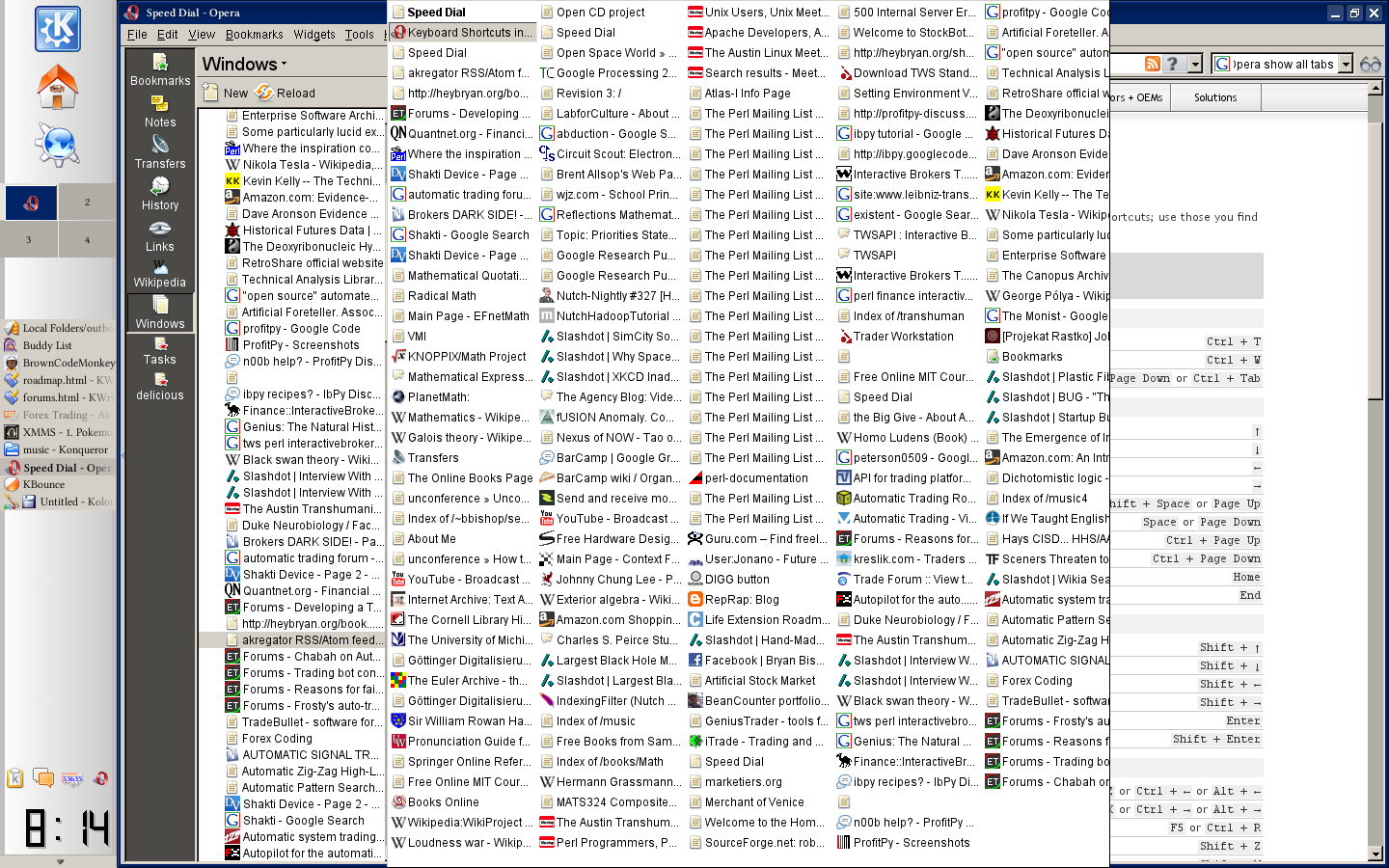
Also, the person who thinks 30 tabs is a lot should get a look at what I do to myself:
Im claiming there is lots of overlap in functionality. The differences are in the default behavior and the UI elements. In the end, it should all be one big directed graph.
I would rather state it the other way around. The fact that people use tabs, means the bookmark functionality is broken from a UX perspective.
Whenever I'm stuck with another browser, I'm still in the habit of launching lots of tabs but then I immediately get lost.
No matter how better Chrome gets - speed and security wise, I just don't seem to be able to give up FF. Addons, cross platform consistency (I use OS X, Windows and Linux all 3 in a typical day), Font rendering, continuous memory usage improvements, less site specific issues etc. seem to be all keeping me on FF.
I can't say I have an issue with load times for either, although i rarely wouldn't have a browser open so it is becoming like the 'irrelevance' that some people claim boot times are, to some extent.
Check out the Google Chrome Comic, which goes into detail on the browser architecture: http://www.google.com/googlebooks/chrome/
I don't get why people care about start up times. I start Firefox up at the beginning of the day when I turn my machine on, and that's it.
Just a prediction, but you will realize that the difference in startup performance is but a perception.
Thanks!
>> Firefox has always felt very unresponsive in terms of the UI and loading times. The only browser I've found less responsive is Safari (IE, is very responsive).
But surely, I need to dig down further to find the cause.
Back when it was called Phoenix. When they renamed it, I guess they changed focuses - firefox became the new hulking monster that was mozilla.
Firefox has always felt very unresponsive in terms of the UI and loading times. The only browser I've found less responsive is Safari (IE, is very responsive).
Memory consumption was an issue at one stage in Firefox's history but they mostly fixed that (from 1 GB/usage down to like 200 MB~ after a day of browsing).