I think you're saying you have a pump that moves hydraulic fluid in anticipation of a road defect/speedbump, and does it per-wheel and proportional to the correction needed. Which is fascinating.
With regards to pre-crash posture, I'm not sure if this is to move the occupants into a more advantageous position for airbag deployment or to get more crash structure involved for a dissimilar vehicle crash (sedan vs. truck). Can you talk more about it? Is there going to be IIHS/Euro NCAP/C-NCAP testing?
For ride control, machine vision helps a bit, but it’s limited due to the need to determine high fidelity road z-measurements which requires very high resolution and clarity at speed, and no visual occlusion. It helps with simple problems like bump vs hill (which is not trivial to predict just with accelerometers), but we’ve figured out how to get most of the benefit of machine vision with just accelerometers and fast actuators. GM was able to use vision to improve pothole performance, but it’s still a semi-active system that only provides fast adjustable damping force.
For pre-crash, the system uses cameras to detect a collision-path vehicle and determine an optimized impact zone for that vehicle. For example, the frame or bumper has more structural rigidity which may be desirable in certain crash scenarios.
You have no choice but to go at a speed useful enough to get anywhere. For me, these are real-world conditions.
Let me guess, all those demos are with carefully mapped bumps.
What does that mean? Was it too complex or costly to make it back then? Did that change now with your developments?
Better tech is nice but if it's to expensive or hard to mass produce then it could end up the same way as with Bose.
And those electric motors and control hardware would not have been cheap. But nobody knows how to estimate it - just that it would be prohibitively expensive.
While most vehicles used in ag are going to be combustion based for a long while, if you could apply the shock mitigation to a just a chair in spray rig (https://hayandforage.com/images/29-Thome_MR_38-WEB.7650.png) or fertilizer buggy, a lot of spines could be saved.
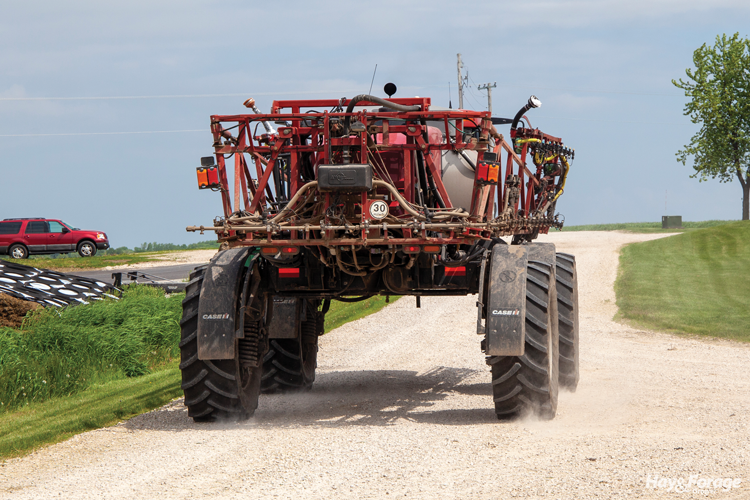
These vehicles are lighter and generally run faster than tractors, and applicators who run them for decades tend to be forced to retire in pretty bad shape.
Unfortunately does not eliminate the slow accumulative injury of going over rough and tilted ground for decades.
It seems like more of an issue here in the willamette valley of Oregon than it was in southwest kansas. I think the steep hills limit what is reasonable for suspension to counter with spines held at an off angle for long periods.
Question: Why not use an onboard front-facing camera to detect potholes in real-time? Using crowdsourced data can definitely have outdated-ness issues. Unless, you'll eventually plan to elegantly in-place switch over the data source to near real-time LEO satellite imagery over even better - below-LEO [0] satellite imagery.
[0] https://techcrunch.com/2025/04/29/near-space-labs-nabs-20m-t...
The ClearMotion1 system is a major leap above all tech currently on the market, with transmitted vibration reduced about 80% versus top market technologies. Here's a video comparing it on production NIO cars against luxury vehicles using semi-active (or slow active) systems others mentioned - sort of like comparing a microcontroller to a NVIDIA H100. http://bit.ly/44TDtgl
This matters especially for autonomous vehicles, where the whole point is to give people back time, and preventing motion sickness while working/reading is essential.
Our tech stack:
- Electro-hydraulic actuators that both push/pull actuate and dampen within a few milliseconds, using electric motors (not solenoid valves or special fluids). We use integrated hydraulics as a mechanical gain lever
- Predictive control software that anticipates vehicle, driver, and road dynamics
- "Infinite preview" control using crowdsourced road data with <3cm localization precision
- Software-enabled features including pre-crash posture mitigation and tire grip technology
The combination creates a "software-defined" chassis, similar to how electric power steering enabled today's driver assist features.
Our Bose acquisition was to acquire specific control software and engineering talent, but most of our IP and our production hardware/software was developed in house.
There were a few questions about durability— our system has passed 5 years of testing across millions of miles - a requirement from all of our customers like NIO and Porsche. It’s also a reason why it’s so difficult to succeed as a startup in automotive, but once you’re in, you’re locked in long-term.