News for hackers. Stuff that matters.
Re:Show HN: My iOS app to practice sight reading (10 years i... by pil0u on Sunday March 23, 2025 @06:15PM (#43456324)
This is incredible because it exactly matches my needs. I started learning the piano 3 years ago as an adult, I love it, but my biggest difficulty is reading scores. I do want to practice but also I'm very lazy, I tried to find a tool to help but never found yours before.

Tiny question before I purchase to unlock the microphone feature (which is really what makes sense for me): does the app understands do ré mi via microphone?

Thanks for your work.

Re:Show HN: My iOS app to practice sight reading (10 years i... by rooster117 on Sunday March 23, 2025 @06:20PM (#43456357)
The mic works on the standard 440 tuning and converts the input to its midi representation. Trying to understand your question but the mic doesn't really care about the do, re, me but rather that it's the right frequency for the displayed note on the staff. The mic feature is something I'm actively working on improving as it's decent now but not perfect. If you have an instrument with a way to connect to the phone through midi it's the best experience but if you have acoustic then the mic or just the on screen keyboard is the good.
Re:Show HN: My iOS app to practice sight reading (10 years i... by pil0u on Sunday March 23, 2025 @06:26PM (#43456390)
Ha, I thought I could "sing" the notes, like reading them out loud (which is what my mentor suggests me to work on)
Re:Show HN: My iOS app to practice sight reading (10 years i... by rooster117 on Sunday March 23, 2025 @06:43PM (#43456495)
You may be able to sing to it but since it's assuming the instrument to be in tune (piano) it may be slightly off and still register since it's estimating which note is most correct.
Re:Show HN: My iOS app to practice sight reading (10 years i... by dhosek on Sunday March 23, 2025 @08:17PM (#43456900)
Joining a good choir can do a lot to really build your ear in this respect. Generating a note from within your body does so much more to build your ear than generating a note by hitting a key or plucking a string (wind instruments are kind of a middle ground in this respect).
Re:Show HN: My iOS app to practice sight reading (10 years i... by doctorhandshake on Sunday March 23, 2025 @06:23PM (#43456375)
Do you mind if I ask what library or algorithm you’re using for pitch estimation?
Re:Show HN: My iOS app to practice sight reading (10 years i... by rooster117 on Sunday March 23, 2025 @06:26PM (#43456392)
currently it's yin
Re:Show HN: My iOS app to practice sight reading (10 years i... by doctorhandshake on Sunday March 23, 2025 @09:08PM (#43457103)
Ah thank you I was not aware of that one.
Re:Show HN: My iOS app to practice sight reading (10 years i... by ajepst on Sunday March 23, 2025 @08:53PM (#43457042)
Sight reading practice for voice is super useful, but not many of us have perfect pitch to pull a starting note out of the air! An option to get a starting note audible cue for vocal sight reading would be a great add-on (and hopefully not too difficult!)
Re:Show HN: My iOS app to practice sight reading (10 years i... by Ericson2314 on Monday March 24, 2025 @12:16AM (#43457748)
I have perfect pitch and it's overrated.

Pro tip: You can pick any note you want as the starting pitch, and do realtive pitch from there. It doesn't matter. Pitch is an affine space, there's no 0 pitch!

Re:Show HN: My iOS app to practice sight reading (10 years i... by ajepst on Monday March 24, 2025 @12:33AM (#43457800)
Oh of course, if you just want to practice sight reading on your own, correct pitch is irrelevant, but if you want to use an app like this and have it follow along and check if you’re accurate with your sight reading, you have to agree with the app on pitch!
Re:Show HN: My iOS app to practice sight reading (10 years i... by Ericson2314 on Monday March 24, 2025 @10:06AM (#43461271)
Can you change the tempo or something to slide around on the first note until you find the pitch it wants?
Re:Show HN: My iOS app to practice sight reading (10 years i... by ozornin on Monday March 24, 2025 @08:58AM (#43460551)
It becomes important if you play with other people though
Re:Show HN: My iOS app to practice sight reading (10 years i... by Ericson2314 on Monday March 24, 2025 @10:07AM (#43461288)
Even then, you need to tune against those other people. Perfect pitch is not so precise that everyone can just start on exactly the same note hah.
Re:Show HN: My iOS app to practice sight reading (10 years i... by eumenides1 on Monday March 24, 2025 @10:18AM (#43461412)
Classic Joke: How do you know a person has perfect pitch?

I learned that as you get older, if you don't use it, you lose it.

Re:Show HN: My iOS app to practice sight reading (10 years i... by tunesmith on Monday March 24, 2025 @03:51PM (#43464753)
In music school, I was in the position of having excellent relative pitch and zero perfect pitch. In the ear training courses, I actually scored better than the peers with perfect pitch, as it seemed they had difficulty with a lot of the exercises, particularly the by-ear transcription of the four-part bach chorale snippets.
Re:Show HN: My iOS app to practice sight reading (10 years i... by rooster117 on Sunday March 23, 2025 @06:24PM (#43456380)
My app appears at the top of a search if you specify sight reading but if you are searching for "learn piano" or similar keywords it will be no where near the top
Re:Show HN: My iOS app to practice sight reading (10 years i... by pil0u on Sunday March 23, 2025 @06:28PM (#43456404)
I just learned via your post the term "sight reading" in English. French words and expressions when it comes to music are very different.
Re:Show HN: My iOS app to practice sight reading (10 years i... by rooster117 on Sunday March 23, 2025 @07:18PM (#43456659)
I've only recently localized the app but only the contents of the app. I'm sure there are a lot of easy improvements on discoverability I'm missing out on.
Re:Show HN: My iOS app to practice sight reading (10 years i... by alwa on Sunday March 23, 2025 @08:53PM (#43457045)
Out of curiosity, what’s the French term for this technique?
Re:Show HN: My iOS app to practice sight reading (10 years i... by patrocle on Monday March 24, 2025 @02:12AM (#43458111)
We call it "solfège".
Re:Show HN: My iOS app to practice sight reading (10 years i... by thaumasiotes on Monday March 24, 2025 @04:04AM (#43458518)
Huh. My instinct was that (in English), "solfège" is just the name of the collection of notes. (The same way that "alphabet" is the name of the collection of letters beginning "A B C D E ...".)

And interestingly enough, the English wikipedia page completely backs me up on that. https://en.wikipedia.org/wiki/Solf%C3%A8ge ("Solfège is a form of solmization, though the two terms are sometimes used interchangeably.")

However, the English wiktionary page gives no gloss other than "a method of sight singing".

Merriam-Webster strongly supports the wikipedia definition, but it does note that "a method of sight-reading music" is an alternative, non-primary meaning.

Re:Show HN: My iOS app to practice sight reading (10 years i... by xibe on Monday March 24, 2025 @05:29AM (#43458908)
Akshually... According to Wikipédia FR, the French equivalent of Sight Reading is "Lecture à vue" [1].

Notes:

  - I'm French; 
  - I learnt to play the piano as a teenager, and I'm trying to get back to it again as at 45+; 
  - I too discovered the "sight reading" term online, but that was long ago (as I recall, through a video of an adult piano player doing "live sight-reading" versions of songs he didn't know beforehand, such as the Mario theme [2];
... and YET neither have I ever heard of nor used "Lecture à vue" (that I remember of). I too would use "apprendre le solfège" (EN: learn solfège) when saying that I'm learning to read the notes on sheet music while playing at the same time.

[1]: https://fr.wikipedia.org/wiki/Lecture_%C3%A0_vue (change language for confirmation)

[2]: Possibly this one? https://www.youtube.com/watch?v=b9IkpUYlOx8

Re:Show HN: My iOS app to practice sight reading (10 years i... by amszmidt on Monday March 24, 2025 @01:36PM (#43463466)
Solmization, I think is maybe what you are looking for? It is where you sing a song using the Solfege (Do/Re/Mi....)?

Though I wouldn't say that it is the same as "sight reading" -- but maybe "sight singing"?

Re:Show HN: My iOS app to practice sight reading (10 years i... by xibe on Monday March 24, 2025 @05:50AM (#43459048)
Indeed! When I first learnd that the English equivalent of...

Do Ré Mi Fa Sol La Si Do

... is...

C D E F G A B C

... it blew my mind :D I mean, I can see the point in using letters instead of words, alright. But why in that order?

Even today I can't find the origin/reason for that -- apart from "It's a German thing" apparently.

It could be just that the "German key notation") and the "Fixed Do key notation" were each created independently centuries ago, and thus differed. And once each system spread and reached users of the other, well, hello, my Do is your C and my A is your La :)

Re:Show HN: My iOS app to practice sight reading (10 years i... by balfirevic on Monday March 24, 2025 @08:49AM (#43460458)
> But why in that order?

Well, it's in the alphabetical order.

Re:Show HN: My iOS app to practice sight reading (10 years i... by amszmidt on Monday March 24, 2025 @09:12AM (#43460682)
Maybe more importantly, it is in that specific order because it is the key of C major! The A major scale is for example would be A, B, C♯, D, E, F♯, and G♯ ...

In fixed Solfège, that would become La Si Do ... but in movable Solfège, Do would be A, Re would be B ...

Re:Show HN: My iOS app to practice sight reading (10 years i... by xibe on Monday March 24, 2025 @10:43AM (#43461684)
Of course, there's the C Major thing :)

And I didn't know about Movable Solfège, thanks! I'll have to study that.

But, to put it in audio perspective rather than comparing words and letters, why is the note that corresponds to 440 Hz named A and not F -- implying that, going lower and lower from 440 Hz for each note, 261.63 Hz would not be named C but rather A instead.

Or, to use maybe a comparison that would work from whence those two notation systems were created/named (I figure with a keyboard nearby), why is the first note of a standard piano octave (you know, this: [1]) labelled C and not A? Since it's the first note of the octave and since the German system is using the alphabet (which, well, starts with A), wouldn't it have made sense to have that first octave piano key be labelled A too :)

[1]: https://www.hellosimply.com/blog/wp-content/uploads/2022/03/...
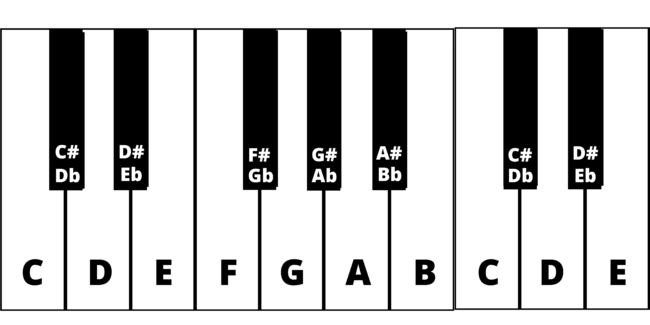
I've seen this conversation several times online, and it's funny to see how participants cannot agree on what is being talked about here, and no conclusion is reached. So I'm aware that I might be asking a super dumb beginner question, but I really do wonder why Do=C and not Do=A.

Don't hesitate to slap me with a "origins of musical notation systems" link, I love to read about music and history :)

Re:Show HN: My iOS app to practice sight reading (10 years i... by amszmidt on Monday March 24, 2025 @11:20AM (#43462090)
The easy answer is that the piano is not the "reference" instrument. If you look at a violin, the A major scale is generally the first scale you learn -- not C.

The piano has C natural in the middle of a full 88 keyboard, which is why it is a "natural" scale to pick (C major only uses the white keys, while A major would use three black keys).

So if you are learning another instrument, your "base" note will sometimes be entirely different.

Many "non-western" tradition also aren't tuned to 440 Hz, and even many _western_ traditions don't use 440 Hz for A, 415 Hz is also common.

[addendum] And why Do/Ut, Re, Mi? Because of a Gregorian chant where each sound sorta fell into a vocal range of monks ... then you adopt Do to whatever "sound" the instrument is closest, many years pass and deviations and standardizations ...

[addendum] I recommend starting out researching Guido d'Arezzo (and the Guidonian hand) a bit, that is where we get do/re/mi .. which was used as a teaching aid (which is maybe why Solfege as a term is often used in combination to sight reading or singing from sheet music). Almost no matter what language someone sings/voices Do/Re/Mi/... ... it falls naturally into a vocal range, irrespective of octave.

And then one could look into the hexachord ... and deep into a very deep well of confusion.

Re:Show HN: My iOS app to practice sight reading (10 years i... by balfirevic on Monday March 24, 2025 @12:09PM (#43462618)
> The easy answer is that the piano is not the "reference" instrument.

The question make sense without ever thinking about piano. The question is: how come the notes named only by letters (without any accidentals) form a major scale, and yet the note A is not the first note (or tonic) of that scale.

The answer is probably related to the fact that those notes also form other scales (seven of them - seven diatonic modes, one of which corresponds to major scale), and it's only relatively recently that the major scale took a central role in music theory.

Re:Show HN: My iOS app to practice sight reading (10 years i... by amszmidt on Monday March 24, 2025 @12:24PM (#43462788)
You will need to blame Boethius, musical notation is a quagmire of many systems that have been merged over centuries. If you venture into non-western systems, it becomes even more fascinating.

Maybe we should make one more standard .. that consolidates all of them? ;-)

Re:Show HN: My iOS app to practice sight reading (10 years i... by balfirevic on Monday March 24, 2025 @11:50AM (#43462425)
Ah, right, so the question of the starting point is a good one. I don't know the exact historical answer, but it's worth noting that if your are in minor scale (or Aeolian mode) then the tonic of the scale (for A minor) is indeed A.

Quick check with Claude hints that various modes were in common use in church music prior to major scale (Ionian mode) taking more central place in (western) music theory.

Re:Show HN: My iOS app to practice sight reading (10 years i... by whiddershins on Monday March 24, 2025 @10:06AM (#43461274)
yeah but why isn't C major called A major
Re:Show HN: My iOS app to practice sight reading (10 years i... by amszmidt on Monday March 24, 2025 @11:44AM (#43462347)
The piano is a new instrument, when it was created its natural "place" was within the C major scale (all white keys); while A major requires 3 black keys.

All instruments have a "sweet" spot for where they like to make sound. The baroque flute for example, prefers the key of D -- not C. The violin is very at home in the key of A.

If you sit down at a piano, and find a place to put your fingers a somewhat natural place would where there are two white keys beside two black keys.

And then press them in order.. C major scale.

Re:Show HN: My iOS app to practice sight reading (10 years i... by DidYaWipe on Sunday March 23, 2025 @10:55PM (#43457490)
Apple's app-store search is a joke. Actually... it's not a joke; it's offensive to developers and users alike. You can search for the name of the publisher, spelled perfectly, and Apple will instead show you hundreds of screenfuls of apps that don't contain your search string ANYWHERE.

This despite Apple claiming that publisher name is one of the top three criteria for search.