I also suspect the surface of the moon is not directly illuminated by sunlight, as you can see what appear to be brighter (higher elevation? more "westerly?") areas of the surface in the distance. It might be scatter from other terrain or the thin atmosphere. Hard to say without more information - on a world with almost no atmosphere and a "moon" the size of earth the usual visual instincts kind of go out the window.
There's another photo here which might be clearer: https://scx2.b-cdn.net/gfx/news/hires/2025/blue-ghost-lander...

That photo shows the top bright circle clearly partially obscured by another dark circle of the same size. The only explanation is it's a partial eclipse of the sun by the earth. Nothing else produces that shape. And indeed, other photos show a full eclipse and are labeled as such, so we know that the timing is right! The shape is clearly defined -- it's not bloom or lens flare. Which means that above the horizon we see both earth and sun. And in the hero image, we see the same thing, as you describe it "a little bit of flatness". But that shape can't be produced by blooming a crescent. It's answered by your linked photo -- it's the dark, black earth obscuring the edge of the sun.
Which leads to my original question -- what the heck is the brightness touching the horizon of the moon? It simply can't be the sun. Also, the way it dips below the horizon shows that if it is real, it actually has to be nearly entirely "bloom". But then the sun above should have way more bloom and it doesn't... which means it isn't a real object at all, not even a real reflection you'd see on the lunar surface.
So I did a little bit more digging and it turns out this is a common effect in camera lenses, duplicating the sun. It's not lens flare exactly, but it's the same idea. Examples here on earth:
https://www.reddit.com/r/Damnthatsinteresting/comments/15dj3...
https://www.reddit.com/r/atoptics/comments/1cqk6dv/took_sunr...
https://www.metabunk.org/threads/explained-two-suns-sanibel-...
So this isn't sunset. The sun is above the horizon, and the bright "sun" touching the horizon is a reflection of the sun in the camera's optics. It doesn't exist in reality.
The dark side of Earth is illuminated by a full moon.
Yes it is, but it's still going to be extremely dark. Think of how dark it is outside even when it's a full moon. You can see things, but it's still orders of magnitude less than daylight brightness.
And if the camera were exposed for minutes in order to not just capture that but overexpose it, we'd see stars everywhere. But we don't. So no. Earth is going to be black in this picture, period, except for a possible crescent.

For a photo like this I use an exposure of around one second.
If you want to capture stars, it needs to be longer. Looking it up says that 20 seconds is roughly the minimum. Which is also around what would overexpose the entire moon in your example. So that's what I'm saying -- the dark side of the earth doesn't seem like it could be overexposed because we can't see any stars.
I agree that I'd expect to see stars when the moonshine on earth is overexposed. Maybe it's just glare that makes the light from earth's crescent orb-shaped. In an image of a different camera where the sun is obscured[0], the earth crescent is well visible, and no moonshine on earth. Firefly's page on the mission has enough detail[1] to put your and my speculation to rest :-)
[0] https://fireflyspace.com/wp-content/uploads/2025/03/Blue-Gho...
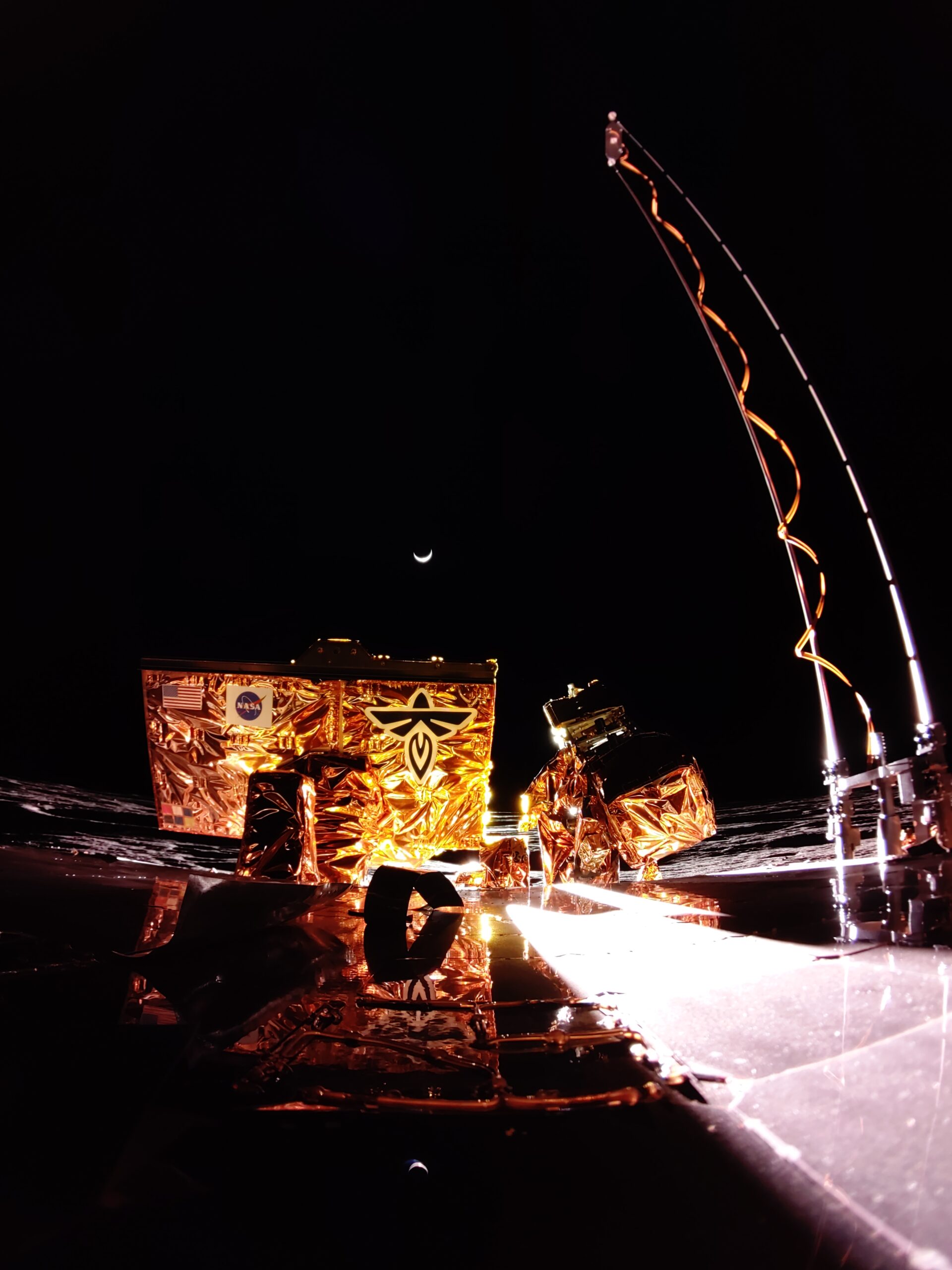
[1] https://fireflyspace.com/news/blue-ghost-mission-1-live-upda...
That was my first thought but I don't see how that's possible since we're looking at the dark side of the earth. It can't be overexposed when it's going to be much darker than the surface of the illuminated parts of the moon. At most, the earth would have a tiny sliver of light at the edge and we'd see a crescent shape.