https://www.youtube.com/watch?v=tMP5Pbx8I4s
And with this, there's no empty space in atoms, as the vacuum perturbations from each particle spread out to infinity, so inside the atom there's more energy in those perturbations than outside - the space is less empty inside than outside.
Either I'm going schizo or I should read some real books on the subject.
As I understand it, the idea in the video is that if vacuum can be seen as non-linear elastic medium, then with the right functions for elasticity and stress, you can create conditions where EM waves at high enough frequency will hit the "sweet spot", a local minimum, where the energy gets confined in space by those non-linear properties, and can't leave without supplying additional energy. And such confined energy seems to behave like you'd expect particles to.
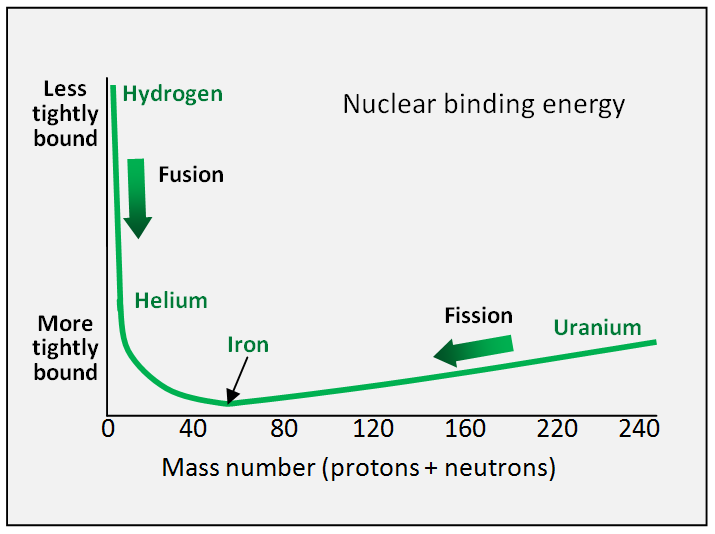
Again, I am not a physicist, so I'm probably wrong in understanding what half of the words I used above mean. But I do understand the idea of multiple forces creating semi-stable states that are "energy traps". For instance, the balance between electric repulsion vs. attraction from strong nuclear force is what defines how tightly bound is the nucleus of any given atom (aka. the "nuclear binding energy"). The nucleus can't expand or split apart, nor can it contract, unless you supply additional energy. When you do - say, you hit a large atom with high-speed neutrons to break past strong force attraction, or smash two small nuclei together at high speeds to overcome electric repulsion, the other force takes over resulting in a rather spectacular release of energy[0] as matter finds new stable configuration.
So I feel the idea here is similar, but with stress and elasticity in place of strong and electric forces - if there's enough energy propagating through some space, the wave gets trapped in a spatially-confined region instead of dispersing into the medium.
--
[0] - https://www.marketbusinessnews.com/wp-content/uploads/2014/0...
No, it does not. It illustrates that the portion of an atom that strongly scatters alpha particles occupies a small fraction of the atom's volume. Asserting that alpha particle scattering is the only correct definition of the threshold between emptiness and non-emptiness is an awfully strange position to take.
When interacting with other electrons at energy scales relevant to human life, i.e. maybe ten electron volts and down, an electron cloud is somewhere between solid (core electrons especially in heavy atoms) and squishy (valence electrons). Give a rock the ol' "I refute it thus!" and your toes will report that that rock's electrons are quite competently occupying their space.
Ask an alpha particle at nuclear energy scales a million times greater, and that electron cloud is like a swarm of gnats to a speeding car. The electrons only interact with the alpha electromagnetically, and it takes another object that interacts through the strong nuclear force to really bother a nucleus (most of the time).
Ask a neutrino, and it will tell you that all the nuclei in the Sun are but a wisp of fog.
This is a good example of how approximations valid in one regime fail in another but are not therefore useless. Rutherford's experiment reveals that there is more going on with matter than what can be probed by fingers and microscopes and chemical reactions, but it in no way invalidates those other observations.
I'm so tired of this. If atoms are "empty space", then there's no such thing as non-empty space, which makes the concept meaningless. Electron clouds have all the properties we want from non-empty space, mainly excluding other objects made of non-empty space, so let's just admit that's what non-empty space is and move past this pseudo-profound silliness.