People often say that the TCP stack overhead is high but this benchmark does not confirm that.
  cargo run --release -- -n 1000000 --method unixstream
  cargo run --release -- -n 1000000 --method tcp
unixstream utilizes two cores at ~78% each core, tcp only utilizes ~58% of each core. so there is also something wrong in the benchmarks where blocking is happening and cores are not being fully utilized.
That said, I made sure to include serialization/deserialization (and JSON at that) to see what a realistic workload might be like.
1. Unless you're using either fixed sized or specially allocated structures, you end up paying for serialization anyhow (zero copy is actually one copy).
2. There's no way to reference count the shared memory - if a reader crashes, it holds on to the memory it was reading. You can get around this with some form of watchdog process, or by other schemes with a side channel, but it's not "easy".
3. Similar to 2, if a writer crashes, it will leave behind junk in whatever filesystem you are using to hold the shared memory.
4. There's other separate questions around how to manage the shared memory segments you are using (one big ring buffer? a segment per message?), and how to communicate between processes that different segments are in use and that new messages are available for subscribers. Doable, but also not simple.
It's a tough pill to swallow - you're taking on a lot of complexity in exchange for that low latency. If you can do so, it's better to put things in the same process space if you can - you can use smart pointers and a queue and go just as fast, with less complexity. Anything CUDA will want to be single process, anyhow, (ignoring cuda IPC, anyhow). The number of places where you need (a) ultra low latency (b) high bandwidth/message size (c) can't put everything in the same process (d) are using data structures suited to shared memory and finally (e) are okay with taking on a bunch of complexity just isn't that high. (It's totally possible I'm missing a Linux feature that makes things easy, though).
I plan on integrating iceoryx into a message passing framework I'm working on now (users will ask for SHM), but honestly either "shared pointers and a queue" or "TCP/UDS" are usually better fits.
I wonder if it would work well as a sort of opt-in specialization? Start with TCP/UDS/STDIN/whatever, and then maybe graduate, and if anything goes wrong, report errors via the fallback?
I do agree it's rarely worth it (and same-machine UDS is probably good enough), but with the 10x gain essentially I'm quite surprised.
One thing I've also found that actually performed very well is ipc-channel[0]. I tried it because I wanted to see how something I might actually use would perform, and it was basically 1/10th the perf of shared memory.
That said, the people who built iceoryx2 obviously believe it's worth investing in, which is interesting.
I second that. It took us quite some time to get the correct architecture. After all, iceoryx2 is the third incarnation of this piece of software, with elfepiff an me working on the last two.
> 1. Unless you're using either fixed sized or specially allocated structures, you end up paying for serialization anyhow (zero copy is actually one copy).
Indeed, we are using fixed size structures with a bucket allocator. We have ideas on how to enable the usage on types which support custom allocators and even with raw pointers but that is just a crazy idea which might not pan out to work.
> 2. There's no way to reference count the shared memory - if a reader crashes, it holds on to the memory it was reading. You can get around this with some form of watchdog process, or by other schemes with a side channel, but it's not "easy". > > 3. Similar to 2, if a writer crashes, it will leave behind junk in whatever filesystem you are using to hold the shared memory.
Indeed, this is a complicated topic and support from the OS would be appreciated. We found a few ways on how to make this feasible, though.
The origins of iceoryx are in automotive and there it is required to split functionality up into multiple processes. When one process goes down, the system can still operate in a degraded mode or just restart the faulty process. With this, one needs an efficient and low-latency solution else the CPU is spending more time on copying data than on doing real work.
Of course there are issues like the producer mutating data after delivery, but here are also solutions for this. It will of course affect the latency but should still be better than using e.g. unix domain sockets.
Fun fact. For iceoryx1 we supported only 4GB memory chunks and some time ago someone came and asked if we could lift this limitation since he wanted to transfer a 92GB large language model via shared memory.
Loading in-process plugins was a great idea 20 - 30 years ago, however it has been proven that is isn't such a great idea in regards to host stability, or exposed to possible security exploits.
And shared memory is a good compromise between both models.
~~It's nice to see that independent benchmarks are in the same ballpark than the one we perform.~~ Edit: sorry, I confused your link with another one which also has ping-pong in its title
We provide data types which are shared memory compatible, which means one does not have to serialize/deserialize. For image or lidar data, one also does not have to serialize and this is where copying large data really hurts. But you are right, if your data structures are not shared memory compatible, one has to serialize the data first and this has its cost, depending on what serialization format one uses. iceoryx is agnostic to this though and one can select what's the best for a given use case.
[1]: https://raw.githubusercontent.com/eclipse-iceoryx/iceoryx2/r... [2]: https://github.com/eclipse-iceoryx/iceoryx2
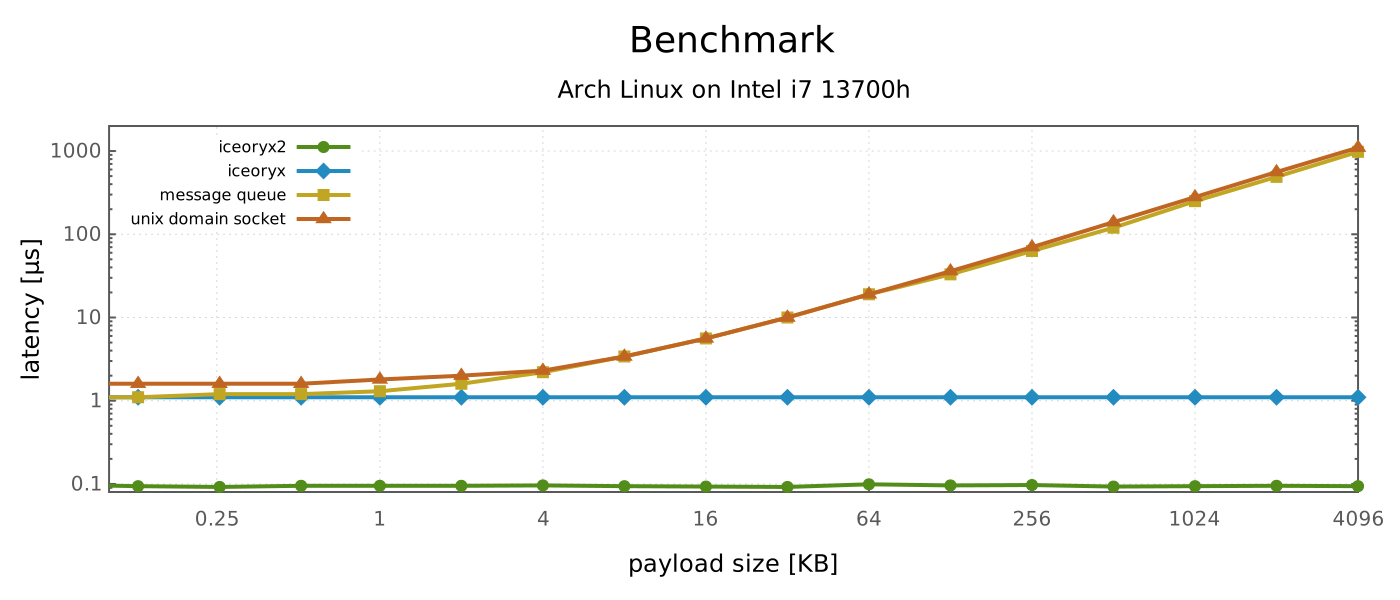
My last systems programming class was already a few years ago and I am a bit rusty, so I got some questions:
1. Looking at the code in https://github.com/elast0ny/raw_sync-rs/blob/master/src/even...) it looks like we are using a userspace spinlock. Aren't these really bad because the mess with the process scheduler and might unnecessarily trigger the scaling governor to increase the cpu frequency? I think at least on linux one could use a semaphore to inform the consumer that new data has been produced.
2. What kind of memory guarantees do we have on modern computer architectures such as x86-64 and ARM? If the producers does two writes (I imagine first the data and then the release of the lock) - is it guaranteed that when the consumer reads the second value that also the first value has been synchronized?
If that’s the case, I want to reassure you that we don’t use locks. Quite the contrary, we use lock-free[1] algorithm to implement the queues. We cannot use locks for the reason you mentioned and also for cases when an application dies while holding the lock. This would result in a deadlock and cannot be used in a safety critical environment. Btw, there are already cars out there which are using a predecessor of iceoryx to distribute camera data in an ECU.
For hard realtime systems we have a wait-free queue. This gives even more guarantees. Lock-free algorithms often have a CAS loop (compare and swap), which in theory can lead to starvation but it's practically unlikely as long as your system does not run at 100% CPU utilization all the time. As a young company, we cannot open source everything immediately, so the wait-free queue will be part of a commercial support package, together with more sophisticated tooling, like teased in the blog post.
Regarding memory guarantees. There are essentially the same guarantees like what you have when sharing an Arc<T> via a Rust channel. After publishing the producer releases the ownership to the subscriber and they have read-only access for as long as they hold the sample. When the sample is dropped by all subscriber, it will be released back to the shared memory allocator.
Btw, we also have an event signalling mechanism to not poll the queue but wait until the producer signals that new data is available. But this requires a context switch and it is up to the user to decide if it is desired to have.
Shared memory is crazy fast, and I'm surprised that there aren't more things that take advantage of it. Super odd that gRPC doesn't do shared memory, and basically never plans to?[1].
All that said, the constructive criticism I can offer for this post is that in mass-consumption announcements like this one for your project, you should:
- RPC throughput (with the usual caveats/disclaimers) - Comparison (ideally graphed) to an alternative approach (ex. domain sockets) - Your best/most concise & expressive usage snippet
100ns is great to know, but I would really like to know how much RPC/s this translates to without doing the math, or seeing it with realistic de-serialization on the other end.
[0]: https://3tilley.github.io/posts/simple-ipc-ping-pong/
[1]: https://github.com/grpc/grpc/issues/19959