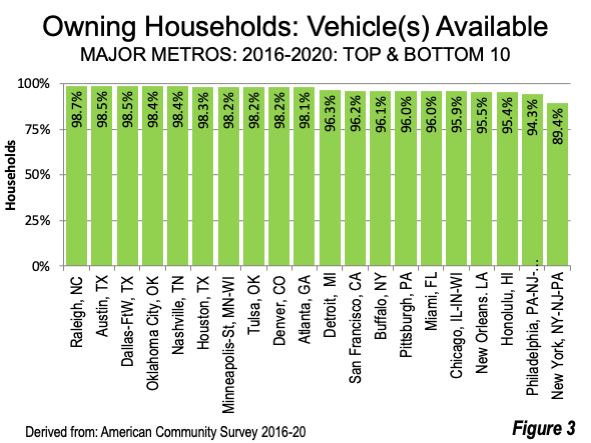
And this isn't like a chicken or egg thing where people aren't walking because it's not nice to walk. The car came first, and then the suburb (as we know them) came second. These places were designed for cars. We're talking about 20-30+ min walks each way to get from most homes to the nearest "commercial area". Even if it was the walkable utopian dream of tree lined sidewalks and pedestrian-centric intersections, it won't change the fact that the vast majority of people would not choose to walk, and so it makes sense that these places are optimized for the way people actually get around.
This is part of a larger frustration where it feels like a very common thing that people in cities want to enforce their expectations and cultures onto rural places that already have their own way of being.
A sign of confidence, you know, the typical American fashion, would be to allow mixed zoning for compatible uses and see what happens, "invisible hand" and all.
Just because the majority are fat doesn't mean it's healthy
I'm not sure why you're shoe horning body weight into this - that's a whole separate can of worms that tenuously related, but not relevant to the fact that these places are so spread out in such a way that walking isn't feasible for a myriad of other very practical and immediately relevant reasons (weather, ability to organize child care/education, ability to run errands before/after work, time spent "commuting", etc.)
In a lot of places it's close to impossible to do what you're saying. There are no side walks. Many suburban streets and especially those bigger roads (stroads) are horrible. No shade because no trees because HUGE ADS SHALL BE VISIBLE FROM CARS, lots of dangerous driveway exists every 5 minutes that you can't even walk in peace lest you are run over by a huge truck, etc.
Streets are dangerous for cyclists (and I mean the regular cyclists, commuter/grocery shopping style, not the lycra-clad racers).
There are modern ways to design infrastructure, it isn't even a lot more expensive than the old fashioned way, and it makes for a lot more pleasant environment for everyone. Even drivers get to enjoy it because... people start walking (under 1km) and cycling (under about 5-7km), so a lot of car traffic just vanishes. So the remaining car drivers get to vroom-vroom a lot more :-)
- removing lanes of traffic to make more space for pedestrians
- reducing speed limits
- increasing gas taxes
You're reacting like advocating for a better pedestrian experience is somehow an attack on drivers, but that's totally not what this post is. Instead, the author points out places where they're already creating affordances for pedestrians (sidewalks, crossings with refuge medians, new curb ramps) but are doing it in a way that is not impactful.
You can make it a more comfortable for people to walk on the sidewalks that they're actually paying for, so the option of walking 20 min to the grocery store is more feasible, normal, appealing, without expecting that people in car-dependent neighborhoods are going to give up on car ownership.
> so it makes sense that these places are optimized for the way people actually get around
This is a misleading framing for two reasons:
- high car ownership does not imply that people don't want to also feel comfortable walking in their own neighborhoods. You can own a car, but walking your dog or walking with your family to a park or walking to the nearest store can still be a welcome option. People can get around in multiple ways, choosing different options at different times for different purposes.
- to the extent that a high proportion of trips are in a car, part of that is because the other options are crappy because of the argument you're making
We can have pleasant walkable neighborhoods and cars, and your kids can walk home from school and you can drive them to costco on the weekends. End this nonsensical pretend conflict between the two.
Further, much of Northfield is very rural, big corn fields, etc.
Could there be improvements in transit and workability? Certainly… especially between the historic downtown and the two colleges…
… but Northfield is actually a good example of a town where car (truck ?) oriented transit and stroads, etc., are well suited.
https://en.wikipedia.org/wiki/Hopkins,_Minnesota
https://en.wikipedia.org/wiki/Northfield,_Minnesota
None of those are rural, they're suburban.
And frankly, even your rural non-homestead areas could use some redesigning. Now you make it unsafe walk in what are basically villages, the quintessential walkable settlements that we've invented back in prehistory.