Diagramming is the same problem, but usually lacking the context to decide what to draw. The same stakeholders may be interested in different combinations of features depending on which business questions they're trying to answer. Geographic mapping is practically a constrained domain by comparison. And it's supposed to be feasible to do it automatically for systems diagrams? /hard-skeptic
A dataflow diagram for example is mostly self constraining in scope.
Automating it is another problem entirely and I agree it has a lot of hard challenges.
That's a huge scope question on its own. What's "complete"? How low level or wide do you go? What about the view of internals of the external systems you rely on? What about their mapping to teams/owners? C4 helps a bit here by saying "whole organisation throws everything possible into this and when you want to see it, you use scoped views instead".
> or up to date diagrams
"When exactly does the system change" is tricky too. When you change the code? When you enable the new system? Who knows that the diagram of the system exists and where? It's a bit of an issue of unknown unknowns. Again, the C4 idea helps here a bit, but there are still going to be random projections of state at a given time saved in various places.
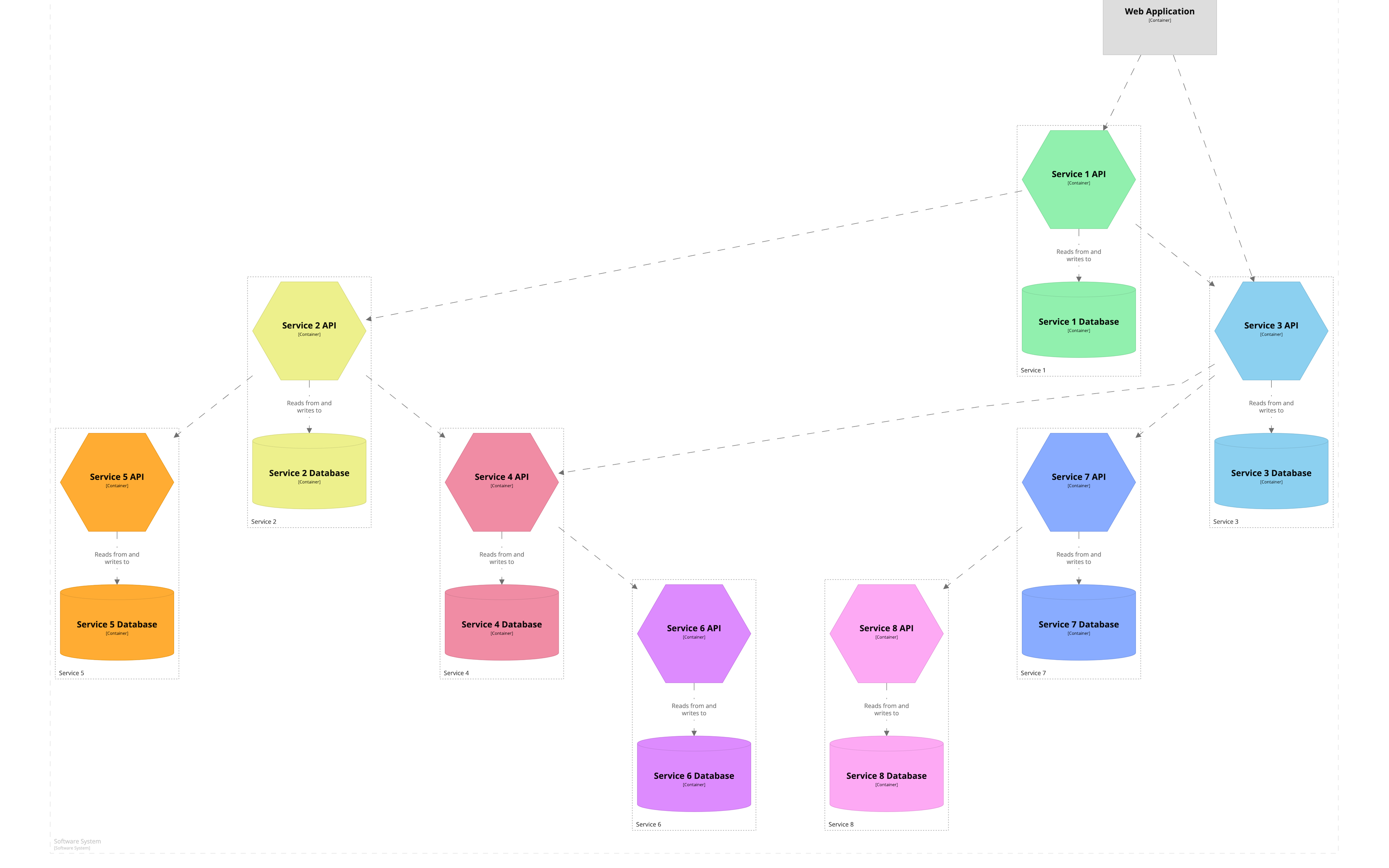
Another big issue is that structure and presentation are very different. Generated diagrams of infrastructure or code look shit, universally. On the other hand, well presented diagrams are just snapshots in time that get preserved for years even if their outdated. I mean this is what C4 page shows as one of their results https://c4model.com/img/alternative-1.png which is an unreadable mess and this is what they initially complain about https://c4model.com/img/sketch-2.jpg which is perfectly sized and context specific goodness. The first is good for knowledge preservation, but if anyone needs to understand things, I'm making the second one for them.

It allows you to specify definitions in one location, and reference them in other pages. So if you have for example a documentation page which is about "installing our nodejs package", you can write a version in vars.json or vars.xml or whatever, and reference it in your installation documentation page.
When you later have another page which is saying "Hey, we found a bit of an issue with ...this-or-that... package because we're using $NODE_VERSION, and the package hasn't been updated so we have ...such-and-so... workaround", you know when you update the $NODE_VERSION in your vars, that you need to take a look at that package again.
It's an extremely basic part of software development, being able to define variables, but I think this is a very good sign of powerful documentation tooling.
The only major downside about the platform is that their XML (HTML) extensions to markdown are proprietary, and as such the platform isn't able to grow outside of Jetbrains' oversight. I'm still debating whether I want to switch from Gitlab's Wiki (which is very basic but is really really easy to edit for anyone on the team) to a solution like Jetbrains' Writerside.
This kind of effort is sabotaged at every place I've ever worked, usually because product or leadership insists that it moves to confluence, and then predictably this increases friction and no one ever updates those diagrams again. People with "20 years experience in industry" can't be bothered login to github, and in the best case instead of confluence they want lucidchart, where inevitably the whole org is sharing like 3 seats.
Partly this is just laziness or ignorance, but partly it's deliberate overreach into engineering business because there's lots of people who see actual information as a threat to to their preferred narratives (think hype/sales promises/etc). Plus you can't say that you didn't know about a design flaw if there is 6 month old diagram calling out the need for a solution in big red letters. Since a picture is worth a 1000 words, and since a git hash can get a date attached to it, dead-on-arrival docs/diagrams tends to decrease accountability.
What is interesting here is that mermaid and graphviz could be committed to source control, but I have never seen it done anywhere likely because the burden of drawing/updating is still too high (hence your wysiwyg comment).
The other sibling comment regarding rendering documentation source to Confluence or <required external system> to keep the corp overlords happy is a great middle ground IMO.
This comes up frequently in the context of secure design review, or more generally when outside stakeholders need to understand a foreign system.
Nobody argues against diagrams as good practice, but so few actually make them. That tells me incentives/costs are still off, despite good intent.
Information extraction from design docs could be one approach to suggest a diagram for free but that creates a dependency on the fidelity of the design document.