per 1 above crypto "boards" have lots of x1 (or x4) slots, the really short PCIe slots. You then use a riser that uses USB3 cables to go to a full size slot on a small board, with power connectors on it. If your board only has x8 or x16 slots (the full size slot) you can buy a breakout PCIe board that splits that into four slots, using 4 USB-3 cables, again, to boards with full size slots and power connectors. These are different than the PCIe riser boards you can buy for use with cases that allow the GPUs to be placed vertically rather than horizontally, as those have full x16 "fabric" that interconnect between the riser and the board with the x16 slot on them.
[0] i didn't read the article because i'm not planning on buying a threadripper (48-64+ lanes) or an epyc (96-128 lanes?) just to run AI workloads when i could just rent them for the kind of usage i do.
i used to use this one when i had all (three of my) nvme -> 4x sata boardlets and therefore could not fit a GPU in a PCIe slot due to the cabling mess.
I thought we were using "fabric" to mean "switching matrix".
1: https://assets.hardwarezone.com/img/2023/09/pre-meteror-lake...

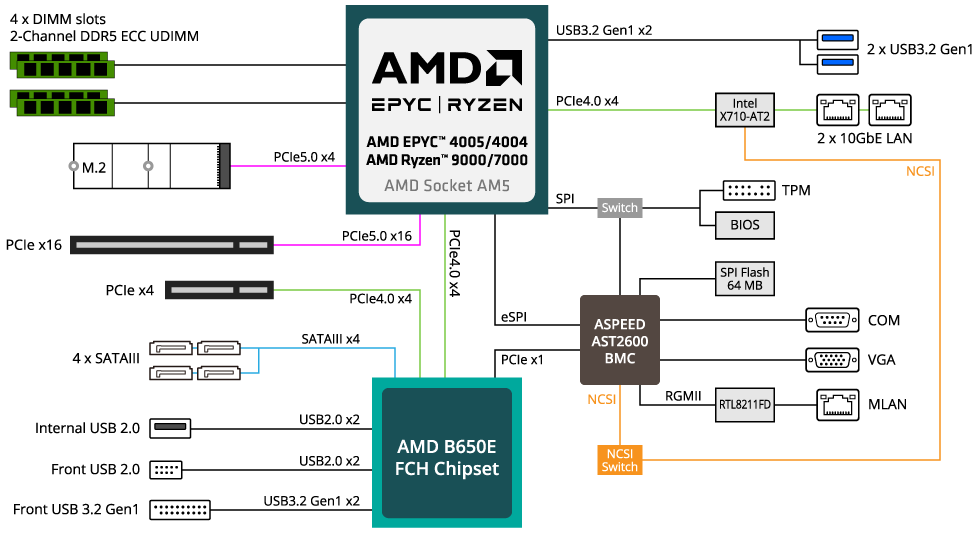
2: https://www.gigabyte.com/FileUpload/Global/MicroSite/579/inn...
NVLink is still very much available in both RTX 3090 and A6000, both of which are still on the market. It was indeed removed from the RTX 40 series{0].
[0]: https://www.pugetsystems.com/labs/articles/nvidia-nvlink-202...
In older NVidia cards this could be done through a faster link called NVLink but the hardware for that was ripped out of consumer grade cards and is only in data center grade cards now.
Until this post it seemed like they had ripped all such functionality of their consumer cards, but it looks like you can still get it working at lower speeds using the PCIe bus.