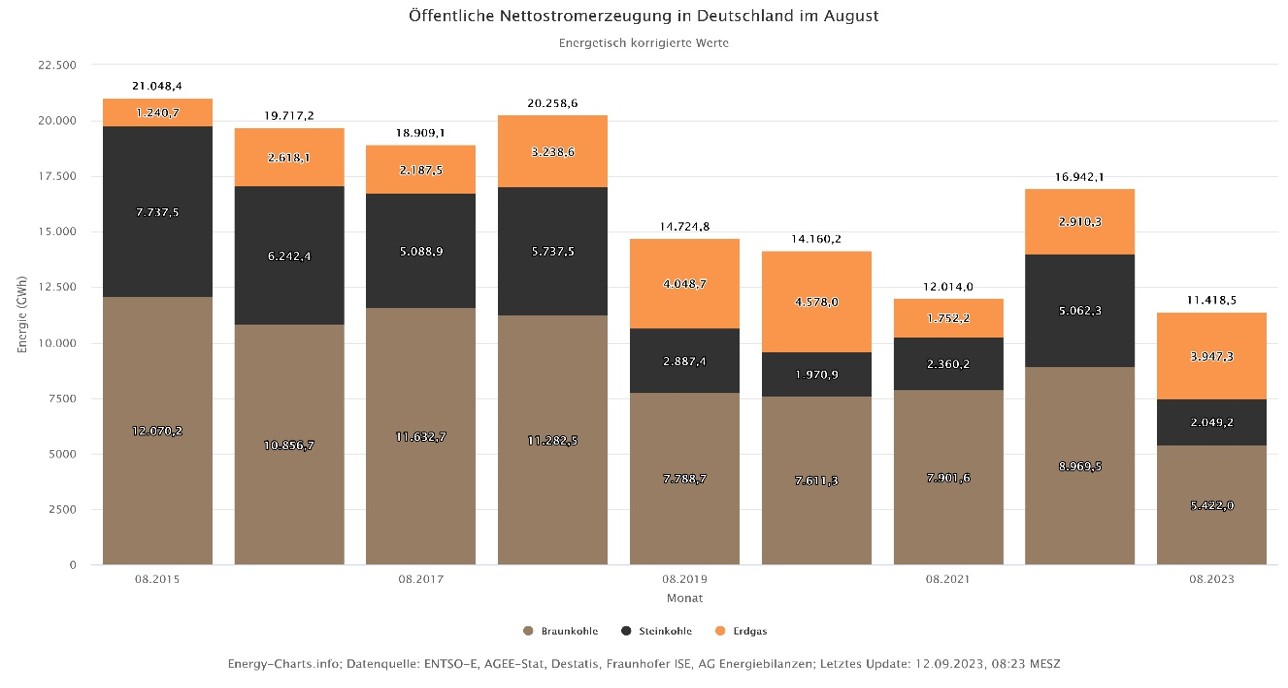
You have seen the statistics? Coal use for electricity is going down?
https://blog.energybrainpool.com/wp-content/uploads/2023/09/...
> Storage of nuclear fuel at interim sites is safe and unproblematic. Which is one of the reasons the purely political problem of a permanent site can be kicked down the road by spineless politicians. Technically, safe final storage is completely solved. Finland's Onkalo site just opened, Sweden is also close to completing theirs and Yucca mountain was also ready.
Incorrect. Germany is currently spending billions to clean-up experiments to store nuclear waste (-> Asse II) and the general solution of other nuclear waste in Germany is completely unclear.
> It is being dramatically expanded all over the world
So far without effect: https://world-nuclear.org/getmedia/332179b1-b865-47cc-a239-7...

> We should be recycling this, but alas fresh Uranium fuel is so cheap that recycling is at best marginally economical at this point.
Definitely not, re-processing nuclear fuel is extremely environmentally damaging and technically challenging.
You are bringing up dead horses, which are dead since decades. Nobody will be able to build a re-processing plant in Germany in the next 50 years.
> The Chinese already finished their copy of the EPR
Still, Europe is not in China. If nuclear friendly countries like France and the UK can't build them cost and time effective, it says something for Germany.
Plus: China finished many many more coal power plants.
Yes, I did. Did you? They first went up for 2 years. Now energy consumption dropped because we are in a recession, due at least in part to...drumroll...high energy prices. Because Germany has the 2nd highest electricity prices in the EU. After only Ireland.
And of course we would expect them to drop at least a bit, because renewables do produce some electricity. Just not reliably, and so we still produce the 2nd dirtiest electricity in the EU, after only Poland, at the 2nd highest prices in the EU after Ireland. Some accomplishment!
And who produces clean electricity? France.
> Incorrect ... Asse.
So which part of the text that I wrote was actually "incorrect"? Who cares about the politically motivated shenanigans in Germany? The world has built 2 final storage sites and a third is close to completion. Claiming this is somehow "unsolved" is simply wrong.
> [Expansion] so far without effect.
Well yes, obviously. The invasion of Ukraine that laid bare the vapidness of the Energiewende happened not even 2 years ago. The cutting off of Russian gas was only a little over a year ago. The political decision-making followed and has just now been announced. Are you expecting this policy change to be implemented in a few days? Seriously?
> re-processing nuclear fuel is extremely environmentally damaging and technically challenging.
Only in anti-nukies scare stories. There are also reactors that can burn the stuff directly. For example the Canadian CANDU reactors, and of course a variety of newer designs.
> Nobody will be able to build a re-processing plant in Germany in the next 50 years.
Where did I say that a re-processing plant will be built in Germany of all places??
> If nuclear friendly countries like France and the UK can't build them cost and time effective
They can. And have done so. But both UK and France believed in the renewables fairy tale and both haven't built a new reactor in, what, a decade or more? And even then the production rate even in France was extremely low. Know how has been lost, the EPR is a difficult design and at the beginning of its learning curve. The only thing that would be surprising is if there were no problems.
That says nothing about nuclear power in principle, because, once again, the average construction time is still just 7.5 years, consistently over the last 50 years or so, no matter how much you want to focus on just the most extreme outliers.
And of course, it also doesn't make any logical sense: do you really believe that something about the universe changed in the last 50 years that somehow has made it impossible to build nuclear power plants when we used to do it just fine?
That idea is so preposterous, it doesn't pass the laugh test, yet it is gospel in EE circles.
like >50% this year...
> CANDU
"Diese wurde jedoch von Indien gebrochen; das Land baute mit CANDU-Know-how und -Technologie sein Kernwaffen-Arsenal auf."
Wonderful.
> no matter how much you want to focus on just the most extreme outliers
France is an outlier? OKAAYYYY...
> do you really believe that something about the universe changed in the last 50 years that somehow has made it impossible to build nuclear power plants when we used to do it just fine?
Well, the reactors developed 50 years ago were designed with completely different technology, which is no longer in use and very very different safety standards.
You can see France struggling with the steel...
Additionally in 2022 up to half of their fleet was down for corrosion inspections...
https://www.reuters.com/article/us-edf-flamanville/edf-must-...
That will be cheap...
The EPR is an outlier.
Once again: the average time to construct a nuclear power plant is around 7.5 years. Now you can focus all your attention on plants that take longer than those, and you can falsely believe that those outliers are the norm.
But that does not change the fact that they are not. The average was, is, and continues to be 7.5 years. The median is actually a bit lower.
https://euanmearns.com/how-long-does-it-take-to-build-a-nucl...
> Additionally in 2022 up to half of their fleet was down for corrosion inspections...
Planned and scheduled corrosion inspections. They have regular inspections, seems like a Good Thing™ to me, which they delayed during COVID. So they scheduled them for the summer of 2022. They always schedule them for the summer because that's when electricity demand in France is lowest.
These days, in addition to demand being lowest, supply is large because summer is when all that over-provisioned PV delivers most...just when other demand is lowest. So a good time to schedule such routine maintenance and inspections.
Because nuclear power can be scheduled. Unlike wind and solar. Which just happen whenever Mother Nature feels like it. Big difference.
so they could not stick to their typical schedule
> the average time to construct a nuclear power plant is around 7.5 years
That's dumb.
"The average time taken to build 441 reactors operational today was 7.5 years."
Most of the reactors operational today are decades old.
Check how long it takes to build an airport. 50 years ago and now. You can build faster in China (guess why, you can also build coal powerplants very fast in China, even though the air quality is already shit), but not in Europe and the US. None of the EPRs in Europe are built in-time and/or budget. Exactly the opposite, even though the constructing company sits in France and is state owned.
They chose not to stick to their typical schedule, prioritizing COVID instead.
> [average construction time of 7.5 years] That's dumb.
Only in the universe of reality-denial. In the Real World™ it is accurate.
> "The average time taken to build 441 reactors operational today was 7.5 years."
Yes. Unlike you, I don't have to look only at the most extreme outliers to make my case. Because my case doesn't need distortion.
> Most of the reactors operational today are decades old.
Yes, they last a long time. Which is good. Alas, since they built so many so quickly and they then didn't expand further and didn't need to replace the existing ones because they last a long time, they didn't keep the expertise of building alive very well. That was bad.
Anyway, if you think that this means construction was only fast in the old days, you would, once a agin, be incorrect.
The reactors finished in 2022 were finished in...drumrolll..around 7.5 years.
And in fact most of the outliers are in the past.
> None of the EPRs ...
And once again, you focus on the currently most problematic design, which also happens to be brand new, so at the beginning of its learning curve...
> ...in Europe ...
...built in the region that has built hardly any plants or reactors in the last two-three decades.
Single examples.
However, hop over to Statistia and you will find, again, that the plants finished in 2022 were finished in around 7.5 years. Just like the ones before.
https://www.statista.com/statistics/712841/median-constructi...
And again, those numbers are consistent:
"Overall, this picture suggests that nuclear plants don’t take a really long time to build (with a few exceptions). Most are built in 8 to 10 years. Many are built much faster."
https://www.sustainabilitybynumbers.com/p/nuclear-constructi...
Are we getting slower?
"The data suggests that the world is not getting slower. Times vary a bit from decade to decade but average times are not slower than in the 1970s or 1980s."
So no, your singular examples notwithstanding we are not getting slower.
Data. Facts.
Have a nice day.
We subsidized China's renewable sector with German taxpayer and electricity consumer money. China says thank you!
Alas, renewables are not viable as a primary energy source, due to their intermittency (at best) und unreliability. They need vast amounts of backup.
The dirty little secret of Germany's "renewable energy revolution" is that it only works with lots and lots of backup...and that backup was Russian gas (because Gas plants can ramp up quickly). Or coal.
Neither option is exactly ideal when the purpose of the exercise is to reduce CO2 emissions, and it turns out that Germany, despite many decades and hundreds of billions of investments, has the second dirtiest electricity in Europe. Not the second cleanest, the second dirtiest. After Poland, who just use coal for everything, and are now starting to invest heavily in nuclear.
And of course, the solution is even less ideal when the Gas is coming from a maniacal dictator, who uses that dependency to blackmail. (And who miscalculated that the blackmail would work, and thus invaded Ukraine).
Germany's solution was to reactivate lots of coal and to essentially buy up all the gas on the international market, at sometimes exorbitant prices. But hey, we're rich, so who cares?
Except of course a lot of that wealth is built on industries that are now struggling...and moving.
Furthermore, one country buying up essentially all the gas on the free market is not a scalable solution for multiple countries.
Which is why, after the Ukraine war and its repercussions, basically the entire world re-evaluated nuclear, and found that the mostly imaginary risks and problems were outweighed, dramatically, by the practical advantages.
> Nuclear is at best stagnating in authoritarian surroundings (China, Russia, ...). In the west it is struggling (US, France, UK, ...).
Incorrect.
It is being dramatically expanded all over the world, and the problems with the EPR are outliers, they are not typical. Average time to build nuclear plant has been remarkably steady at 7.5 years since the 1970s (with some fluctuations above and below that line).
> not able to demonstrate safe storage of nuclear waste,
Incorrect.
Storage of nuclear fuel at interim sites is safe and unproblematic. Which is one of the reasons the purely political problem of a permanent site can be kicked down the road by spineless politicians. Technically, safe final storage is completely solved. Finland's Onkalo site just opened, Sweden is also close to completing theirs and Yucca mountain was also ready.
"The Government Accountability Office stated that the closure was for political, not technical or safety reasons."
https://en.wikipedia.org/wiki/Yucca_Mountain_nuclear_waste_r...
One of the reasons nuclear fuel is unproblematic is that there is just very little of it, because the fuel is so energy dense. For example, just the single Herfa-Neurode site in Germany stores an order of magnitude more of both arsenic (enough to poison the entire world several times over) and heavy metals than there is nuclear waste. In containers that are far less safe. And of course arsenic has no half life, it stays poisonous forever.
Last not least, there would be even less nuclear waste (and it would be even less dangerous) if we actually used up the nuclear fuel. Currently, we use less than 5% of the nuclear fuel we feed into the reactor, and throw away the remaining 95+% after it comes out of the reactor. Unsurprisingly, this 95% of the original fuel still contains a lot of energy, and so that is producing the most radiation.
We should be recycling this, but alas fresh Uranium fuel is so cheap that recycling is at best marginally economical at this point.
And since waste disposal is also not an actual problem (just a political one) there is also no real incentive coming from that side either.
> UK:
Yeah, the EPR is apparently a difficult design to build, and these are the first reactors of that type built, so it is at the start of the learning curve and last not least, we let our know-how on how to build reactors slip away, so we are now re-learning how to do that.
The Chinese already finished their copy of the EPR, and the average time to construct a reactor has remained steady at 7,5 years, including and notwithstanding the outliers.
And yes, if it's 7,5 years including the outliers, that means that a lot of reactors get built much quicker, 5 years and less.