Why does it necessarily mean that?
Data from 2020, but it's probably not changed much: https://www.pewresearch.org/social-trends/2020/01/09/trends-...
2023 graph: https://www.gspublishing.com/content/research/en/reports/202... (from https://www.gspublishing.com/content/research/en/reports/202...)
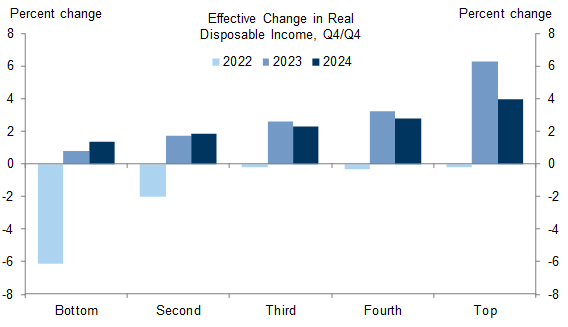
With the massive increases in inflation and housing costs, the middle class and below can't really keep up. A 5% increase in earning power for them is like a few thousand dollars a year (that they have to immediately spend on housing and services), vs millions or billions for capitalists that can then reinvest in growth sectors (AI and whatnot).
What's stopping you?
Also, my partner is American and has family here. I keep trying to convince her to give foreign living a try, and she's traveled with me a bunch now, but it's still a lot to ask of someone who's only ever lived in their home country. Me, I've spent a lot of time traveling to different countries and have a pretty broad perspective to draw from. It's harder for someone who's never really done that. Still, I hope to coax her into it over time!
The Netherlands has DAFT, which take ~$5k and a business bank account (I think you also need to run a business, but freelancing web dev would count from what I've read) to get a visa, and after 5 years in country you can apply for citizenship
If you move to any Mediterranean country, you will feel wonderful at first because our culture is so different, but for some people it gets tiresome and unbearable after some years.
Here you will find some more commentary about this: https://www.youtube.com/watch?v=SiVV5udK_NM
They even have a specific page on that site for software engineers. It seems like as long as you get a job offer over a certain salary threshold and meet background check requirements, you can live there. I've heard a lot of jobs there operate in English, also.
For example, Brexit made it harder for EU citizens to move to the UK, but it made it significantly easier for everyone else. To get a "skilled worker visa" you need 70 "points" in the new system, which you can achieve by speaking English (10 points) and getting an offer from a visa-sponsoring company (20 points) for a "skilled" job (20 points) that pays £25600 (~$31k) or more a year (20 points):
https://www.gov.uk/government/publications/uk-points-based-i...
£25k/year isn't high; pretty much any tech or tech-adjacent job in the UK will pay more than that. And if you know how to do web dev then you're probably considered "high skilled", e.g. I see "Internet developer" and "Web designer" on the official list of eligible occupations:
https://www.gov.uk/government/publications/skilled-worker-vi...
(Incidentally, this is why it's completely deranged and insane that the current British government is constantly accused of being "anti-immigration". Has no-one looked at the actual data? Immigration to the UK has never been easier, nor have rates of immigration ever been higher than under the current government. But that's another topic entirely.)
And the UK's not the only option. My wife and I looked into this a few years ago; iirc we could meet the points requirements to move to Canada or Australia pretty easily, and we're not exceptionally "high-skilled" (we're comfortably middle class but have very normal tech/corporate jobs.)
Moving countries doesn't have to be a permanent decision either. I lived abroad for many years, then I came home, and I don't regret either move.
Anyway, I don't know you and I'm not going to tell you to up-end your life and start again in a completely new country. Obviously it's a huge decision and everyone's personal circumstances are different. All I'm saying is that it might be easier than you realise.
I don't know that I'd want to live in the UK, but this makes me more hopeful about the possibility of moving elsewhere. Thank you.
Depending on where you go to (and what type of institution) a bachelor's alone is sufficient. The more exclusive places might require a teaching certificate, but those are easy to get and, in any case, such requirements tend to be quickly relaxed when talking about harder to fill positions, like calculus teachers. You might find you enjoy this. If you don't, it can give you the foundation to find something else you might enjoy. Many companies are also constantly looking for skilled native workers. I've friends working in everything from web design to rehab counciling.
I'm not very happy with the current state of the US to say the least, but being born American and simply natively speaking this language is just an unbelievably valuable gift that one should never take for granted. It's really a gateway to the world, even if it's one hell of a scary gateway to step through the first time.
(Edit: Wait, is there an actual pathway to permanent residency/citizenship this way, or is it only a temporary work visa?)
Until that point you'll usually have to do something like check in with immigration once a year, dependent upon what visa (work, education, tourist, etc) that you end up on. But like another poster said, you don't really need to worry about most of this to begin with, as at most places you'll be granted a visa on arrival that'll be good for more than enough time to find a job. The most you might want to do is drop by the embassy of wherever you plant to go to. They can give you more information, and also set you up with a visa that will generally last much longer than the visa-on-arrival if desired.
But the main thing I'd say to anyone considering moving countries is that most countries aren't highly desired immigration destinations like the US or Western Europe, and thus most countries don't have strict and tightly-controlled immigration systems like Western countries do. If you want to go spend a few years in Thailand as a Westerner, it's laughably easy - just buy a flight and you'll probably figure it out once you're there, as your Western dollars/pounds/euros will go a looooong way.
(I apologize to any Thai people reading this; I know that digital nomads and other wealthy foreigners aren't universally appreciated in the countries they park up in. Am just sharing my own experience.)
I wouldn't want to live in that part of the world for the rest of my life, but the time I did spend travelling was the best thing I ever did and I have no regrets. I wrote about it here if anyone's interested:
The TN visa works in both directions - you can go work/live in Canada or Mexico. A BS is plenty; I'm not sure that "web dev" is a valid category, but you can probably find a job in either country that does qualify. And if it doesn't work out, you're just a quick plane ride home.
Unless you get married, how exactly would you propose an average American emigrate to Germany or Japan, for example?
There's a ton stopping someone. It's not impossible, but it can take years of work, require a change of careers, and you have to say goodbye to a lot of family and friends.
> We treat our society like a zero-sum game.
In my experience, Americans are some of the least zero-sum thinking people, perhaps driven by the natural geographic advantages of the country. In other parts of the world, a zero-sum attitude is the norm, not the exception. It's suffocating if you live in it. I regard this as one of America's greatest strengths.
As for some of the things you find dissatisfactory with the US:
> politics
I'm sure many people everywhere think their country has uniquely dysfunctional politics, just like how people in every city claim that their city has the worst drivers. Belgium went without a government for years. The Taiwanese parliament breaks out in fistfights every now and then.
> insane housing costs
I don't know how things are in Scandinavia, but Canada or any part of East Asia are absolutely much worse by this metric. Look up median multiples in different countries; you'll find that the US is very favorable, especially among developed countries.
A middle-class family being able to afford to own a house happens more in the US than virtually any other place.
> corrupt judges
I'm not really sure what you mean. Do you find the US judiciary to be more corrupt than in other countries?
> stances on drugs and abortion
What do you find terrible about these? Drug laws are relatively lax in general in the US, and especially in certain states. Many Asian countries punish drug users and traffickers very harshly.
On abortion, you might be surprised to find that most Western European countries are much more restrictive than the liberal American states.
> the rich get richer, leaving everyone else even further behind
The real median personal income[0] has been on a broadly upward trend. The great majority of Americans make more money than their parents; more than half of people born to parents in the bottom quintile of incomes end up in a higher quintile; and conversely, more than half of people born to parents in the top quintile end up in a lower quintile[1].
In Europe, some of the very richest have remained the very richest for literal centuries[2]. In the US, you'd be hard-pressed to find people on the Forbes 400 list whose grandparents were also on the same list.
> Life actually seemed way better for millions of working class folks during COVID, when the economy was tanking and government simply propped it up
Your argument is that life seems better when the government prints money and hands it out to people? Surely you understand that there's a very sharp limit to how far that can go.
> if you just want a peaceful, boring life, this is not the place to be
I don't know where in the US you are, but it's a huge country with very diverse lifestyles to be found. Where I live, in a midsize Southern city, my barber, who has no college education or inheritance, lives on a 10-acre property with his wife and children. Their house is very modest, but they are saving up to build a bigger one. This seems the definition of a "peaceful, boring life".
If you want this kind of life on a median or below income in some of the most desirable cities in the country, I grant you that's going to be very tough. But that is the case anywhere in the world. People constantly tread water just to get by in big, competitive cities.
> I also spent several weeks in a few other countries -- enough to get a very basic feel for their society and services
Being on vacation in a country is very different than living there.
Ultimately, different people value things differently, and you may very well find yourself happier in another country. I'm just pointing out that it's very easy to view other countries with rosy glasses, and that the view of the US as "a hellhole where either you're rich or you're worthless" is by many objective metrics untrue.
[0]: https://fred.stlouisfed.org/series/MEPAINUSA672N
[1]: https://www.pewtrusts.org/~/media/legacy/uploadedfiles/pcs_a...
[2]: https://www.vox.com/2016/5/18/11691818/barone-mocetti-floren...
I read an interesting point recently: Austria's 100 wealthiest families have two thirds of the country's wealth, and zero have earned their money from technology; they've all inherited it.
How different would the same list be for Germany? One, perhaps two families earned their fortunes from tech?
Um... The most liberal European places are more restrictive than conservative states. Florida tried a fifteen week ban and that was controversial.
Meanwhile abortion is illegal, unconstitutional in fact, in Germany and only decriminalized before fifteen weeks. After that, it's only decriminalized for certain cases.
Sigh. You're painting with a huge black and white brush.
This and being a community is not exclusive. Asian countries are some of the worst zero-sum countries, simply by virtue of resource/person, yet simultaneously being very community focused.
People behave in zero-sum way for one thing and in a community way for another.
This is delusional. Aside from government enforced job loss, firings of people with differing views, and forcing low status occupations to continue working crazy hours and burn out, I guess labor won? Maybe? Needing unions to fight for higher wages caused by stupid economic policy is hardly a win
The US is great if you want to "get ahead" (and manage to do so), but if you just want a peaceful, boring life, this is not the place to be. We treat our society like a zero-sum game. Between our terrible healthcare, education, school safety, infrastructure, public transportation, politics, insane housing costs, corrupt judges, stances on drugs and abortion, it really feels like a hellhole where either you're rich or you're worthless. I'd much rather prefer somewhere in Europe, especially Scandinavia, or maybe Canada or East Asia. But it's not easy to emigrate.
Even this framing is itself pretty terrible: Our GDP outpaced expectations, so that must be good, right? Hardly. That just means the rich get richer, leaving everyone else even further behind.
Life actually seemed way better for millions of working class folks during COVID, when the economy was tanking and government simply propped it up, and suddenly workers everywhere had a lot more respect and negotiation power, and unions grew for the first time in decades. It was the first time in my life I saw our society come together to work together, instead of trying to massively exploit the poor. Then a couple years after COVID and that all goes away, whether it's WFH or mass layoffs.
I would say the US only makes sense IF you are strongly competitive/entrepreneurial and libertarian, not if you are community-minded and just want to live a normal life under a functioning democratic society. "Pro-business" usually means "anti-democratic" in our society, by disproportionately empowering capital ownership rather than democratic participation and process.