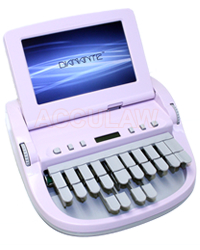
You have to write at 225 words a minute in order to graduate, but some people are able to write at speeds of 300+ words a minute. If you look at the keyboard, the machine is separated into two halves. On the left half there are only 9 keys, but each letter of the alphabet can be written with those 9 keys because it's context sensitive. The letter "t" by itself would be the letter t, but if it's next to a "k", it might become the letter d. You mentioned that we can knock out certain letters such as c, and that's indeed what is done with stenography. The word "car" is written "kar". There are sometimes conflicts, like "sell" and "cell", so you still need a way to write a c, but that's the gist of it.
Worth mentioning is that there are only 4 vowel keys on the machine (the vowels are the keys that are on the bottom), but you can write a lot of different sounds with these four keys. A, O, E, and U are the vowels that are on there, and if you press one of those keys individually, you'd write a short vowel of that key. If you wanted to write a short I, you'd press E and U together. You would write long vowel sounds by combining different vowels together. So for example, if you wanted to write a long e sound, you'd write aoe, long U sound would be aou, long a sound would be ai (or aeu depending on how you look at it), long o is oe, and long i is all the vowels together at once.
It can be hard to read what you've written if you're not extremely good at it. The word dime, for example, you would see as "TKAOEUPL". There are a few different theories out there, and even if everyone learns the same theory, everyone puts their own little spin on it, so if you wanted to read what someone else wrote, it might be tough.
This is the layout of the keyboard if anyone is interested (http://dmc122011.delmar.edu/ba/crtrgallery/images/steno_keyb...)

This is a bad practice not only because it misrepresents the original thought (the person was not claiming that X was an improvement, they clearly called it pathological), but more perniciously it subtly erodes the (altogether sensible and honorable) habit of good people to give full disclosure of their ideas and methods. To put it simply: attacking someone on the weaknesses that they themselves have revealed about their own process or idea is neither fair nor useful, and does not contribute to the discussion.
I'm not in any claiming that they should be typing on QWERTY. I'm wondering why the pathological case exists at all when it seems it doesn't have to, and if there's a reason for it that I'm not aware of. Maybe there's a market for machines like this to spit out English, maybe there isn't, but I'm not in the field so I really don't know.
Reading it in English isn't as ideal as you may think, though. I actually prefer reading the notes. The problem is that if you're writing at 225 words a minute, it can be very easy to accidentally leave off a letter, or add an extra letter to a stroke. The English might come up as come up as a completely different word, where as if you're reading what you've actually written, it can be a lot easier to see your mistake and read the correct word.
For example, let's use the word Dime again. If I'm going at 225 and I accidentally add an "R" to the word dime, it'll look like "DRAOEUPL". In English, this would read "Did there come a time", where as if I were looking at my notes, it would be obvious to me that I intended for that to be "dime". If you're reading back at court, you don't want to make mistakes like that.
It's good to know that it has at least been done. There are so many places where technology lies untapped, I was half-expecting this to be one of them since it's such an old field (and with close ties to the government).

While it is possible to make a phonemic alphabet (phonetic would capture people's accents as well, which is probably not what you want), this removes the connection words have with their foreign origins. Plus pronunciation might change and you don't want to rewrite all books whenever that happens. You have to learn reading & writing anyway, so it might as well be a separate language to some extent, so that it can be more stable.
A binary representation of the Hangul system could be very interesting. Use the symbol 1 for "vowel base" and +1 for "high", +2 for "high front", +3 for "high back"… You could eventually have each byte represent a syllable. It'd be like chmod commands + phonetics.
There goes my evening…
Do you mean language or writing system? Hangul is ~500 years old, comparatively new for a somewhat widely used writing system, though it's an odd case given that it's not really adapted from another system. The Korean language itself is much older.
When I was (briefly) doing some linguistics, there were several times when I spent minutes trying to work out what a certain set of IPA symbols were. (I was pretty good normally, but words with multiple/varying/regional pronunciations are very confusing.)
Obviously, with more practice it'd be easier to read, and if the alphabet were in use around the world, pronunciations and accents would converge.
I think there is a difference between an alphabet that one uses from birth, and one that you try to teach to adults. In the former case, you're starting from scratch. In the latter case, you've got your old alphabet confusing things.
Evidently, phonetic alphabets are possible; but for an adult to learn to use one it would take practice and effort, and many people would probably be fairly resistant to that ("our old one is perfectly good", "if it ain't broke, don't fix it" etc.).
When you read Simpel-Fonetik words, you must pay attention to each letter. Remember: each letter has always the same sound, the sound given in the Simpel-Fonetik alphabet, regardless what letter is next to it.
And here it is re-written in Simpel-Fonetik:
Wen ju riid Simpel-Fonetik wörds, ju mast pei ätenshon tu iitsh leter. Rimember: iitsh leter häs olweis the seim saund, the saund given in the Simpel-Fonetik alfabet, rigaardles wat leter is nekst tu it.
I disagree about the 's', but otherwise I like it.
German's most newbie-ish computer magazine, Computer Bild, actually uses a pretty system to explain the pronunciation of IT terms to the layman.
That's exactly what steganographers do, and they go further along by condensing syllabes, words or even phrases in a single chord. Pretty amazing, although it seems a lot harder than this, and not as good for reading.
(disclaimer: i'm just generally against comments like these, my apologies to other readers that didn't have to read this)
Sounds a bit like omniglot.com/writing/franklin.htm. Franklin scrapped c, j, q, w, x, and y.
The idea sounds reasonable to me. He gave up on it after a while though. I'm guessing the more differences you have, the bigger the barrier to adoption tends to be.
> just press every sound that's in the word
Sounds reminiscent of omniglot.com/writing/shorthand.htm.
> Chording becomes your standard input device
Check out http://dotsies.org/typing.html.
I think computers change the equation, though. Machine translation would be almost impeccable. Using phonetics visually would make chording intuitive in a way it hasn't been until now... You can do a soft launch where you start out teaching people to type phonetically, but showing them alphabetic English. Gradually work into the idea that the buttons you press could be their own writing system. And the benefits would greatly reward anyone who decided to work in the system.
> Check out http://dotsies.org/typing.html.
I hate to say it, but that's kinda the opposite of a chording keyboard. The idea with chording is you press symbols simultaneously to write an entire word with a single keystroke (this is how stenographers are able to type >300wpm). That looks like using multiple keys to type a single character, which is an interesting hack, but ergonomically a step back from a conventional keyboard, yeah?
Here are some sources, including a particularly cool 2009 Salon article on Klingon, Esperanto and conlangs in general:
http://www.salon.com/2009/06/03/invented_languages/
http://en.wikipedia.org/wiki/Esperanto
http://en.wikipedia.org/wiki/Klingon_language
http://answers.yahoo.com/question/index?qid=20080228012811AA...
That's not typically the case - http://en.wikipedia.org/wiki/Chording_keyboard.
> this is how stenographers are able to type >300wpm
Stenography is very fast, but can't replace a normal keyboard (i.e. you wouldn't want to use MS Word with it or code with it). Also it has a large learning curve and can vary from person to person.
> using multiple keys to type a single character, which is an interesting hack, but ergonomically a step back
On the other hand, you don't have to move your fingers around - they stay in one place. And it makes possible a very large number of key combinations (when using both hands) that can be used as optional shortcuts for typing common words.
This is completely wrong. Current machine translation struggles not because languages are hard, but because translation is an inherently hard problem. Humans can only translate reasonably after years of training. Semanticists can only provide a formal logical treatment of very small fragments of language, which indicates that a logical language would be either incomplete or not completely formal.
The bottom line is that translation involves understanding meaning, which involves a lot of interpretation and world knowledge, which is very difficult to put into a computer, whatever the kind of language you're trying to translate.
Compared to this, speech recognition has been relatively successful, so a language with a phonemic alphabet is not very urgent.
Phonetic alphabets are not that great a leap, I think. Hungarian has a mostly phonetic 44-word alphabet, and if there is an advantage in reading/writing speed compared to English, it's rather small. I agree with the "easier teaching" part though.
(And since what you're really asking is not for people to learn a new alphabet, but to learn a new symbol for every word in their lexicon, it wouldn't be that much more of a leap. Think about it.)
Thinking about it-- you increase your bandwidth immediately. You can knock out /c/, /q/ and /x/ right off-- maybe a couple other consonants (/j/?) with creative digraphs (/gi/?). Use the extra bits to add in the more confusing vowels sounds, and appropriate current digraphs where they aren't confusing.
Chording becomes your standard input device; just press every sound that's in the word at once and move on. Anyone would be able to type as fast as they could talk, at least, and read far faster. Text to speech and vice versa would be much easier. Machine translation would make you perfectly legible to the non-phonetically-literate, and the vastly improved typing speed would more than make up for any minor hiccups. It would be much, much easier to teach English to children and non-natives, so much so that we'd stop using letters for everyday writing. Alphabetic English would be bizarrely unintelligible within a couple generations, but again, thanks to machine translation, perfectly readable.
Of course you get all of this just from having a phonetic alphabet; a concise binary representation is just icing on the cake. If your goal is to get people to read different, why not go for the grand prize?