One major contributor to the overshoot is our current agricultural practices, with animal agriculture being a primary offender.
https://ourworldindata.org/land-use
https://ourworldindata.org/uploads/2013/10/World-Map-by-Land...
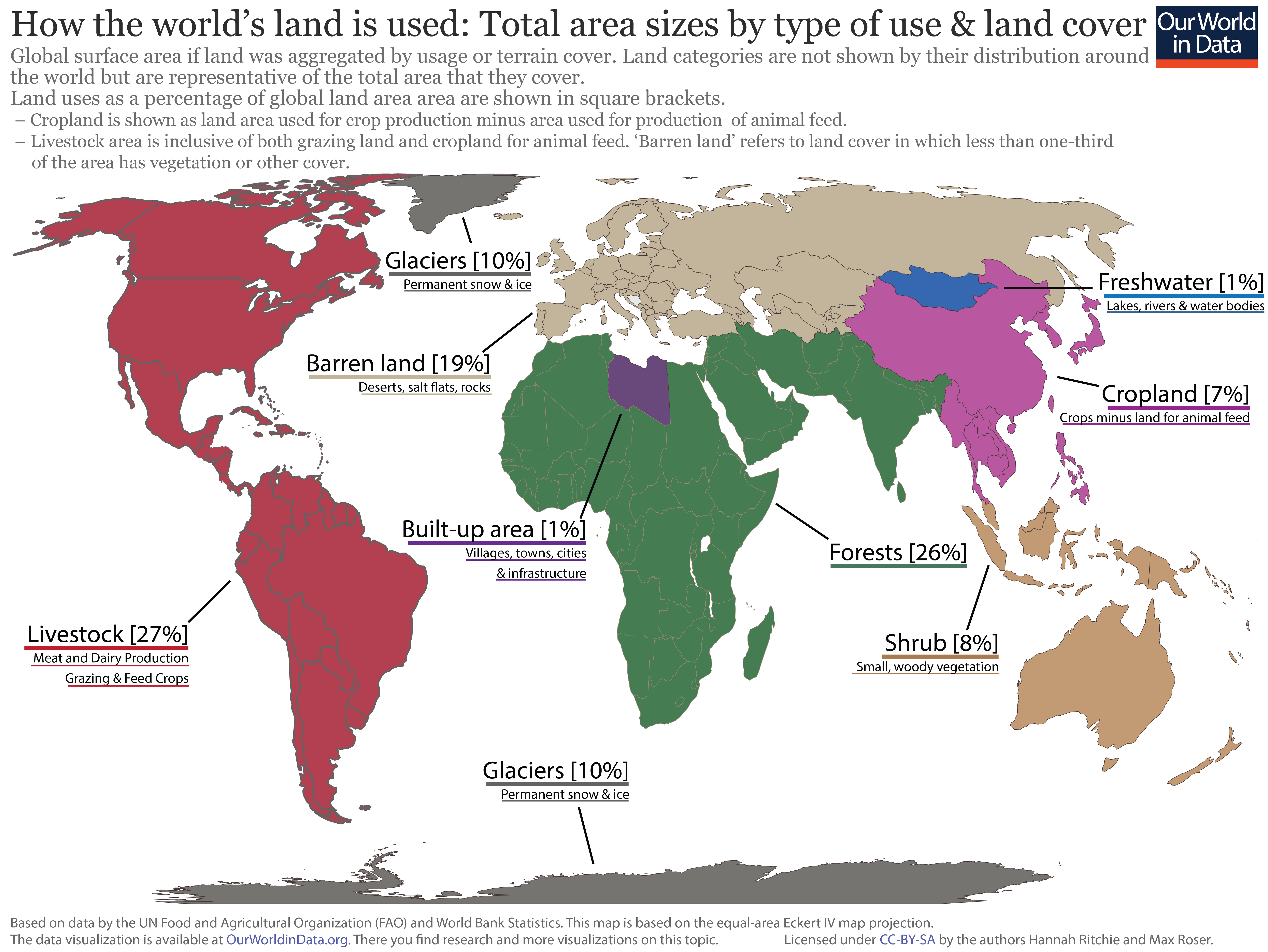
Most of the damage is caused by animal agriculture. It's responsible for a significant amount of greenhouse gases, it's a leading driver of biodiversity loss and deforestation, and it contributes to soil degradation and water pollution.
BIODIVERSITY LOSS
https://www.nature.com/articles/d41586-019-01448-4
Humans are driving one million species to extinction - UN backed report finds that agriculture is one of the biggest threats to Earth’s ecosystems
https://www.unep.org/news-and-stories/press-release/our-glob...
Our global food system is the primary driver of biodiversity loss
https://pubmed.ncbi.nlm.nih.gov/26231772/
Biodiversity conservation: The key is reducing meat consumption
DEFORESTATION
https://ourworldindata.org/drivers-of-deforestation
Drivers of Deforestation - combined, beef and oilseeds for animal feed account for nearly 60% of deforestation
https://www.ucsusa.org/resources/whats-driving-deforestation
Just four commodities — beef, soy, palm oil, and wood products—drive the majority of tropical deforestation.
Beef - 2.71 million hectares / year
Soy - 480,000 ha / year (77% for animal feed)
Palm Oil - 270,000 ha / year
Wood - 380,000 ha / year (but probably more)
GREENHOUSE GAS EMISSIONS
CO2 - 16.5+% animal agriculture (https://www.researchgate.net/publication/352100490_Emissions...)
Methane - animal agriculture leading driver, https://ourworldindata.org/emissions-by-sector#methane-ch4-e...
N20 - animal agriculture leads again, https://ourworldindata.org/emissions-by-sector#nitrous-oxide...
SOLUTIONS
We can significantly reduce our footprint by adopting plant-based diets, reforesting the pastures (more than 50% of which were originally forests), and allowing biodiversity to recover.
https://ourworldindata.org/land-use-diets
If the world adopted a plant-based diet we would reduce global agricultural land use from 4 to 1 billion hectares
https://www.nature.com/articles/s41893-020-00603-4
The carbon opportunity cost of animal-sourced food production on land - shifts in global food production to plant-based diets by 2050 could lead to sequestration of 332–547 GtCO2, equivalent to 99–163% of the CO2 emissions budget consistent with a 66% chance of limiting warming to 1.5 °C
https://www.eurekalert.org/news-releases/917471
Feeding 10 billion people by 2050 within planetary limits may be achievable
Yes - deadly serious.
I had to travel to the US midwest recently, after not having been there for a long time. As I drove out of the city the first impression of the farmlands was pleasant. But after an hour of highway-speed driving past nothing but bare fields (out of growing season) with scant rows of trees, we became a bit horrified — there was absolutely zero habitat for anything but the artificial plantings, when they were in season. And they would be coated with pesticides to ensure that there were no insects, or anything that ate them, or that ate the things that ate the insects, etc.. And indeed, returning to the airport in daytime, there was remarkably little wildlife.
It was a seriously disturbing experience, which I did not expect.
>>Feeding 10 billion people by 2050 within planetary limits may be achievable
Yikes. The damage being done by 7 billion right now, adding 20-30% more is kind of unthinkable, even setting aside the agricultural damage. And you're absolutely right that we need to adopt a plant-based diet.
The conversion away from meat does seem much more doable, since only 12% of Americans eat 50% of the beef. Moreover, that's men between 50-66 years old, so if younger generations don't acquire that habit, we'll get a 50% reduction just by that sub-population aging out.
[0] https://phys.org/news/2023-08-mere-americans-nation-beef-sig...
Did you also notice a lack of dead insects on your windshield?
Maybe you're not old enough to remember, but several decades ago, any significant drive in most of the US would result in your windshield being coated in dead bugs. Not enough to cover it of course, but enough you'd have to run your washers and wipers sometimes, and use the scrubber at the gas station to clean your windshield (back in the full-service days, the attendant did this automatically for everyone, because they needed it).
These days, you can take a long drive and get virtually no dead bugs at all.
The only viable method is lab grown meat that tastes exactly the same, same texture, and is cheaper. That's it. People have real stuff in their lives - they're not worried about planetary survival in 100 years, they're worried about next months rent, etc.
I suspect it's true that the only way to substantially cut animal-based protein consumption at scale is some technological alternative that offers a comparable culinary experience but with a lower cost (and lower impact). Although as another poster notes, it's also true that — like many resource consumption issues — the distribution isn't flat, but shows the majority of consumption coming from a relatively small fraction of the population.
However, what I wanted to point out is that "lab grown meat" is not the only possibility in this general area. Precision fermentation of proteins (e.g. https://gfi.org/science/the-science-of-fermentation/) is another approach that seems to have potential. Although I note that I don't have a specific horse in this race, and would be delighted to see anything that can reduce the overall environmental impact of food production at a global scale take off.
We're using up resources at a pace that outstrips Earth's ability to replenish them. For instance, we're already consuming 1.7 times the Earth's available resources.
If everyone were to adopt a diet similar to the American diet, we would require more than five Earths to sustain it.
https://css.umich.edu/publications/factsheets/sustainability...
> The only viable method is lab grown meat
Achieving the required scale and price point may take decades, potentially leading to the collapse of biodiversity long before that occurs.
> that tastes exactly the same, same texture, and is cheaper
Is our love for the taste really worth destroying the planet?
What will we say to our grandchildren? "Sorry, I couldn't give up those burgers. Now, go play in a desert."
https://www.independent.co.uk/independentpremium/uk-news/mea...
Veggie sausages and burgers up to ten times better for environment than meat, study finds
> they're worried about next months rent
Vegan diets are typically the most economical choice, even in first-world countries. The affordability of animal products is primarily a result of significant subsidies, without factoring in the negative externalities.
https://www.ox.ac.uk/news/2021-11-11-sustainable-eating-chea...
Sustainable eating is cheaper and healthier - Oxford study
Don't be silly. Our grandchildren won't need refrigerant to survive a hot Earth; they can just live underground. Caves stay cool year-round. Or they could dig a bunch of silos, 144 levels deep, and live in those, sending outcasts to the "outside" to die in the poisoned air.
The remaining half is spread among the other 88%. Convince that 12%, or let them age out, and half the problem goes away.
[0] https://phys.org/news/2023-08-mere-americans-nation-beef-sig...
https://phys.org/news/2023-08-mere-americans-nation-beef-sig...
That conditional statement should set your skeptic sense to Defcon one.
Doesn't work. A long time ago I thought when all the old farts are gone, everything is going to be better. Had to have faith in my own generation right?
You know what happened... Humanity just grew a new set of old farts.
but hope somehow contigent or predicated on the age of those people? nah.
If you are actually worried about next month's rent, then going mostly vegetarian is FAR cheaper than eating beef
Plus, only 12% of the people eat 50% of the beef in the US. That is a group of 50-65 year-old men. Change their habits to match the normal population (or let them age out) and 50% of the problem disappears.
[0] https://phys.org/news/2023-08-mere-americans-nation-beef-sig...
The way the vegan movement has weaseled its way into the discussion on climate change has been frankly horrifying to watch. As you said, people will not stop eating meat. Tell them that going vegan is the only way and they'll just say "fuck the planet" and not bother with it. Like, the worst that could happen is humanity going extinct. The Earth itself will be fine. Put that way, well, if we can't figure out how to run our farms more optimally, we should go extinct. Chickens don't contribute to atmospheric changes by themselves.
You think that is little? 200 g per day would be 80000 tons of meat for a 400m population (EU) - let's generously account for the less hungry babies and we'd maybe have 60000 tons.
How many cows and pigs are we talking about here daily?
> The Earth itself will be fine.
Sure. Earth will be fine even if we are hit by a megathingy that rips apart the entire lithosphere. Nature will be fine even if our sun blows up tomorrow. But what has that to do with anything?
PS My own meat consumption is down to 2-3 meat dishes per month. Don't know if that helps...
If people had to pay the real price of meat with environmental externalities factored in most people would consume at a level you've described or even less. My issue with that is it doesn't address how most lifestyle emissions are attributable to the wealthiest economic class. It's still a better alternative to the system we have now, which is clearly unsustainable.
A 1/3rd pound burger takes 660 gallons of water to produce, or about 2500 liters. That's not even getting into any of the typical inputs like antibiotics which have their own collection of problems. Say what you will about vegans, it's impossible to talk about the environment without bringing up the impacts of industrial agribusiness and factory farming.
While we're talking about efficiency, you gain an order of magnitude improvement by farming crops for humans to eat rather than farming crops for animals to eat for humans to eat. Only about 55% of the crops we go are directly consumed by humans, the rest is used for feed and biofuels. It would take a tenth of the land area to feed the same amount of people plant-based vs an omnivorous diet. We should absolutely be pushing for less centralized food production, and chickens are a useful part of that. They turn food waste into new food and deal with several pests. That's very different from slaughtering them wholesale for cheap dinosaur nuggets.
The entire ecosystem on which we depend for sustenance is an extremely complex web of interlocking dependencies, from plankton to pollinators, to soil microbiota, to temperature & hydration, and so on, endlessly.
This is the food web. If it collapses, we as a species are beyond fooked. Because it is so complex (and even something relatively simple such as CO2-driven greenhouse effect climate change is too complex for the lower half of the population to understand), it is barely even discussed.
But make no mistake, the food web is under massive assault from all kinds of human activities (and even the artificial agriculture web is coming up against the hard limit of a phosphorus crisis). This is likely to be a sooner and more catastrophic failure than the climate crisis. The Fine Article nicely clarifies some of the threat.