Since we don't know everything (not even everything about our own creations like stock exchange markets and software systems), it becomes risk management. After writing software for decades, I still have no idea whether these circumstances were predictable let alone preventable, but perhaps they could have spent more time considering the minutia of the system writing more tests or whatever. Yes, the mistake was the fault of the humans designing and implementing the system. But that could be said of any (non-natural, human-made) system that fails.
At some point, someone has to decide that code should just be shipped. We're not perfect enough as people to build bug-free systems. Risk comes with releasing "unproven" code. And yes, it's embarrassing when the fit hits the shan in front of the whole world. But I try to avoid becoming one of those jaded people that can't tolerate mistakes on behalf of others nor can admit their own.
And it's compounded by quantum effects, multi-body problems, and emergent phenomena.
Your requirement is that we 1) have absolute knowledge of a state of the universe, and that 2) all later states can be predicted from this a priori state.
Heisenberg says "you can never have absolute knowledge".
Numerous other elements argue that even where absolute knowledge is available, it's not possible to predict future states with certainty, or in less than real time.
So, no, everything is not foreseeable.
Mind: some risks are predictable in a probabilistic way, though generally these are good for saying that "in T' period of time, there's P probability of X event occurring", though that's a far cry from saying that event X will happen at time T. Much of my life revolves around clarifying the distinction between these two statements.
An instance which comes to mind: Schneier's blog has mentioned that the 9/11 attacks were statistically probable given terrorism trends. As has been the absence of similar-scale follow-on attacks since. Though with time, a similar magnitude attack becomes a near certainty.
Also, you're trivializing the challenges likely faced by the kind of venture. It's not always possible to find all bugs, unless you want to code in Ada and formally verify things with OCaml and are trying to fly a plane.
The problem could have been caused by a strange hardware defect, a rare bug in a library, etc.
Or competition, a disgruntled employee, etc. Just speculating but IMO it's a pretty big coincidence that it failed exactly when they did the IPO.
I read that to mean that this is the first time they've ever used their IPO-related code in production and it failed badly. So it sounds like it was the normal sort of bug, in their own code, and their own IPO directly triggered the bug.
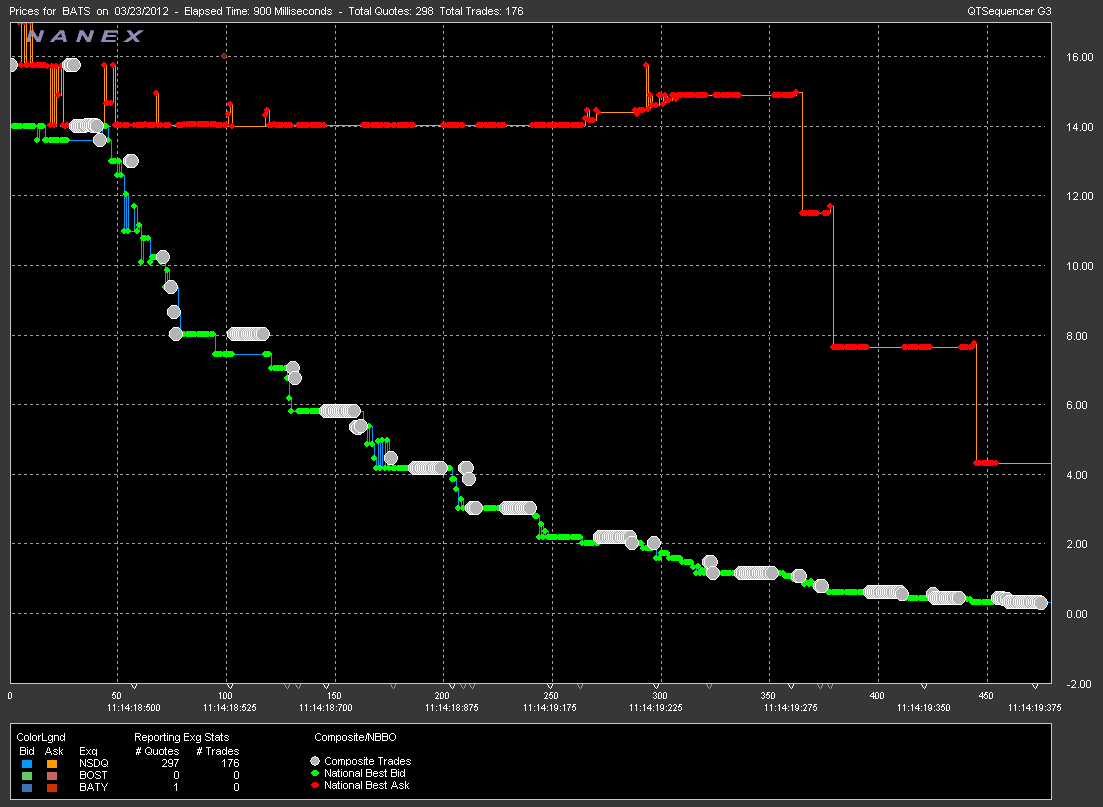
It happened in less than a second.
You might also familiarize yourself with the Just World Fallacy: http://en.wikipedia.org/wiki/Just-world_hypothesis
Maybe I'm just reading too much into this, but this quote makes it sound like Tabb really doesn't understand technology. The platform didn't "backfire", the gods of finance didn't frown upon their venture, their code was incorrect. This could have been avoided if they had found whatever bug they hit before they went live. Don't get me wrong, I also feel bad for them because it sucks to have a technical error cause anything more than debugging frustration, but this was preventable.