I disagree. I've been in many projects which looked exactly like the stereotypical waterfall, with the expected results (delays, death marches).
Unfortunately the strawman was what started getting traction.
The horror is that it got picked up as a legitimate SDLC. Hence your exposure to it.
It’s almost like they saw the pictures and didn’t read the words.
At the same time, that process he described was the standard procedure for government and any large corporation contracts.
I worked as an external employee in an environment that had a very functional scrum implementation. You had groomings, plannings, dailys, retrospectives. Every task was defined, estimated, time on them tracked to get better in estimating. You had scrum masters, capacity plannings. On the surface, it was all very functional and productive.
But the reality is, business analysts and product managers who had little knowledge of how the system works were in charge of talking to clients, writing specifications, getting them approved and ready for development, and very little possibility to iterate if there was a problem in the definition.
It was very efficient at building a bad product. :D
I saw a quote recently from Erik Dietrich that said, "A lot of people mistake activity for productivity” and that describes every scrum implementation I’ve ever seen.
It’s a cargo cult, no doubt in my mind.
https://upload.wikimedia.org/wikipedia/commons/d/de/1970_Roy...
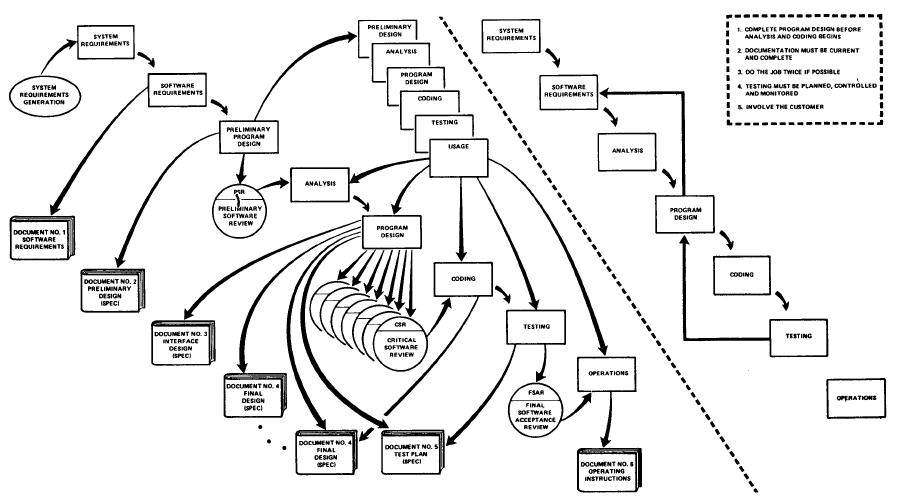
Neither process was explicitly called “waterwall” - and the former is what I was taught at software engineering school.
Technically, that’s exactly what it means. The entire design is signed off and completed before the implementation starts, and there is no feedback loop.
But waterfall itself was a straw man in a paper intended to recommend a much more complex process. It’s more than ironic that it became seen to be a valid process in and of itself.
(Sadly I’ve lost the link to the original paper, but if I find it I’ll update my comment)
> Besides, waterfall is just the straw man of scrum zealots.
The irony is that scrum itself is often just a wrapper for a waterfall process with all the problems it comes with. So many corporate implementations of scrum are AINO - agile in name only. Management that doesn’t understand the complexity of software is doomed to oversimplify it.
That said, if you are working iteratively - one feature at a time, with feedback - then whatever you call it, that’s not waterfall.