Sun’s out = heavy AC load?
Doing any grid 100% solar needs a lot of storage, but there’s gotta be a perfect point that mostly shaves peaks really nicely.
(Yeah yeah, it can be cloudy and hot+humid, but still)
> Shift some of your summer energy usage away from the on-peak time periods (2-7 p.m., Monday–Friday, June–September, excluding holidays).
Battery backed solar is becoming really popular with grid operators because you get the upsides of load following without the overhead of mostly idle production. The economics get interesting as more solar comes online, but things are only getting much worse for nuclear and coal. Which is why there is basically nothing in the pipeline for either one.
1. https://b698061.smushcdn.com/698061/wp-content/uploads/2023/...

Collocated Solar with batteries increases efficiency as DC from solar is used to directly charge batteries without the cost or losses associated with DC>AC>DC you would see if these where separate. LCOE is already below 60$/MWh because you only need batteries for a fraction of total production.
https://atb.nrel.gov/electricity/2022/utility-scale_pv-plus-...
The cost of batteries would skyrocket if countries actually tried to provision 12 hours of battery storage. Because the US alone uses 500 GWh of electricity each hour. This is greater than the global battery production figures in 2022 [1].
1. https://www.spglobal.com/mobility/en/research-analysis/growt...
To simplify if you have 8 hours of power and you store 1/2 of it you need 4h of storage. So our hypothetical 4GW solar power plant produces 2GW for 8 hours and 1 GW for 16. That already batter fits the demand curve than steady state output.
However things get better if you instead consider real world demand and the actual production of solar panels being spread across the entire day a 4 hour of storage is close to perfect. Except, the real world isn’t a hypothetical 100% solar grid so 2h ends up working fine in most areas.
These factors do depend on geography. Hotter climates do see more energy use during the day to power A/C. But on the flip side, colder climates see even more energy demand during the night to heat homes. And unfortunately this also coincides when solar is producing the least amount of energy due to fewer sunlight hours, axial tilt, and more cloud cover.
There are niches solar can carve out: Las Vegas and Australia have loads of empty space, clear weather, and hydroelectricity that can fill in periods of non-production. But nuclear power is a much more flexible solution. All you really need is water to cool the reactor, and 80% of the population lives within a hundred miles of the coastline (you just need water, not fresh water).
Do we have any idea what the cause of that 9pm spike is? That seems like a bizarre time to be the peak to me (I can't work out what the primary energy users would be at that time).
Net effect you tend to see them in areas where there’s a surplus of winter electricity which also tends to be places with minimal demand for heating like Virginia rather than Mane. 46% in South Carolina, 42% in North Carolina, 30% in Virginia etc: https://www.statista.com/statistics/1327164/share-of-househo...
* Except of course when people want to heat a pool, that takes crazy amounts of energy.
“Israel became the world leader in the use of solar energy per capita with 85% of households using solar thermal systems (3% of the primary national energy consumption)” https://en.wikipedia.org/wiki/Solar_water_heating
> The amount of heat delivered by a solar water heating system depends primarily on the amount of heat delivered by the sun at a particular place (insolation). In the tropics insolation can be relatively high, e.g. 7 kWh/m2 per day, versus e.g., 3.2 kWh/m2 per day in temperate areas.
Because of this, many solar thermal systems are supplemented by convention heaters.
> In winter, the percentage of your hot water heated by the sun drops to as low as 10-20%—as you might expect with short days and weak sun in December. That’s why practically every solar water installed in the US will be connected to a backup conventional water heater to ensure that your hot water needs continue to be met even in January.
https://www.aspessolarproducts.com/solar-water-heater/how-do...
If you really want to model things you need to consider the vast drop off between midnight and 5 am in which that steady state I talked about would be wasted. Batteries don’t really care about when the peak is just the total demand minus power production. And again steady state like nuclear looks terrible by comparison.
Running summer numbers you see an extension in the number of hours the panels are producing which then reduced the gap you need to fill with batteries. Winter sees the reverse as average output drops but conversely batteries are storing a higher percentage of total energy produced. Sizing is further adjusted based on expectations for daily output not hypothetical maximums.
Which of those is more critical depends on local conditions but the grid is always sized for absolute worst case not the average one. There’s lots of micro optimization such as aiming panels East or West to shift production, local hydropower and wind resources etc etc.
None of which is that important compared to the overall effect I was describing where batteries are sized to the daily output not the peak output. The important number is the cost which is running 60$/MWh vs the daily demand not whatsoever the nameplate numbers people love to talk about to make projects seem more important.
Pointing to one specific project is not relevant: we can't replicate this project to the point where demand is fulfilled because that would require an order of magnitude more batteries than are produced.
As to storage we’re talking 4h * 500 GWh +/- whatever that’s only 2,000 GWh ish, but the specifics aren’t important. By comparison we’re talking a nearly 100% EV cars so 75 kWh per car * 282 million, that’s ~ 21,150 GWh. Those numbers are so huge we could bump things to 16 hours of electricity and it’s still fairly trivial by comparison. Build enough generation and storage could actually be even lower, it’s just a cost tradeoff and renewables are really cheap. (Edit: There’s been a lot of research into it and there’s plenty of raw materials for a 100% EV transition and on this timescale ramping battery manufacturing isn’t an issue.)
Also, that 30% number is wildly incorrect. Even just over a week the CA demand is expected to go from a low of 24,867 to a high of 42,007 in a single day, but you can’t design a grid for a single day. https://www.caiso.com/TodaysOutlook/Pages/default.aspx#secti... Things look similar nationally, we don’t have enough interconnects to really smooth things out and even if you did the daily variation is quite significant.
However, the actual disparity between peak annual demand and minimal annual is vastly higher and you can’t smooth it out. That delta is why idling a grid of mostly nuclear power would be so wildly expensive. Without France style exporting and importing from non nuclear countries cost go insane. The only way it’s even vaguely viable in the US is with similarly vast amounts of storage. But at that point adding just a little cheap solar + wind saves money, and that keeps being true as you use less and less nuclear.
TLDR; Cost effective mostly nuclear grid needs even more storage due to capacity factor issues when you can’t follow France’s model of importing and exporting a large fraction of your power to non nuclear countries.
Provision enough generation to satisfy peak demand and spend the excess power doing things like carbon dioxide sequestration or desalination in places with limited drinking water. Too much energy is a vastly easier problem to solve than too little. And the great thing about nuclear is that it's no more expensive to run at 100% capacity than 50%.
The issue with nuclear is it costs twice as much per kWh at 50% capacity than it does 100% capacity. Nuclear is expensive at 90% capacity factor, it’s insane at 45% capacity factor.
Further, daily demand isn’t that problematic. It’s really seasonal demand that kills people’s dreams of scaling nuclear power. Over 24 hours going from a 100% high down to 50% low might average say 70-80% depending on specifics. But if 1/2 the year you never get over 80% capacity, and you also need to curtail on nights and weekends year round, and take the plant offline for weeks to refuel etc, then things look much worse.
The temptation is to say batteries to the rescue, but then you’re directly competing with solar on price per kWh. It’s really hard to make things work without natural gas to pick up the slack.
Even in the summer in Texas, where we experience the largest demand fluctuations, minimum demand is around 60% that of peak demand. And this is indeed a good use case for rooftop solar, especially since it can be used to power A/C in the same building on which its mounted - I never said we should have zero solar power, just that it's infeasible to use for the primary source of electricity. Rooftop solar is indeed a good way to mitigate A/C power draw. But outside of summer peak and minimum power draw is only about 20% difference, and again the peak power is at night.
I don't doubt that nuclear power is expensive. But at least is feasible to build. "Feasible but expensive" is much better than "not feasible regardless of cost". Intermittent sources are only feasible in a grid backed by fossil fuel and hydroelectric sources that can flexibly respond to solar and wind's variation. Once you enter the realm of a predominantly renewable grid, this changes drastically. Storage at a scale anywhere close to what's required to smooth the intermittency of renewables is not even feasible regardless of cost. No amount of money is going to provision the amount of storage required to smooth out the daily fluctuations of solar, let among the seasonal variations of both solar and wind. Overproduction and HVDC connections only take you so far unless you're going to cross the Atlantic (which is also of dubious feasibility). Even just a few hours of storage is well outside of reach. Don't be misled by a handful of battery stations in the MWh scale: actually trying to providing 2 TWh of storage would cause prices to skyrocket because production cannot remotely fulfill that level of demand. Not to mention it'd kill electric vehicle adoption.
This is why most proposals for a primarily renewable grid involve a novel storage system. Will hydrogen, or compressed air, or giant flywheels deliver the required scale? Maybe, in the same vein that maybe deep-drilled geothermal power will deliver cheap decarbonized energy. Those are unknown factors in that one cannot assume will work out. Would you consider it a reasonable plan to assume deep-drilled geothermal will solve decarbonization? After, Iceland has used geothermal for decades, and we have lots of experience drilling for oil? This is how we ought to regard things like hydrogen electricity storage or ammonia: they're in the realm of possibility not feasibility.
Again, it's not a question of cost it's a question of what's even possible without an engineering breakthrough. Maybe we'll figure out a way to build storage at grid scale. And maybe we'll figure out geographically independent geothermal power. But both of those are things not presently within our technical capabilities.
> ...and take the plant offline for weeks to refuel etc, then things look much worse.
Nuclear has historically had the highest capacity factor of all generation sources [2]. This hasn't been an issue with existing generation sources with even more downtime, so why would it be an issue with nuclear?
1. https://www.deegesolar.co.uk/do_solar_panels_work_in_the_win...!
2. https://www.eia.gov/tools/glossary/index.php?id=Capacity_fac....
Note the two peaks: 1 happens at 7am. There's very little solar at 7am even though the sun is up, but demand is at a maximum. The other happens at around 6pm - when people get home. There's also very little solar at 6pm (sun sets at 5pm in Winter, during the day it's longer).
Also note the demand fall off in the evening: that's a very lopsided peak, because people stay at home (whereas in the morning they turn on the kettle, then leave). But also note the absolute magnitudes: at the minimum, which is about 4am, demand last night bottomed at about 6,800MW. The peak was 9,800MW. So even the "low demand" was 2/3rds of peak demand, and it took 8 hours to get there. Most of the night, consumption was a lot higher.
But it gets worse: before you're going to recover any real capacity from your solar, the largest demand of the day is about to happen in 3 hours, with the sun just barely over the horizon.
[1] https://aemo.com.au/en/energy-systems/electricity/national-e...
Also, your not actually getting 100% solar output over the day. Batteries that could store 50% of your hypothetical maximum are well over half of your expected average output especially in winter when these peaks are most pronounced.
You can see the difference here for today (choose a previous day if it's near the start of the day in California):
https://www.caiso.com/TodaysOutlook/Pages/default.aspx#secti...
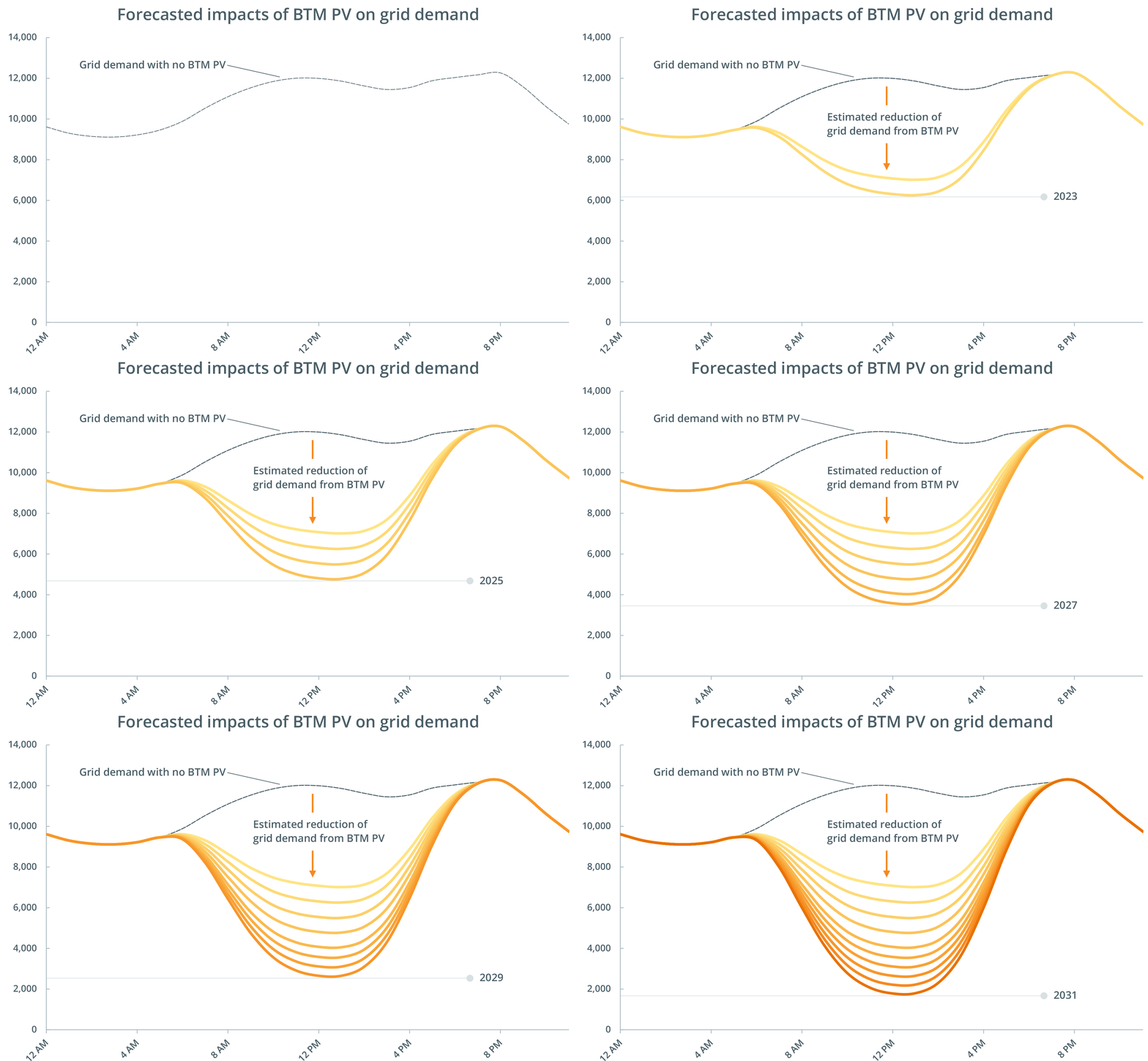
The non-grid PV and wind peak is lowered, and shifted a couple of hours later.
And that graph still doesn't show consumer and behind the meter commercial PV impact. Historically there was a double peak, one of which has been wiped out entirely.
Here's an animated diagram that explicitly calls out BTM (behind-the-meter) solar:
https://isonewswire.com/wp-content/uploads/2023/02/btm_forec...
The same criticism can be applied to any electricity source: What happens wind stops during a heatwave? Or when the sun goes down? You might say nuclear is less reliable, but the reality is nuclear power has the highest capacity factor of all generation sources: https://www.energy.gov/ne/articles/what-generation-capacity#....
Capacity factor does not address reliability or emergency planning...
Again, peak electricity demand does not happen at noon. It happens at around 9pm, when the sun either has set or is about to set. Unfortunately, solar's production does not match demand patterns.
> Instead of proposing cross-continent distribution lines, just build more small regional renewable sources...
Again, all the renewable sources in the same region are subject to the same weather patterns and and day/night cycles. Sure multiple solar farms gives you redundancy against some sort of mechanical failure that causes one specific solar farm to go down. But the most common failure mode in intermittent sources is cloud cover or lower-than-expected wind speeds. A backup solar plant a mile away isn't going to give you redundancy against weather patterns. This is why a lot of plans for renewable grids are contingent on thousands of miles of HVDC lines to move energy across continents.
> Capacity factor does not address reliability or emergency planning...
Capacity factor describes the uptime of a power plant. Nuclear power has the highest uptime. The point is it's less likely to go down than all alternatives.
These aren't artificially constrained issues. These are real practical barriers. Why haven't countries the world over completely to renewables if it's cheaper? Because corporations want to screw up the environment because... they're moustache-twirling evil people or something? But the reality is that intermittent sources still have significant barriers to implementation that won't go away without massive, orders-of-magnitude improvements in storage performance. Renewables are good to deploy in an opportunistic fashion, supplementing dispatchable sources during periods of production and then turning the gas back on when they're not producing. But actually producing a primarily renewable grid becomes vastly more challenging due to the intermittency.
1. https://www.vox.com/videos/22685707/climate-change-clean-ene...
10-25% short fall doesn't require 10x over capacity, it requires a mix of overcapacity + storage + energy conservation measures.
Energy conservation is probably a better payback than either nuclear or renewables and better resilience for people infrastructure. For example, better insulation reduces energy costs in both cold winters and heat waves, and reduces the impact if there are grid/source failures by any technology. It also doesn't have a big crossover on the logistics tail of either nuclear or renewables, and so is a great thing to do in parallel to address climate change in general.
"Conservation is an admission of failure" is a purely ridiculous position.
Energy conservation is likely not going to be feasible as more and more transportation gets electrified, as gas heating is replaced with electric, and industrial processes like smelting are decarbonized. Conservation is indeed an admission of failure, because success involves accommodating the growing demand for electricity in the future. Remember, electricity production is only about a third of total energy consumption: https://www.eia.gov/energyexplained/us-energy-facts/
More production costs X which reduces the need for batteries by Y, as long as X > Y you build more production even if most of it’s output is unnecessary. 16% of global electricity comes from hydroelectric generation, we really don’t need that many batteries.
Actual optimized energy storage is on the order of 2 to 6 hours total globally ~30 years from now depending on how much prices drop. With larger numbers representing lower battery prices. In the shorter term it’s a tiny fraction of that.
Hydropower dams are already storage. When you don’t release the water it’s saved until you do.
If you have enough rain from 3 months ago to release 10 MW 24/7 over a week then you also have enough water to release 15 MW for 12 hours and 5 MW for the other 12 every day etc. You can’t save 100% of the water or the river downstream runs dry but the minimum is generally well below the average flow rate.
This isn’t unusual, most dams ramp production up and down to maximize the value of the stored water.
No, this is not even remotely true. No amount of solar overproduction will let you produce energy at night. 12 hours a day (on average, depend on the season) you will not have any production regardless of overproduction. You'll have a lot of excess energy during the day, but still no energy when the sun has set. Infinity times zero is still zero. Not unless you create transoceanic HVDC cables that connect Eurasia to the Americas, literally piping electricity from one side of the world to the other. Wind also has windless days, with more extreme seasonal fluctuations. Overproduction is not a silver bullet that eliminates the need for storage. Just because you have net surplus over the course of a 24-hour period does not mean demand was satisfied at all times. This is why intermittent sources are so challenging.
> Hydropower dams are already storage. When you don’t release the water it’s saved until you do.
But you can only save energy at the rate that rainfall refills the dam. If you have a dam that refills at a rate of 10MW, you can only effectively store 10MW of excess energy. If you have 20MW of excess production, you can still only store 10MW and the other 10 MW is wasted. Dams are not batteries, they can store a lot of energy but they can only be refilled at the rate dictated by rainfall.
You also can't completely shut off a dam or the river will run dry with serious ecological consequences, and impairing downstream water supply.
> But you can only sacs energy at the rate rainfall refills the dam. > can’t completely shut off
You’re completely misunderstanding how dams are used look here: https://en.wikipedia.org/wiki/Hoover_Dam
Installed capacity 2,078.8 MW, Capacity factor 23%
Minimum flow rate isn’t 0, but is plenty low enough to have a great deal of flexibility.
...which would require an enormous and infeasibly large amount of batteries. You're right: overproduction doesn't mean you get power for every second per day. But a grid does need sufficient energy at every single second per day or you have blackouts. This is why overproduction of intermittent sources is not as useful as it sounds.
Nothing in your link about dams contradicts what I wrote: their rate of recharge is limited. You can shut off much of the turbines and let the reservoir build up, but they cannot be recharged faster than the rate at which rainfall refills the reservoir. Judging by a 2 GW capacity and 23% capacity factor, one would infer that it's refilled at a rate of ~500 MW (in reality, less than that since Lake Meade is shrinking). Completely shutting off the turbines would only refill at a rate of 500 MW. If you have 2 GW of overproduction, you can't refill Lake Meade with 2 GW of potential energy. You can shut down its turbines and let the reservoir refill at a rate of 500 MW, but the other 1,500 MW can't be used to recharge Lake Meade.
A dam is sort of like a battery but its rate of recharge is much more limited than it's rate of discharge, which is a big disadvantage when trying to capture the overproduction from intermittent sources.
False, but you can’t substantiate your argument by simply saying the words you need to back it up with something such as actual calculations etc.
> Their rate of recharge is limited
That’s completely irrelevant here. Rainfall is so concentrated in short periods that they often have months of water in reserve and can decide when exactly to release it over that kind of timeframe. 95% of the time there is less water flowing out of a dam than flowing into it. That’s why we build dams.
The rate of recharge is absolutely relevant, because you can't actually capture excess production from intermittent sources. If you're relying on a dam to fulfill periods of non-production, you need a way to put the excess energy during periods of overproduction back into the dam. But a dam can only shut down its turbines, it can't be recharged faster than the rate that rainfall refills it.
If you're relying on 2GW of power from hoover dam at night, you can't overproduce 2 GW of solar power during the day and put it back into the reservoir. At best, you can shut down the turbines at let rainfall refill it 500 MW, but you'll be chronically losing energy. Rate of recharge is critical if you're trying to store energy during periods of overproduction, which is exactly what your proposal calls for.
I understand your point but it’s based on faulty assumptions.
Simply not using existing water means it’s still there. If you have 10,000$ in your bank account and you don’t buy something you still have the 10,000$. Dams are the same way if you have 20,000 MWh worth of water and can average 20 MWh for the next 1,000 hours then generating 10 MW for the 500 hours of those hours and 30 MW for the other 500 hours hits zero at exactly the same time.
Recharge is important long term but irrelevant in the short term. You might expect to receive water from the spring thaw, but that’s a long way away. Large dams like the hover are built to contain multiple years worth of average flow for a river. It took more than a full year just to collect enough water for them to start generating hydropower.
As to your analysis,
> 500 GWh globally
That’s an outdated estimate for last year even just EV’s broke 500 GWh. “Automotive lithium-ion (Li-ion) battery demand increased by about 65% to 550 GWh in 2022, from about 330 GWh in 2021” https://www.iea.org/reports/global-ev-outlook-2023/trends-in...
Your number was an estimate for 2022 total production made during 2022, and they got it wrong which isn’t that surprising as EV sales ended up 55% from 2021 and average battery sizes also increased. 2023 numbers are hard to estimate for similar reasons.
> Production of batteries may grow in the future
Again, the rates have been increasing by double digits per year for a long time, that’s wildly faster than the increase in electricity demand. We don’t need to talk in hypothetical terms here just current factories already wildly invalidate your calculation let alone any kind of longer term estimates when grid storage may start to pick up.
> 12 hours
As I mentioned that’s a monumental overestimate, but not particularly relevant compared to the first two issues. We can quibble about specifics here but compared to even a 50% EV world grid storage simply isn’t a major factor.
Overproduction doesn't help you here: if you have 3 GW of solar energy and 2 GW of electricity demand, you can't use the remaining 1 GW to refill Hoover Dam. If you produce enough solar to meet demand, you can shut off hoover dam's turbines. But if you overproduce - if you produce more energy than the grid needs - it's wasted, you can't use excess energy to refill the dam beyond just shutting off the turbines.
> That’s an outdated estimate for last year even just EV’s broke 500 GWh. "Automotive lithium-ion (Li-ion) battery demand increased by about 65% to 550 GWh in 2022"
Demand, not production. Just under 500 GWh of batteries was produced, a good chunk of demand went unfulfilled. If anything, all your source shows is that grid storage is even more infeasible because we can't even satisfy EV's storage needs.
> As I mentioned that’s a monumental overestimate
No, if anything it's an optimistic underestimate. 12 hours is just enough for diurnal storage. But you also need storage to offset seasonal fluctuations.
But of course you don't have store every kWh used. Peak demand in the summer is caused by A/C and corresponds closely with peak solar generation and can be used directly. New solar farms have a cost of about 0.5cents per kWh, but we'll use 1cent per kWh to be generous. So if you use 3/4 of your power directly and shift 1/4 you end up with an average cost of 0.751c + 0.25(11+1) = 2.75 cents.
And those costs aren't theoretical. For a concrete example, the 8minute energy Eland project proves 24h battery+solar energy for under 4 cents per kWh.
The reality is that renewables are currently only viable to supplement a grid primary backed by a dispatchable source of energy. If you have loads of hydroelectricity, that's fine, but the regions that don't have hydroelectric potential are going to be stuck burning fossil fuels until a massive storage breakthrough is found.
https://www.tesla.com/ns_videos/Tesla-Master-Plan-Part-3.pdf
Actually, we just need improvements in fusion power and then we don't need solar, wind, or battery storage!
"Just scale up" is a good summary of how to decarbonize through nuclear power. We have decades of experience building nuclear plants. Not so with hydrogen based electricity storage. Plans for renewable grids call for the use of novel electricity storage systems because none of the existing storage mechanisms are feasible. Until we've built the storage mechanisms proposed, any plan involving it's use is effectively hand-waving a big part of its implementation.
Sure seawater extraction is more expensive. But procuring raw uranium is a tiny fraction of nuclear's cost. You'll see statistics saying nuclear fuel is a significant cost, but most of that expense is from enrichment not extracting raw uranium.
Uranium is a small fraction of nuclear's cost at current uranium prices. But eventually that runs out, and the price of uranium would increase dramatically. This has always been the motivation for breeders.
> The cost of raw uranium contributes about $0.0015/kWh
Even if this increases by an order of magnitude, this is not significantly impacting the cost of nuclear power. Heck, even two orders of magnitude still amounts to ~1% increase in net cost per KWh.
RE your edit after I commented:
> Uranium is a small fraction of nuclear's cost at current uranium prices. But eventually that runs out, and the price of uranium would increase dramatically. This has always been the motivation for breeders.
Again, the cost of raw uranium extraction amounts to $0.0015/kWh in nuclear generation. A 100x cost increase will not amount to even a quarter of a cent per KWh. This is the power of fissile energy density: it's so energy dense that the cost of extraction is largely decoupled from the net cost of nuclear power.
By comparison, how would the price of lithium ion batteries be affected if the price of lithium carbonate increases by 100x? Half of a battery's cost comes from the cost of cathode material: https://www.visualcapitalist.com/breaking-down-the-cost-of-a...
A plan that's dependent on something like hydrogen electric storage is like a plan calling for widespread deep-drilled geothermal power: We have plenty of experience with drilling, and steam turbines. Iceland has plenty of geothermal power - but it sits right on a fault line. That's no guarantee we'll actually be able to build geographically-independent geothermal power. Would you view a plan that involves widespread installation of geothermal power as feasible?
There are thermal storage technologies. An example is pumped thermal storage. This involves (1) adiabatically compressing argon, (2) transferring heat from the compressed argon to a hot store (say, molten "solar salt", a potassium/sodium nitrate salt mix) by a countercurrent heat exchanger, (3) expanding the cooled argon back to the initial pressure, (4) using that now cold argon to extract heat from a "cold store", say liquid hexane, cooling it to -100 C. To discharge, reverse this process. Round trip efficiencies similar to pumped hydro could be achieved. The high temperature side of this process is within the creep range of ordinary steel, so no exotic materials are required.
Resistively heated thermal stores would not be quite as efficient (maybe in the low 50s%) and involve higher temperature (~1200 C), but could work with existing gas turbines. Babcock and Wilcox are commercializing this now, using their very nifty direct contact sand/gas fluidized bed heat exchanger. The storage medium here would be ordinary sand, of which there is an unlimited supply.
This last approach also allows an external heat source, such as hydrogen combustion, to act as a backup heat source. So if your thermal stores run out, you can keep running them by burning hydrogen (or some other e-fuel). The marginal capital cost of this capability would be very low, just that of adding a fluidized bed hydrogen combustor to heat the sand.
Hydrogen electric storage has issues producing hydrogen without emitting fossil fuels: almost all hydrogen produced today is through steam reformation which emits carbon dioxide. Electrolysis has issues with corroding electrodes, in particular. We've known about electrolysis for decades (centuries?) but its disadvantages have not been solved. Likewise, how long have sodium and iron batteries been on the verge of commercialization? How long did lithium ion batteries take to reach the scale sufficient for EVs? Sources say that they're projection sodium ion batteries to be produced at 20 GWh per year by 2030 [2]. Even if that level of optimism pans out, this is nowhere near a scale sufficient for grid storage.
People still hope for lithium ion batteries to deliver, because it's the best (or least-bad) option and none of the competitors are set to unseat it. And remember, almost all of this battery production is going to EVs and electronics, only a fraction of it is going to grid storage.
1. https://www.babcock.com/home/about/corporate/news/babcock-wi...
2. https://cen.acs.org/business/inorganic-chemicals/Sodium-come...
The Eland project provides 24 hour power with only 4hr of storage. That's the demand curve in action.
Sure thing! Right now we have an annual battery production rate of 500 GWh globally [1]. If we're going to use global battery production figures, we need to use global electricity consumption, which is about 70 TWh per day [2]. How much storage we'll need varies, depending on the mix of solar and wind. Estimates I can find say 12 hours on the low end, 3 weeks on the high end [3].
So even with the optimistic estimates of 12 hours, that means we'd need 35,000 GWh of storage. This is 70 years of global production at our current rate, for the optimistic storage estimates. And of course we can't dedicate all battery production to grid storage - we need them for electric vehicles, and electrical devices
Production of batteries may grow in the future, but then again so will electricity demand as countries develop and transportation becomes more electrified. Furthermore, we're not counting the fact that batteries have limited lifetimes. It depends on depth of discharge, but we're usually looking at 1,500 to 3,000 cycles before they're substantially degraded.
As your can see, the scale of battery production and the scale of energy storage required to make intermittent sources variable are totally mismatched. The reality is there is no amount of money that will provision the battery storage required, because if countries across the world start trying to buy terawatt hours of batteries when only 500GWh of batteries are produced then the cost of batteries will skyrocket. Cathode material already
> The Eland project provides 24 hour power with only 4hr of storage. That's the demand curve in action.
The "demand curve" means Eland doesn't provide 24 hours of power at its rated output. It provides a fraction of its rated power at night and tells customers not to use as much electricity. This may work for some consumers, but not others. The pumps powering your sewage system can't demand shift if you want to flush your toilet at night. The reality is that peak energy demand happens at night [4], when storage isn't producing electricity. Eland can do this demand shift because other producers are picking up the slack.
When you read about storage projects you need to be on the lookout for weasel-words like this. Demand curve means they produce a fraction of the rated power output during periods of non-production. If I have a plant that produces 1,000 MW during the date and 100=MW at night, that's technically 24 hours of production. But clearly this is not the same thing as a nuclear plant that produces 1n000 MW at all hours.
1. https://www.spglobal.com/mobility/en/research-analysis/growt...
2. https://www.statista.com/statistics/280704/world-power-consu...
3. https://pv-magazine-usa.com/2018/03/01/12-hours-energy-stora...
4. https://reneweconomy.com.au/california-duck-curve-now-a-cany...
1: https://publications.anl.gov/anlpubs/2022/11/178584.pdf
> The reality is that peak energy demand happens at night
Peak net energy demand happens at night. Peak gross demand is during the day.
> Eland can do this demand shift because other producers are picking up the slack.
Eland is producing at a rate identical to the California demand curve, it's in their contract. It's the solar producers who don't have solar along with consumer rooftop solar that's causing the duck curve daytime demand drop.
> If I have a plant that produces 1,000 MW during the date and 100=MW at night, that's technically 24 hours of production. But clearly this is not the same thing as a nuclear plant that produces 1000 MW at all hours.
But the former costs 1/10th of the latter, so you build 10 of them to get 1000MW at night and 10000MW during the day.
You can't store energy in a battery factory, you store energy in batteries. Cite the actual production figures, not the stated capacity figures (spoiler alert: it was just under 500 GWh last year.).
And to reiterate, the vast majority of this production is not going to grid storage, it's going to EVs and electronics. Even if battery production matches the predicted growth, it's still vastly insufficient to provision grid storage without heavily crippling EV rollout.
> Eland is producing at a rate identical to the California demand curve, it's in their contract. It's the solar producers who don't have solar along with consumer rooftop solar that's causing the duck curve daytime demand drop
Again, electricity demand at night is still high: https://www.caiso.com/TodaysOutlook/Pages/default.aspx
Demand remains high well into midnight. I'm not sure why you think matching the demand curve is somehow going to mean you're going to get away with less storage. Unless Eland is going to be producing much less than its nameplate capacity at all times of day, 4 hours of storage is nowhere near enough for it to match the demand curve. And remember, solar is also subject to cloud cover. I'm sure Eland has clauses exempting it during periods of cloud coverage otherwise they'd need weeks of storage not hours.
> If I have a plant that produces 1,000 MW during the date and 100=MW at night, that's technically 24 hours of production. But clearly this is not the same thing as a nuclear plant that produces 1000 MW at all hours. But the former costs 1/10th of the latter, so you build 10 of them to get 1000MW at night and 10000MW during the day.
The former doesn't have a price tag, because no amount of money in the world will buy you that much lithium ion batteries. Again, the world uses 70,000 GWh of electricty per day, most of that being consumed when solar is not producing electricity. No amount of money can fulfill that amount of storage.
1. https://www.visualcapitalist.com/breaking-down-the-cost-of-a...
> If we're going to use global battery production figures, we need to use global electricity consumption, which is about 70 TWh per day
Don't forget about all the energy usage that isn't currently electricity, but will need to be! Especially heating & transportation.
IOW, the US could build a 100% solar+wind+hydro grid WITHOUT ANY STORAGE. The wind is always blowing somewhere in the US.
Of course that much HVDC and overbuild would be ridiculously expensive, but some HVDC and some batteries are a lot cheaper than only HVDC or only batteries.
To me it seems reasonable to assume that not only will battery consumption grow, it will grow exponentially (over the medium term - say the next 10 - 50 years). Rationale:
- There is high demand
- The production process is well established technology that can be easily replicated
- There are no obvious limits to growth in the medium term (In the short-term there are resource constraints as mines are opened).
After that, storage gets rolled out. Nuclear never makes sense, and eventually the existing NPPs go away.
Batteries don’t need much Lithium and the stuff is more abundant than lead, tin, iodine, mercury, etc.
https://www.visualcapitalist.com/breaking-down-the-cost-of-a...
Also, the cost of a battery cell isn’t the cost of a battery pack, let alone the cost of all the associated equipment, land, installation, etc needed for grid scale batteries which is what matters here.
We really don’t need any major breakthroughs beyond economies of scale to see sub 7c/kWh rates 24/7/365. People are already deploying 50% battery backed solar because it’s cost competitive vs both base load and peaking power.
No country produces the majority of its electricity from wind and solar. Australia produces the 15% and 13% of its electricity from solar and wind respectively. Denmark produces 2.5% and 42% from wind and solar [1].
Unfortunately, battery prices have stopped dropping and started increasing [2].
1. https://en.wikipedia.org/wiki/List_of_countries_by_renewable...
2. https://about.bnef.com/blog/lithium-ion-battery-pack-prices-...
Yet, but infrastructure lasts far longer than the recent dip in prices which favors renewable energy. As to battery costs that article specifically mentions expectations of near term drop in prices, these are long term trends not specific annual guarantees. Solar prices have occasionally increased due to supply shortages even in the middle of vast longer term price drops.
Also, countries electric grids aren’t independent outside of a few islands.
Globally Hydropower is ~16% of global electricity generation and quite flexible. A country with 100% hydropower generation can easily add wind and solar panels and then export flexible and cheap hydroelectric energy. In fact if you look at countries running over 50% of hydroelectric power they tend to export quite a bit.