There are other decoding approaches, other than beam search:
https://arxiv.org/abs/2202.00666
> Other than that, things like gpt can't go back and edit what they've outputted
Actually, they can, they may emit a backspace token [1]
[1] https://arxiv.org/abs/2306.05426, https://news.ycombinator.com/item?id=36425375
https://blog.fastforwardlabs.com/images/2019/05/Screen_Shot_...
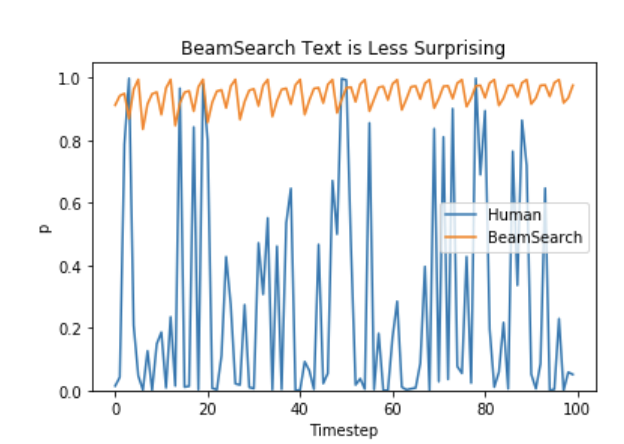
The way most GPT models are set up, they don't edit, but there was a lot of work (made redundant by OpenAI) on using gap filling tasks (masking) to iteratively improve or construct or otherwise edit and formulate logic using the encoder-decoder models of yesteryear - in many ways, I think it would have been more exciting if that approach powered the likes of 'think step-by-step' results.
There's nice stuff you can do with the probabilities, a shame it's more restricted with the chat models. I hope they add some lightweight thing you could pass with your request to constrain the response.
You could then greedily take the most probable single token, or select a bit more randomly (that's where temperature comes in) in a few different ways. You can do better still by exploring a few of the possible top options to select a high probability chain of tokens. That's because the most probable next token may not be the start of the most probable sequence of tokens. That's called beam search.
Other than that, things like gpt can't go back and edit what they've outputted, so it's much more like listening to someone talk from the top of their head and writing down everything they say. They can say something wrong, followed by correcting themselves. The fact that the output becomes the input makes it much more obvious why "lets think through step by step" helps them reason, they can do simpler things then see the simpler steps they've already done to answer the more complex parts.