You sure about that? The US homelessness rate has been long-term declining for a while now (and it absolutely collapsed during the pandemic, which is the only reason the short-term seems like an uptick), and I've never seen any evidence that the opioid crisis was "bigger" in any quantitative sense than the earlier heroin and cocaine crises; it just hit more politically sympathetic populations.
The problem is particularly acute in California, which had 171K homeless in 2022 and bottomed out at 114K in 2014.
But yes, long term trends are still down.
[0] https://www.hudexchange.info/resource/6802/2022-ahar-part-1-...
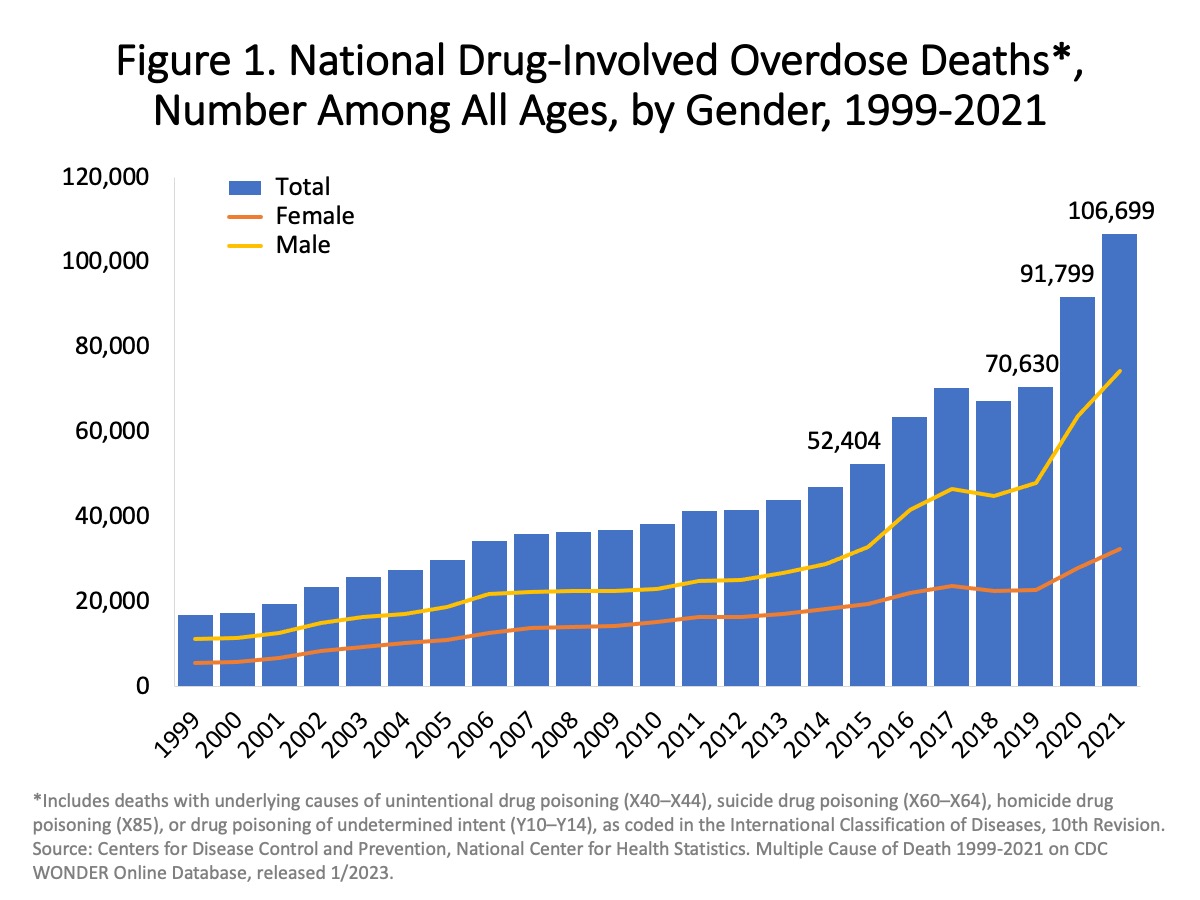
And with drugs, I am admittedly not sure of the long term historical trend, but over the past decade or so, things have gotten substantially worse:
https://nida.nih.gov/research-topics/trends-statistics/overd...
https://nida.nih.gov/sites/default/files/images/2023-Drug-od...
Huh? Oh my God yes it did. Cities in the 1980s were dystopian nightmares compared to today.
As a Texan who has relatives all over the U.S., and has been paying a good deal of attention to the frequency of power outages when in Texas, vs out of state, I dare say, Texas is doing something right, that winter incident notwithstanding. When I compare outages I've experienced to what I experience when I travel out of state, in most cases, other states have more frequent outages, with longer resolution times. Texas, in particular, went the direction they did in isolating themselves from the National Grid in large part due to the gain in resilience of their resulting grid becoming loosely coupled to other State's grids/cascading problems.
From a Systems point of view as well, the Texas grid is smaller, and stands a much better chance of being reasoned through once the chips are down. Even during the winter crisis; the power company still managed to make sure that the service area (divided into 4ths) got at least a 1/4 hour uptime to allow people to maintain some semblance of heat. Most of the worst stories amongst my peer group, came from people working in the cities, Austin in particular being a nasty piece of work.
Austin Power apparently had their emergency (non-load shed) trunk shared by many of the skyscrapers and office buildings dowm town, meaning that when it came time to load shed, you'd have entire blocks of residential area dark, but at no point did the 15+ story office buildings that people were very pointedly told not to go to deprived of either power or heat. It didn't help there wasn't a native Texan on the Public Utility Commission (ERCOT regulator), one of those on it was caught on a hot mic assuring Wall Street that their gains in terms of spiked energy prices would not be clawed back in any way by the state, and any efforts to do so he'd obstruct.
Texas has it's slieu of issues, many self-inflicted, most knowingly; however that doesn't detract from the point posited by the headline. Systems of greater complexity by definition will have higher demands on the competency of those operating them. Less population growth means fewer cranks on the slot machine that in time produces competent system operators.
And no, immigration doesn't fix it if the working migrants are still primarily invested in funneling capital elsewhere. In fact, it may be arguably deleterious if there's a glut in the number of short-term "oh well, this is a bad idea, but I'm not gonna have to deal with the long term consequences" types that are willing to just say "yep, okay, fine."
It's an ugly problem to even think about, let alone talk about/come to terms with in any meaningful way. Hell, I've tried to phrase my ciew of it uncontroversially as I can, but even I can point to at least two or three things that would instantly be perceived as dog whistles/intellectual stop points in certain circles. ... And I'm not even sure we've covered the full problem space yet!
Totally with you on the 737 MAX and McDonnell Douglas angle though!
Really? As fewer people than ever are dying in plane crashes. Medical malpractice claims are declining. There are far fewer errors in banking, communications, convictions, far fewer deaths in fires (and fires in general). There are certainly some things getting worse such as homelessness and drug addiction, but most things have dramatically improved over the past generation.
It is great to have anecdotes, but you need to demonstrate that reliability is declining in some numerical way, as "increasing regularity" is by definition somehow numerical.
> Following three completely avoidable collisions of U.S. Navy warships in 2017 and a fire in 2020 that resulted in the scuttling of USS Bonhomme Richard
The US Navy has a pretty lengthy record of hitting things, losing boats to stupid, and killing its sailors for want of training.
Is it all that unusual for the US armed forces to lose dozens of people in accidents a year? Admittedly anecdotal from Wikipedia reading, but it doesn't seem to be so.
> Recently, the tremendous U.S. record for air safety established since the 1970s has been fraying at the edges.
A bunch of people have died due to ATC failures between now and the 1970s.
https://en.wikipedia.org/wiki/2005_Logan_Airport_runway_incu...
https://en.wikipedia.org/wiki/United_Express_Flight_2415
https://en.wikipedia.org/wiki/Los_Angeles_runway_disaster
It is obviously not good that these incidents have happened, but they are not exactly new. The "tremendous record for air safety" still has a lot of bodies attached to it.
> Shortly after releasing the 737 MAX, 346 people died in two nearly identical 737 MAX crashes in Indonesia and Ethiopia.
Exactly as many people died when McDonnell Douglas (the real predecessor to Boeing in terms of organizational culture) cut corners on cargo doors. Boeing corporate ethical challenges are not new if you consider MD.
https://en.wikipedia.org/wiki/Turkish_Airlines_Flight_981
Airline manufacturers killing people due to being sloppy is not new. They are arguably killing the fewest flyers per capita in history.
> The modern U.S. is a system of systems interacting together in intricate ways. All these complex systems are simply assumed to work. In February of 2021, cold weather in Texas caused shutdowns at unwinterized natural gas power plants. The failure rippled through the systems with interlocking dependencies. As a result, 246 people died. In straightforward work, declining competency means that things happen more slowly, and products are lower quality or more expensive.
That is not lack of competency at all. That is a deliberate choice by Texas to not spend extra money on a resilient system. They deliberately keep their grid disconnected from the rest of the USA so they do not need to comply with Federal standards. Texas is well aware of the issues. They just prefer the free market with cheap power.