When they were trying to sell the new mac pros as AI/ML devices they underlined a lot the technical specs of those Macs. Or when they introduced Retina displays they all went into PPIs and pixel numbers. Or when they introduced M1s to show the performance and wattage boosts.
But in general, it's much more nuanced. I have both a desktop with a Ryzen 7700x and a mac book pro m2, my coworker has a 13900k and a m2 max, the performances aren't really always comparable.
There's many tasks where you are looking at a much less capable machine. Compiling and IDE performances are still way better in general on x86 linux than a notebook macos. You may not care about that 0.5second more lag every time you save and EsLint reprocesses your entire file, and the watcher restarts some application after and you're looking at 5/6 seconds instead of a couple. I do.
There's no doubt that Apple produced a great CPU, but when you get into considering costs and performance there's still a huge lag. There's no doubt that the crown on laptops is in Apple hands right now. That's not every use case out there.
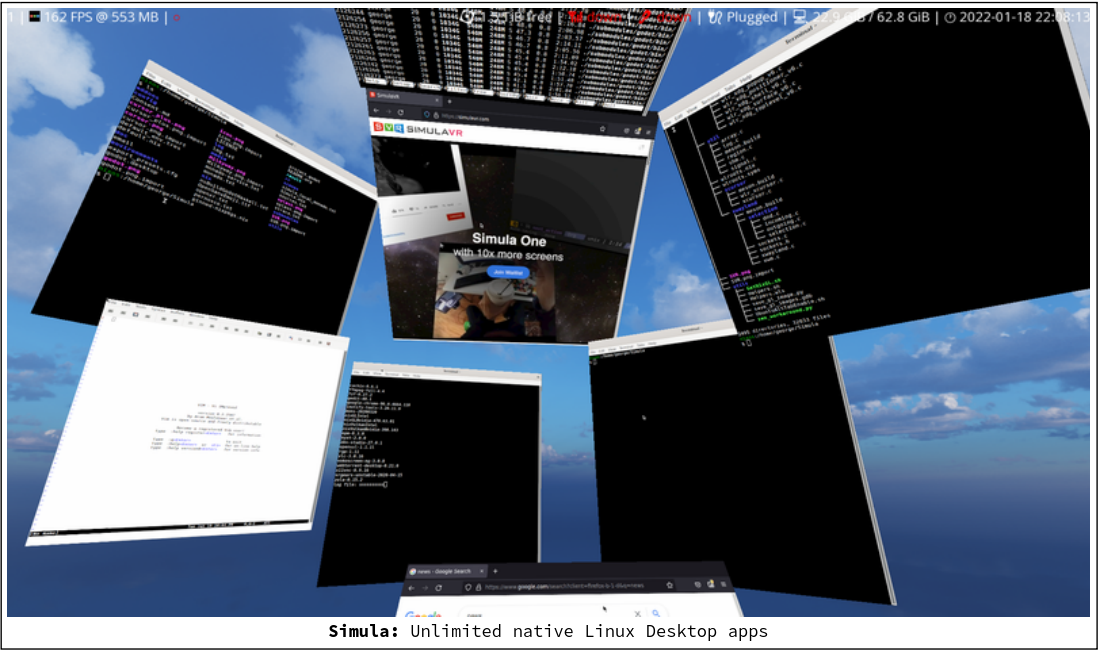
Also, this -- https://www.wolframcloud.com/obj/george.w.singer/simula/png/... -- is the "year of the linux desktop" of VR. I imagine someone wants that, but no.
This opinion is deeply subjective. I have a Varjo Aero, and I can use it as a daily driver (for productivity), no problem. The Vison pro looks to be lighter... and so would have better ergonomics.
Notice, I don't even mention eye strain... because I personally don't experience any.
The problem with the Varjo Aero is that's it's a cord-tethered headset which needs to be attached to a powerful GPU. It doesn't run Linux Desktop natively (nor even when attached to a host) since it doesn't have Linux support. So in our opinion it doesn't actually replace a laptop, which we're taking as the "holy grail" of VR computing.
If Simula VR had been shipping on January of 2022, I would have ordered it over an Aero.
If simulaVR were in stock and shipping today, I would sell my Aero at a loss and place an order.
I honestly do have my fingers crossed that by the time the SumulaVR is in stock and shipping I still feel the same.
right now the problem with SimulaVR is that I can not buy it.
Anecdotally I've worn the Oculus S for extended periods and didn't notice any eyestrain, but also "extended periods" obviously wasn't a full workday so can't be too confident yet.
This is not a controversial take. Yes, there are tech bros who will insist that this is all fine, but the actual feedback from the majority of the population is that extended wear of pretty much all VR helmets anyone has bothered to look at causes the same eyestrain issues.
There are always people who will put up with discomfort or for whom the discomfort is relatively lower (or they are younger and it is less of an issue), but these products are not going to replace monitors. Resolution is not the only issue, just the one that is most notable when you first put the helmet on.
In addition, the weight of the helmets is an issue. Extended wear is a problem and one of the few notable, repeated comments from the carefully-managed 30-minutes-max Apple Vision Pro demos is that the weight started to get annoying. Seated demos under 30 minutes.
There's also VAC ( https://en.wikipedia.org/wiki/Vergence-accommodation_conflic... ) as an issue depending on the UI in use.
I want VR to happen as much as anyone, but the Vision Pro is an entertainment-light device for media consumption with a nod for people who want to check their laptop (and I'm sure, eventually, their phone or tablet) while watching faux-bigscreen movies.
>Critique #2: The Vision Pro seems to be built on top of Apple's iPad/iPhone ecosystem, which could hinder it from becoming a true PC/laptop replacement.
These are both indicators and flexes of Apple's strengths. Apple doesn't want to tell users what the hard specs are on their headset. Not because they're trying to deceive the user, but because they don't want the user to care. They don't want the experience to be hampered by comparisons to other products or considerations of "how real" the experience can be. They want it to be it's own experience. An experience where the conversation isn't ever "Which programs can I run on this..." or "how fast does it go?" because it's holistic. A big confirmation of this is how often Apple compares its products to their predecessors instead of competitor products.