BTW I don't think many people were actually predicting 6 degrees so this is a bit academic. 6 degree rise sounds more like the IPCC's discredit "business as usual" RCP8.5 scenario. Most models predict a linear-ish trend of about 0.25C per decade, as you'd expect given their underlying premise that warming is all driven by CO2 and CO2 increases more or less linearly:
https://www.drroyspencer.com/wp-content/uploads/CMIP5-90-mod...
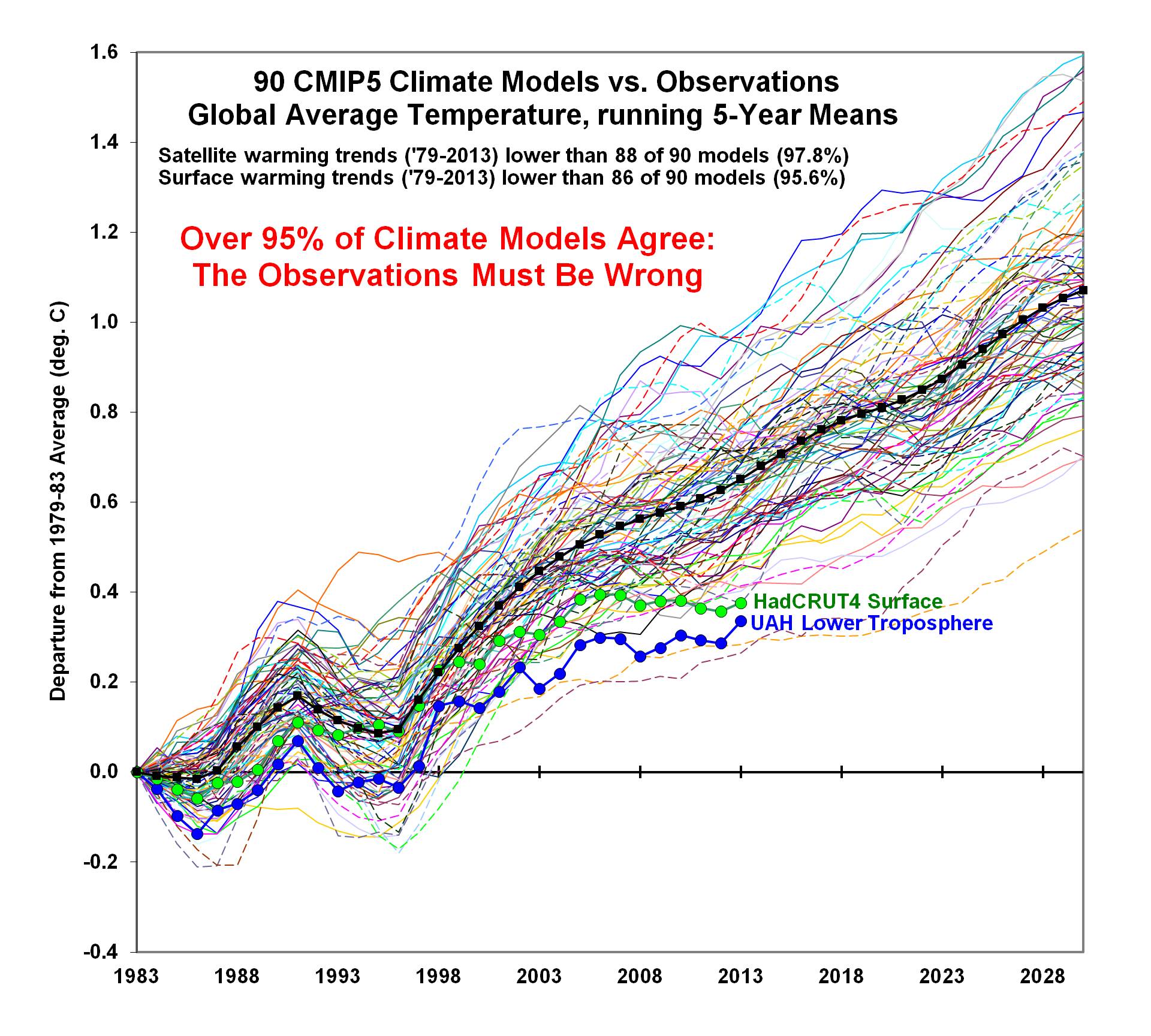
the predictions weren't based on a "perfectly understood relationship", but yeah, they're assuming we didn't do anything, and we did stuff, in order to reduce that number, and succeeded
so what's off base?
I pull this part out because it's key to so many of the disputes and is why climatology is such an incredibly divisive field compared to others. People who call themselves scientists should not be making high confidence predictions to the public or politicians when they don't perfectly understand the underlying relationships. They also shouldn't be making unfalsifiable predictions that rely on vague claims. This is what destroys trust in science.
For the rest I can only repeat what was already said. In reality nothing has been done. Look at the CO2 line and then mark on the various international summits, treaties, etc. They aren't visible. Nothing changed.
that is an interesting opinion, but it doesn't seem to make a lot of sense, considering nobody perfectly understands the underlying relationships of any of our science, with quantum physics still a work in progress
perhaps that is why trust in science remains, despite any nihilistic claims to the contrary
> Look at the CO2 line and then mark on the various international summits, treaties, etc. They aren't visible. Nothing changed.
it would be farcical to suggest that an international summit would somehow immediately decrease CO2 levels, and to thus treat the absence of such a ridiculous and nongradual change as evidence that there was no change
is that indeed what you're suggesting?
It's like a huge train with tons of momentum hurtling towards a cliff. But every second we're not only pressing on the accelerator we're pushing harder on the accelerator. In other words, we were increasing the momentum of our foot on the accelerator. Over the last twenty years we've stopped pushing that accelerator harder and are just starting to very slightly ease up on the accelerator.
To avoid hitting the cliff we need to let off the accelerator and slam on the brakes. But at least our changes will have a significant impact on the speed we have when we hit the wall.
Anybody looking at the train from the side will be unable to notice tiny differences in rate of change of accelerator depth. But over time that increasing accelerator would have made things a lot worse.
https://mlg.eng.cam.ac.uk/carl/words/keeling.jpg
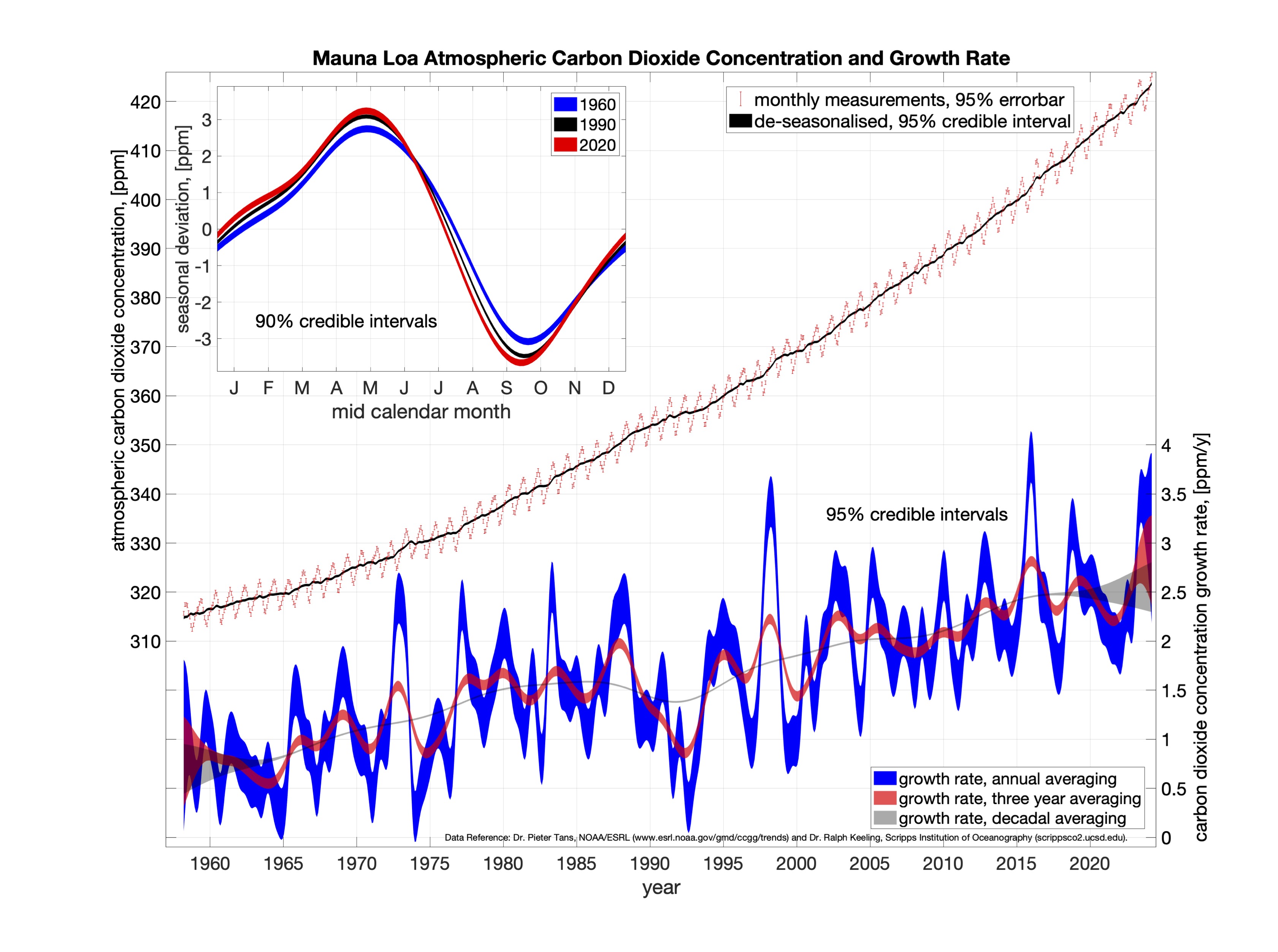
Growth rate is very stable. You could almost put a ruler against the absolute line. As you say, people cannot really "notice tiny differences" on that scale.
The 1st derivative line of the CO2 levels is very noisy (as derivatives almost always are), but it seems to me that it shows a steady increase until it hit a peak in 2015 and now is decreasing. Hard enough to see in the derivative graph and completely impossible to see in the absolute CO2 level graph. So 2nd derivative of CO2 is now finally pointing in the right direction.
And the absolute CO2 level is approximately the first derivative of the temperature. So in other words we've only turned the 3rd derivative of temperature in the right direction. If it stays negative, over time that will eventually turn the 2nd and 1st derivatives. It's time we don't have if our goal is 1.5 degrees, but it's enough time to avoid 6 degrees. Where in the middle will we land?