https://mlg.eng.cam.ac.uk/carl/words/keeling.jpg
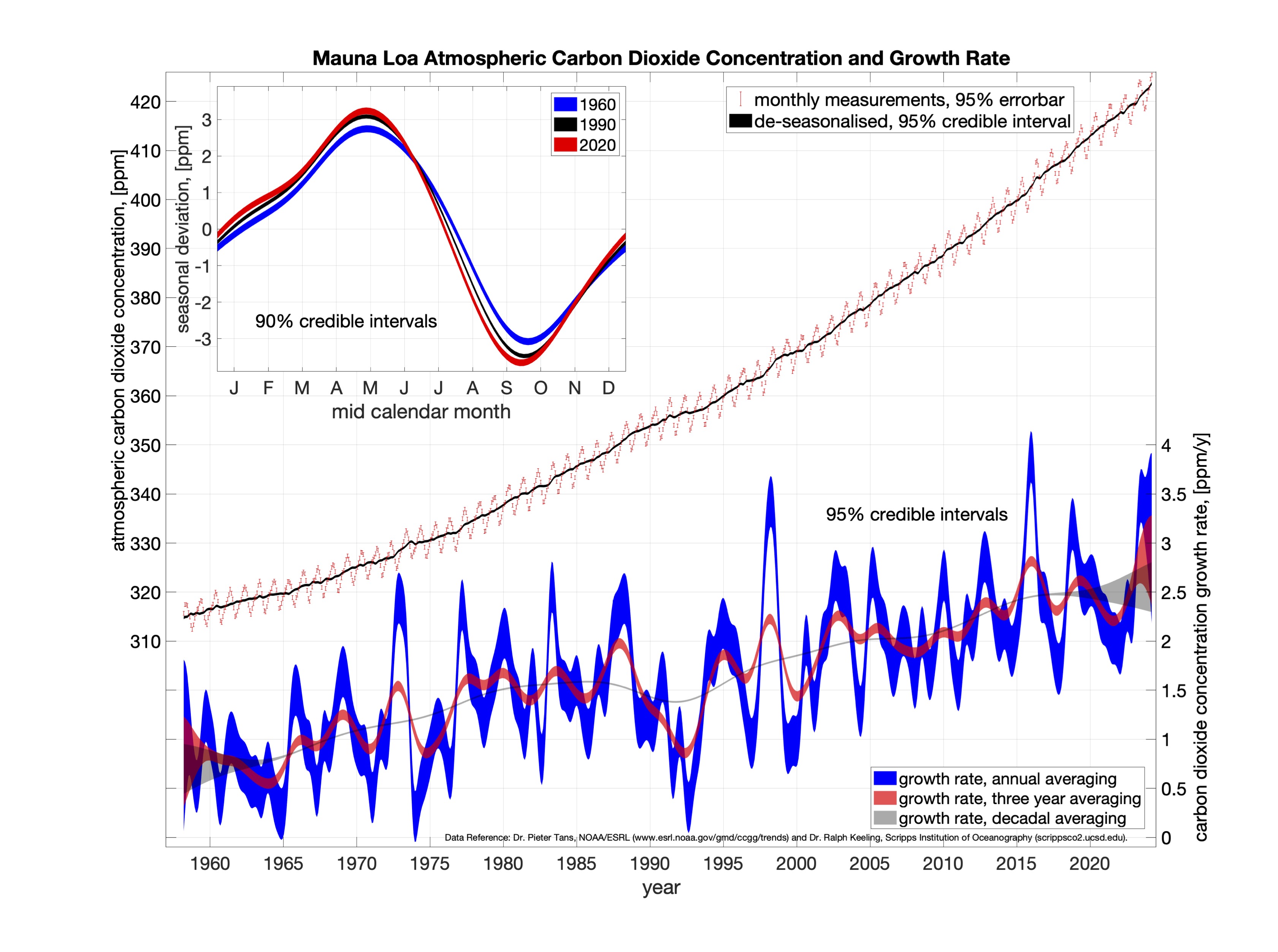
Growth rate is very stable. You could almost put a ruler against the absolute line. As you say, people cannot really "notice tiny differences" on that scale.
The 1st derivative line of the CO2 levels is very noisy (as derivatives almost always are), but it seems to me that it shows a steady increase until it hit a peak in 2015 and now is decreasing. Hard enough to see in the derivative graph and completely impossible to see in the absolute CO2 level graph. So 2nd derivative of CO2 is now finally pointing in the right direction.
And the absolute CO2 level is approximately the first derivative of the temperature. So in other words we've only turned the 3rd derivative of temperature in the right direction. If it stays negative, over time that will eventually turn the 2nd and 1st derivatives. It's time we don't have if our goal is 1.5 degrees, but it's enough time to avoid 6 degrees. Where in the middle will we land?
It's like a huge train with tons of momentum hurtling towards a cliff. But every second we're not only pressing on the accelerator we're pushing harder on the accelerator. In other words, we were increasing the momentum of our foot on the accelerator. Over the last twenty years we've stopped pushing that accelerator harder and are just starting to very slightly ease up on the accelerator.
To avoid hitting the cliff we need to let off the accelerator and slam on the brakes. But at least our changes will have a significant impact on the speed we have when we hit the wall.
Anybody looking at the train from the side will be unable to notice tiny differences in rate of change of accelerator depth. But over time that increasing accelerator would have made things a lot worse.