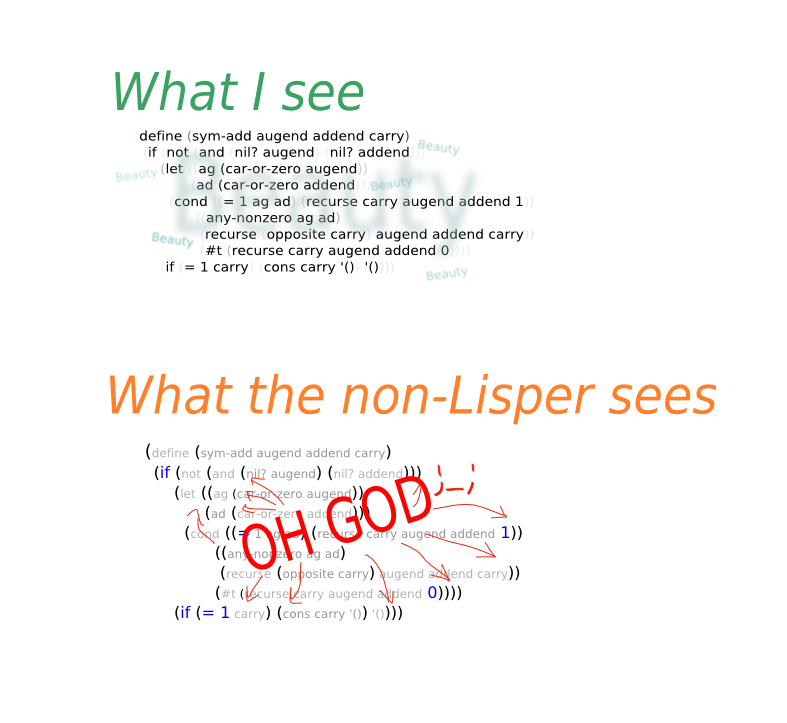
Don't look at the parens and don't stop at the superficial look :]
However I agree with you on some level. Lisp code can easily be written in a way that’s hard to read. Specifically because of nesting expression way more often than is comfortable for me to read. I much rather prefer let bindings and threading so most of the code reads from left to right.
Just know that almost no one STARTS off by liking Lisp-Syntax, but oh boy does it grow on you.
And, the non-Lisp languages tend to have more rat droppings => , ; . etc.
f is a function which takes two arguments, adds them, and returns the result.
Clojure: (def my-var ["hello" 123 (f 10 20)]) -> my-var: ["hello" 123 30]
([""()]) -> 8 noisy characters
JavaScript: const my_var = ["hello", 123, f(10, 20)]; -> myVar: ["hello", 123, 30]
=["",,(,)]; -> 11 noisy characters
Obviously this difference becomes more pronounced with longer argument lists or array element counts.
Every now and then I try to check out a Lisp project and this is my reaction the moment I see the code: https://giphy.com/gifs/seinfeld-bye-jerry-106PwpLIIXJnXi