News for hackers. Stuff that matters.
Re:Relic: Functional relational programming for Clojure(Script) by tmtvl on Sunday February 26, 2023 @06:19PM (#34950789)
I like the structure that S-expressions convey. Must be something with how my brain works. It's probably also why I find Python code utterly unreadable.
Re:Relic: Functional relational programming for Clojure(Script) by brap on Sunday February 26, 2023 @06:25PM (#34950848)
To each their own. There are obviously very smart people choosing Lisp so I’m not trying to knock it down or anything, I just never got the appeal

Every now and then I try to check out a Lisp project and this is my reaction the moment I see the code: https://giphy.com/gifs/seinfeld-bye-jerry-106PwpLIIXJnXi
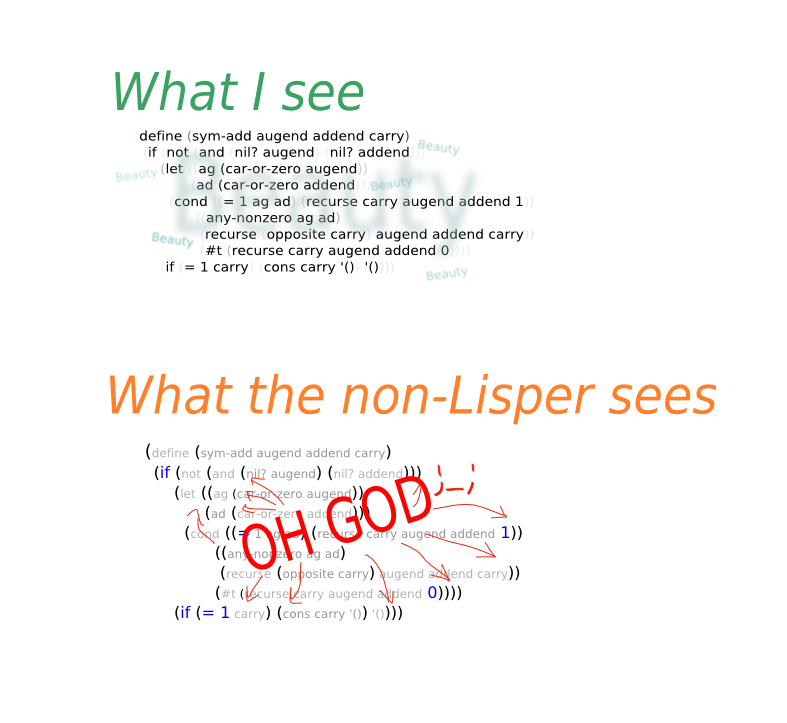
Re:Relic: Functional relational programming for Clojure(Script) by vindarel on Sunday February 26, 2023 @06:53PM (#34951114)
This is what we see: https://raw.githubusercontent.com/tarsius/paren-face/master/...

Don't look at the parens and don't stop at the superficial look :]

Re:Relic: Functional relational programming for Clojure(Script) by dgb23 on Monday February 27, 2023 @03:16AM (#34954205)
For me much of the appeal of the syntax comes from using it with a editor integrated REPL, or when writing macros, or when generating linter configuration from a domain model etc.

However I agree with you on some level. Lisp code can easily be written in a way that’s hard to read. Specifically because of nesting expression way more often than is comfortable for me to read. I much rather prefer let bindings and threading so most of the code reads from left to right.

Re:Relic: Functional relational programming for Clojure(Script) by rawoke083600 on Monday February 27, 2023 @05:37AM (#34954909)
>To each their own. There are obviously very smart people choosing Lisp so I’m not trying to knock it down or anything, I just never got the appeal

Just know that almost no one STARTS off by liking Lisp-Syntax, but oh boy does it grow on you.

Re:Relic: Functional relational programming for Clojure(Script) by michaelteter on Monday February 27, 2023 @07:35AM (#34955664)
In most cases, an imperative example in a curly-bracket language (JavaScript as one example) has the same number of parens and curly brackets as a Lisp has in parens. They're just in different places.

And, the non-Lisp languages tend to have more rat droppings => , ; . etc.

f is a function which takes two arguments, adds them, and returns the result.

Clojure: (def my-var ["hello" 123 (f 10 20)]) -> my-var: ["hello" 123 30]

([""()]) -> 8 noisy characters

JavaScript: const my_var = ["hello", 123, f(10, 20)]; -> myVar: ["hello", 123, 30]

=["",,(,)]; -> 11 noisy characters

Obviously this difference becomes more pronounced with longer argument lists or array element counts.

Re:Relic: Functional relational programming for Clojure(Script) by Lyngbakr on Sunday February 26, 2023 @06:31PM (#34950903)
I totally agree with this, but my love of Lisps wasn't instantaneous. When it clicked though — which required some effort — and I could appreciate the elegance of the language, I didn't want to use anything else.

Regarding Python, I've always disliked its functional whitespace and OO inclination. Given its popularity, though, I'm clearly a minority!

TL;DR — to each their own.

Re:Relic: Functional relational programming for Clojure(Script) by michaelteter on Monday February 27, 2023 @07:21AM (#34955586)
For me, S-expressions remove a whole layer of stuff to think about and remember. It normalizes everything.

And you get the bonus of being able to construct or parse code from within code, since the structure is so uniform and flat.