In my experience (I am retired from a telecom operator) using a database made applications quite inflexible yet real life implies constant changes in their data model and as a result when there was a "database migration" there was always some information lost.
On contrary Pick databases (MultiValue databases) were very useful.
When a data schema is the foundation of a system, it's often the most difficult thing to change.
I think this is a common mistake. People think their code is what’s important. But it’s the data and how it gets transformed that is the core of most applications.
Example is storing customers address and purchase history in same place, only because they "belong to customer" in a data sense. This is very bad because it leads to entangled architecture where everything depends on everything and you cannot extract truly independent modules. The project implemented like this simply cannot scale beyond a certain size.
So no, data is not important but how it is used.
So - I certainly agree 100% with what you say about keeping thing independent. Maybe I’m just unfamiliar with the terms.
On reflection, I'd also add that I do design systems "data first" however to me this doesn't mean "database first". It's important to think about how data flows through the system, how it gets transformed, and what parts of the system "own" which data.
All of this requires understanding of the boundaries of the various systems that make up the whole, which I think is exactly your point.
*or whatever external system.
If you had to make a guess at how many different pieces of information you have about you in databases for services worldwide (and how many of those are inaccurate, or unnecessary to provide the service), that number would be fairly ridiculous for most people (OOM thousands or tens of thousands).
Taking the address idea - no e-commerce site really needs to store this as a profile item. It needs to be in my browser so I can autocomplete for any shipping form.
The second point I’m making is the same as your last. “How it gets transformed” is often more important to start with than how it is at rest.
Ultimately where I’m coming from is that the flow of data through a system and how it is transformed is actually what’s important. For me that’s taking a “data first” approach, to use your term, but I took the term to mean something different to what you meant.
You are totally right about things like customer info. If you have an email component then that’s where email addresses live. If you have a fulfilment component then that’s where physical addresses live. 100% agree that they don’t belong together, at least not by default.
In fact, I tend to think of entities like customers as just a uuid. The bits and pieces we attach to that uuid depend on the system. But many domain objects should be treated in a very abstract way.
I’m not sure this is widely accepted, but it’s where I got to.
I don’t think there is any particular problem, or solution. Applications get old, assumptions change, the world moves in.
It’s true that our database design became inflexible over time and needed to be hoisted. But so too did our authentication layer (hand built - JaaS - JWT), the UI (AWT - Swing - Web 1.0 - Web 2.0), the deployment model (on prem - cloud - docker), even the API scheme (RMI - soap - rest - graphql).
Any application that lives long enough is going to go through this sort of change. The only constant in all of the above was SQL.
You should just write SQL for the database you are using (e.g. PostgreSQL). Switching databases without changing queries is unrealistic anyways.
I agree with your other points, but I am yet to see a layer above SQL that improves on them enough to justify its additional complexity.
However, SQL is IMO the best of a bad bunch. Most non-SQL databases I've used have been extremely sharp cornered, whether this be via: unpredictable/unbounded worst case performance in pessimal storage cases (RocksDB, Cassandra), various parts of the code where unbounded memory/storage usage is required (Cassandra, Spark, Elasticsearch), extremely low level APIs making it easy to make unobservably (as in, you won't notice it and will eat the pain every read) slow APIs (RocksDB). I'm not saying there's nothing better, but it's probably not an all-rounder.
There are certainly things I don't like about most SQL databases. Few SQL databases are columnar, which is _the_ key to good performance in the 2010s, and native LZ4-style data compression is also not widely used. But for most engineers they solve a lot of problems for you without having to think about them.
I think you are talking about Testcontainers, although it only matches the second part of the comment (can manage different external moving parts in containers for integration tests): https://www.testcontainers.org/
I'd be interested in seeing an embedded Postgres library; I only see H2 and maybe Derby being used for tests and "getting to know the ropes" use cases, eg. a default install.
So on one hand, most of the times people are doomed to re-invent an ORM.. poorly. On another, if you don’t have people knowing behind the scenes using “a proper ORM”(tm) they will roll mud around, and if you do have people knowing, most will object ORM in the beginning and start, over time, to roll their own. Overall, there must be a thin line where one should walk on, but it’s unclear exactly where since it’s highly project-specific.
SQL is composable through views, CTEs, temp tables, and set-returning functions. It's a set-oriented language, so its composability is going to be based on sets, not the constructs in your favorite general purpose programming language using a completely different paradigm. Just because that's unfamiliar to you doesn't deny its composability. Impedance mismatch.
Regarding syntax, the best "solution" I've seen are query builders that put the FROM first but fail to fully implement the full range of functionality available to an engine, mostly due to catering to the lowest common denominator of functionality. (Looking at you, MySQL!)
This "I hate the syntax" is generally a petty argument. No popular multiuser database allows direct access to its internals, but I don't see Cypher or Mongo's QL getting anywhere near the same level of critical scrutiny SQL gets, and it's not due to their clarity, elegance, or comprehensiveness. You simply want a functional (or OO or whatever) syntax model, and it's not gonna happen because the problem SQL is solving doesn't match up. Impedance mismatch.
Unit testing: https://pgtap.org/ https://sqitch.org/docs/manual/sqitch-verify/ https://learn.microsoft.com/en-us/sql/ssdt/creating-and-defi...
SQL linters suck, I'll grant you that one. At least the syntax and error highlighting is there for good editors like DataGrip, but folks have a hard time accepting a universal style guide for their SQL though it's sorely needed along. Most folks just cobble together stuff with haphazard newlines and spacing then complain about how no one can read each others' SQL.
Wait… you're pissed there's a different set of keywords for generation and modification of structure vs generation and modification of data? You think… they should be the same… because… you think they're related?
> Plus, it's not very readable.
Ever notice how someone in every thread on every language says, "I hate the syntax. I think it should look like <insert personal favorite language>." Just accept that your difficulty with the language is a personal preference or reflection of your familiarity with it, not some kind of objective fact. It's like claiming Chinese is less understandable than English when you were born and raised in London.
> …when you discover yet another edge case of your query planner…
That's not SQL's fault. Any query language would do this. If you had to write accessors by hand such as for DynamoDB, you'd find that the original algorithm you wrote is no longer effective because the dataset you're querying got much larger. Fix your indexes, vacuum, and reset statistics. Stop blaming your tools.
You don't like SQL? That's fine. But that hatred is also not universal. I and many other folks LOVE SQL. That isn't to say it's flawless or cannot be improved. But most folks always seem to focus on those aspects that probably don't matter as much, missing the relational forest for syntactical trees.
"Beware the old man in a young man's game. He is always much more capable than he seems."
There is a proverbial consensus that written Chinese is very difficult to understand [0, 1]. It is a supremely challenging script. A well educated Chinese person can conceivably encounter words in a written text that they know the meaning of but they cannot understand or verbalise without consulting a reference book.
[0] https://en.wikipedia.org/wiki/Greek_to_me
[1] https://flowingdata.com/wp-content/uploads/2015/04/Greek-to-...
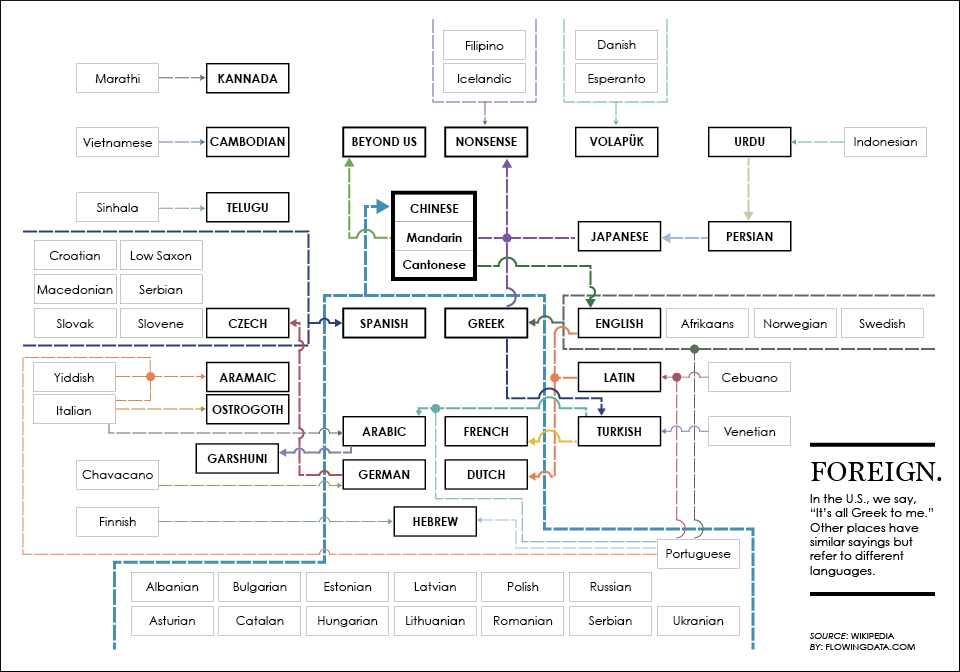
Whereas in English, a well-educated American can (and does) conceivably encounter words in written English that they neither know the meaning of, understand, or pronounce correctly without consulting a dictionary.
Hell, English pronounces the exact same written words in wildly different ways as well as multiple words spelled differently but spoken identically to the point that a non-trivial part of the written language is merely memorized rather than learned.
But we learned English when we were young, so I guess it seems "normal" that "Buffalo buffalo Buffalo buffalo buffalo buffalo Buffalo buffalo" is a grammatically correct sentence.
https://en.wikipedia.org/wiki/Buffalo_buffalo_Buffalo_buffal...
Or how animal poops can have so many semantic meanings.
Tables are just sets of records. Nothing more. Nothing less. SQL references tables as sets of records, but JOINs are referential subsets of tables, not complete tables themselves. And LATERALs may not even have a table underneath at all! Same with set-returning functions. generate_series(…) doesn't have any table under the covers; it's purely a dynamic set of values generated on the fly.
It's turtles all the way down.
As for duplicates, that's up to your defined constraints to sort out. You're right that SQL DML knows nothing about whether the underlying set of records contains duplicates. The DDL however can trivially define a set of records to have no duplicates based upon varying conditions/attributes.
Whether a set is ordered or not or has duplicates are not has no bearing whatsoever on whether the data is set-oriented or not.
I'll take SQL over almost any language used to write the "application layer" any day...
Also, why do you think that databases solved problems with disks? Do you mean disks as in block devices? If so, none of the popular databases ever touches that level, most popular SQL databases work with filesystem.
It’s a pretty shit language — its just the only one we get to have, and the value of what it interfaces with (the RDBMS itself, ACID and the relational algebra) is… invaluable. You can’t get away with not knowing it, and it’s generally dumb to avoid it (because you’re then avoiding the glory behind it) but as a language it’s basically COBOL-tier.
Stored procedures?
> lacks type safety
How so? Can you give some examples? I have no idea what this is even about.
> you have to codegen your statements
Never happened to me. Not in any capacity that I would feel like this was a burden. The only cases where I needed to generate SQL code were some fuzzing tests intended to figure out problems with database performance, s.a. feeding a bunch of generated SQL to pgbench to see what may cause the database to slow down / use too many resources. This seems very strange in an application that is simply using SQL database rather than trying to do something weird with it (eg. testing performance). SQL is a very high-level language, which means you don't need to do as much code generation compared to, say, Assembly or even Java.
I do see that people do this when they use ORM, but this is a self-inflicted pain. They shouldn't have been doing ORM to begin with.
> get worthless compiler errors
From what? Are you talking about writing SQL functions (eg. in Java) and then using them from SQL (eg. Oracle)? This doesn't sound like a SQL problem, more like Java compiler problem... But, yeah, I can see how this is a complication and an inconvenient thing to do, so, if that's what you mean, I'm generally with you on this one. Well, I think that the benefits are still worth doing this.
> whole tooling support is reverted to the 80’s.
Again, I don't see the connection. But, even if it was so... what's the problem? You get to work with an old and reliable technology, with decades of knowledge and experience to support it. And it's not like it died in the 80's. Tons of effort is being invested into this technology, it's amongst the first to get updates and integrations with new hardware and system capabilities (eg. vectorized ISAs support, even GPU access, bet you that when "smart SSD" become common enough, SQL databases will be the first to support them). What's not to like? This is like complaining about C compilers for being "old tech"... for all that's wrong with C (compilers), being old is not one of those things.
> It’s a pretty shit language
If you were honest, you'd write it like this: "I don't like it". And, well, you are allowed not to like whatever you want. It's subjective, and completely up to you. It just has less of a convincing power. But, really, this is your entire argument...
    • "Exactly one"
    • "Optional"
    • "Text but matching this pattern"
    • "A 16-bit integer from 1 to 1000"
    • "Many to many without any duplicates"
    • "A unique combination of id and a time range"
• "This field can be NULL but only if this other field is NOT NULL"Maybe inconvenient, but not impossible... but if this is the kind of problem you have, then, try in your favorite language to create integers that are 63 bit long or 65, and see how it goes? Looks like the comparison won't be in that language's favor.
Trying to use it to store the full range of unsigned values would mean awkward math everywhere, to convert between the two ranges.
Lots of software uses uint64s, for e.g. as identifiers handed out by some API, and not being able to store them conveniently definitely hurts.
Now explain why you need an unsigned bigint in this set-oriented language. What's your use case?
That said, not a limitation of SQL, just Postgres, who avoided it for similar maintenance and interoperability issues that Java avoided them. MySQL supports unsigned bigint just fine. There is nothing in the SQL spec that forbids unsigned integer values.
• views • CTEs • temporary tables • set-returning functions
It will not compose like an OO language or like a functional language because it isn't one of those. It's set-oriented. This is the biggest hangup I've seen from folk who hate SQL: mistaking it for something it isn't, never was, and was never intended to be given its problem domain.
But unfortunately databases have solved common-as-mud problems to do with data, disks, multiple users (which, if your data is worth storing, you will eventually have) and the interactions thereof. It is worth putting up with SQL to get all the lessons of the 70s, 80s, 90s, 00s, 10s and now 20s in how to store data without creating buggy software. People probably have these problems and it is usually faster to solve them the usual way that works. Write some SQL and maul a stress ball, it'll be easier long term.