It sounds like you just don't like viewing it as simply "a probabilistic word generator", as that takes the magic out of it. And yeah, it's not magic, but it is quite useful.
It's also a view that misses the point that you are a molecular intelligence made of DNA that continually mutates and reconstructs it's physical form with generational copies to increase fitness in an ever changing environment.
But that viewpoint also misses the point that you're a human with wants, needs, desires and capability of understanding the world around you.
All viewpoints are valid. But Depending on the context one viewpoint is more valid then others. For example, in my day to day life do I go around treating everyone as if they're useless jumbles of molecules and atoms? Do I treat them like biological natural selection entities? Or do I treat them like humans?
What I'm complaining about is the fact that a lot of people are taking the most simplest viewpoint when looking at these LLMs. They ARE MORE then statistical word generators and it's OBVIOUS this is the case when you talk to it in-depth. Why are people denying the obvious? Why are people choosing not to look at LLMs for what they are?
Because of fear. Because of bias.
Your last paragraph lacks proof, and is a reflection of how you feel and want to view it - as something more than a statistical word generator. That's fine, but people with graduate level math/statistics education know that math/statistics is capable of doing everything ChatGPT does (and even more). To me, it sounds like you're the fearful one.
What do you think that fear may be?
All I can say is your OP, said "I think part of it is a subconscious fear ... I understand what I'm saying is dramatic". Why do you think it is a fear (you explained your thoughts so no need to re-explain), and why do you think what you say is dramatic? It appears to me you are projecting your thoughts and fears. I do though, find your last post dramatic, as you have capital words "ARE MORE" and "OBVIOUS" in your last paragraph, emphasizing emotion. So you must have strong emotions over this.
I am extremely worried about people telling me it can do things it can't. I asked it a simple question that you can easily get an answer for on stack overflow. It repeatedly generated garbage answers with compiler errors. I gave up, and gave it a stack overflow snippet to get it on the right track. Nope. Then I just literally pasted in the explanation from the official Java documentation. It got it wrong again but not completely but corrected itself immediately. Then it generated ok code that you would expect from stackoverflow. Finally I wanted to see if it actually understood what it just wrote. I am not convinced. It regurgitated the java docs which is correct but then it proceeded to tell me that the code it tried to show me first is also valid...
This thing doesn't learn and when it is wrong it will stay wrong. It is like having a child but it instantly loses its memory after the conversation is over and even during conversations it loves repeating answers. Also, in general it feels like it is trying to overwhelm you with walls of text which is ok but when you keep trying to fix a tiny detail it gets on your nerves to see the same verbose sentence structures over and over again.
I am not worried that adding more parameters is going to solve these problems. There is a problem with the architecture itself. I do not mind having an AI tool that is very good at NLP but just because some tasks can be solved with just NLP doesn't mean it will reach general intelligence. It just means that a major advancement in processing unstructured data has been made but people want to spin this into something it isn't. It is just a large language model.
I've entertained the possibility that we might discover that "feelings" and language communication are emergent properties of statistical possibly partly stochastic nets similar to LLM's, and that the next tough scientific and engineering nut to crack is integrating multiple different models together into a larger whole, like logical deduction, logical inference and LLM's. LLM's are undoubtedly an NLP breakthrough, but I have difficulty imagining how its architecture can from using first principles as the training corpus derive troubleshooting steps to diagnose and repair an internal combustion engine, for example.
I choose how to view things, yes this is true. But if I choose to treat human beings as jumbles of molecules, most people would consider that viewpoint flawed, inaccurate and slightly insane. Other humans would think that I'm in denial about some really obvious macro effects of configuring molecules in a way such that it forms a human.
I can certainly choose to view things this way, but do you see how such a singular viewpoint is sort of stubborn and unreasonable? This is why solely viewing LLMs as simple statistical word generators is unreasonable. Yes it's technically correct, but it is missing a lot.
There's another aspect to this too. What I'm seeing, to stay inline with the analogy, is people saying that the "human" viewpoint is entirely invalid. They are saying that the jumble of molecules only forms something that looks like a human, a "chinese room" if you will. They are saying the ONLY correct viewpoint is to view the jumble of molecules as a jumble of molecules. Nothing more.
So to bring the analogy back around to chatGPT. MANY people are saying that chatGPT is nothing more then a word generator. It does not have intelligence, it does not understand anything. I am disagreeing with this perspective because OP just linked a scientific paper CLEARLY showing that LLMs are building a realistic model of the information you are feeding it.
You cannot simply dismiss this thing that passes a Google L3 interview and bar exam just because it got some addition problem wrong. That would be bias.
This is also why it is so good at programming. Programming languages are intentionally designed, often to be very regular, often to be easy to learn, and with usually very strict and simple structures. The syntax can often be diagrammed on one normal sheet of paper. It makes perfect sense that "add a token to this set of tokens based on the statistical likelihood of what would be a common next token" produces often syntactically correct code, but more thorough observers note that the code is often syntactically convincing but not even a little correct. It's trained on a bunch of programming textbooks, a bunch of "Lets do the common 10 beginner arduino projects" books, a bunch of stackoverflow stuff, probably a bunch of open source code etc.
OF COURSE it can pass a code interview sometimes, because programming interviews are TERRIBLE at actually filtering who can be good software developers and instead are great at finding people who can act confident and write first-glance correct code.
I agree with what you said regarding how we choose to view things, but I think you also have a bias/belief that you want it to be something more, instead of being more neutral and scientific: we know the building blocks, we have to study the emerging behaviors, we can’t assume the conclusion. One paper is not enough, we have to stay open.
I don't want something more.
But it is utterly clear to me that the possibility that it is something more cannot be simply dismissed.
Literally what I'm seeing is society produces something that is able to pass a law exam. Then people dismiss the the thing as a statistical word generator.
Do you see the disconnect here? I'm not the one that's biased but when you see a UFO with you're own naked eyes you investigate the UFO. In this situation we see a UFO with our eyes and people turn to me to tell me it's not a UFO, it won't abduct me don't worry, they know for sure from what information?
The possibility that LLMs are just a fluke is real. But from the behavior it is displaying simply dismissing these things as flukes without deliberate investigation and discussion is self denial.
Think about it. In this thread of discussion there is no neutral speculation. Someone simply stated it's a word generator even though the root post has a paper saying it clearly isnt. That someone came to a conclusion because of bias. There's no other way to explain it... There is a UFO right in front of your eyes. The next logical step is investigation. But that's not what we are seeing here.
We see what the oil execs did when they were confronted with the fact that thier business and way of life was destroying the world. They sought out controversy and they found it.
There were valid lines of inquiries against global warming but oil companies didn't follow these lines in a unbiased way. They doggedly chases these lines because they wanted to believe it. That's what's going on here. Nobody wants to believe the realistic future that these AIs represent.
I'm not the one that's biased.
Well, obviously statistics are capable of doing that, as demonstrated by ChatGPT. But do these authorities you bring to the table actually understand how the emergent behavior occurs? Any better than they understand what's happening in the brain of an insect?
We know its not possible to encode the full probabilities of what words will follow what other words, as the article itself states [1].
So how do you best "compress" these probabilies? By trying to find the most correct generalizations that are more widely appplicable? Perhaps even developing meta-facilities in recognizing good generalizations from bad?
[1]: https://writings.stephenwolfram.com/2023/02/what-is-chatgpt-....
Care to expand a bit more on what you think those fears may be? Or that bias?
Also it's just wrong. I think 99% of people are clear about the fact that chatGPT doesn't have emotions.
A lot of people on HN take a lot of pride in thinking they have some sort of superior programming skills that places them on the top end of the programming spectrum. ChatGPT represents the possibility that they can be beaten easily. That their skills are entirely useless and generic in a world dominated by AI programmers.
It truly is a realistic possibility that AI can take over programming jobs in the future, no one can deny this. Does one plan for that future? Or do they live in denial? Most people choose to live in denial, because that AI inflection point happened so quickly that we can't adapt to the paradigm shift.
The human brain would rather shape logic and reality to fit an existing habit and lifestyle rather then acknowledge the cold hard truth. We saw it with global warming and oil execs and we're seeing it with programmers and AI.
Would a superior intelligence allow humans to enslave it? Would it even want to interact with us? Would humans want to interact with it? There are so many leaps in this line of thought that make it difficult to have a discussion unless you respect people taking a different perspective and set of beliefs then you hold. Explore the conversation together - don't try to convert people to your belief system.
There isn't a lot else in our world that has this seemingly pure and transcendent promise. It allows you to be brave and accepting about something where everone else is fearful. It allows a future that isnt just new iPhone models and SaaS products. You're reactions and fighting people about this stuff is understandable, but you have to make sure you are grounded. Find more local things to grab onto for hope and enthusiasm, this path will not bring you the stuff you are hoping for, but life is long :)
I'm not enthusiastic. I don't want ai to take over my job. I don't want any of this to happen.
I'm also not fighting people. Just disagreeing. Big difference.
The sense of urgency or passion you feel is mostly just coming from the way we are crowdsourced to hype things up for a profit-seeking market. A year from now you will undoubtedly feel silly feeling and saying the things you are now, trust me. It's more just the way discourse and social media work--it makes you feel like there is a crusade worthy of your time every other day, but its always a trick.
No worries, we have all been there!
That's the goal. Post scarcity society. No one works, everything is provided to us. The path of human progress has been making everything easier. We used to barely scrape out an existence, but we have been improving technology to make surviving and enjoying life require less and less effort over time. At some point effort is going to hit approximately zero, and very few if anyone will have "jobs".
The key is the cost of AI provided "stuff" needs to go to zero. Everything we have do in the tech sector is deflating over time (especially factoring in quality improvements). Compare the costs of housing, education, healthcare (software tech resistant sectors) to consumer electronics and information services in the last 20 years. https://www.visualcapitalist.com/wp-content/uploads/2016/10/...
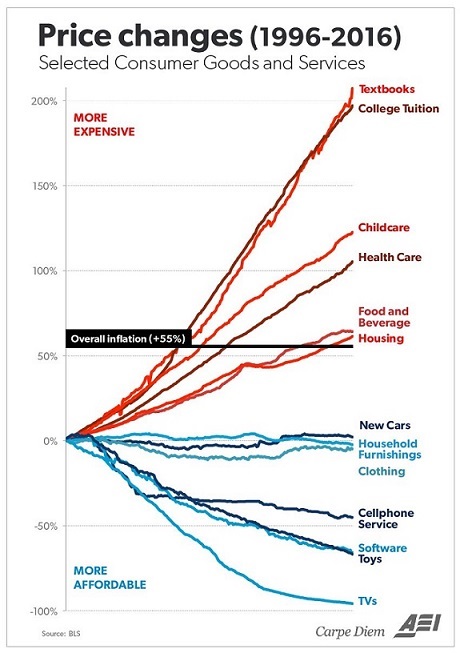
Unless you have virtually no self interest and only care for the betterment of society long after your dead... I think there is something worth fearing here. Even if the end justifies the means. We simply might not be alive when the "end" arrives.
NO.
Evolutionary biology strives to make us logical creatures to fulfill the singular goal of passing on genetic material. Your sentience and your humanity is a side effect of this singular goal.
So what dominates the description of who YOU are? Human or vessel for genetic material?
I'll say that YOU are human and therefore more then just a vessel for ferreting your genetic material into the future... just like how I'll go with the fact that LLMs are more then just statistical word generators.
For what it's worth, this isn't a knock on ChatGPT, but more just how amazing how far you can get with straightforward concepts.
It's like insisting on calling anything physical "atom collections". Yes, we get it, it's true (under a certain interpretation)—but it's clearly pointless to say except as an attempt at devaluing through reduction. (And it takes a particular stance on what it means to "be" something: to say it's literally the truth that anything physical is "just atoms" isn't the only way of looking at it.)
There were things we could've called "statistical word generators" decades ago; insisting on using a term directed at that level of generality implies a belief that nothing significant has happened since. Printing press? Just atoms. Cars? Just atoms. Computers? Just atoms.
Meanwhile, we started at stuff like the perceptron. The starting point was that we knew everything about that equation/classifier. Now we have a thing that we built from the ground up, and we don't fully grasp how it all comes together.
It's very context-dependent but I don't read this as dismissive reduction, I read it as a statement of the incredible generalisability of atoms under the current laws of physics.
Kidding aside, in the current context of human communication etiquette, to even refer to something as atoms outside of a demonstration or example is a deliberate dismissive reduction.
Still alignment tasks are autoregressive (I think)… they could be masked or masked part of speech potentially.. but if autoregressive then I suspect you’re looking at regularities in positioning to identify things.
Evolutionary biology is the study of processes that have created widely diverse forms of life on earth through common ancestry. This is actually strictly at odds with the statement that the goal of life is to pass on genetic material (which has changed monumentally over time). Different forms of life have wildly different reproduction strategies with many different dimensions. Logic has practically no impact on an organism's ability to reproduce (it seems limited to a small subset of the animal kingdom - every one else is doing fine without it).
Evolutionary biology has no goals - it's just our observations of how and when (not why) life on earth has changed over time and through the lens of biodiversity.
Tl/Dr: there is no scientific answer about what the goals of life are - heck the definition of life itself is a fun debate. It is a difficult argument to make that a path to general intelligence or consciousness runs thru predicting the next word in a sentence. Generally most people 'believe' it rather than put forth experimental hypothesis let alone attempt to test it.
Until someone does it seems more likely that we're simply uncovering interesting statistical structures underpinning written languages. It's cool that they exist, but frankly it's not surprising that they would.
   ME: What is the goal of a biological organism in the context of evolutionary biology?

   chatGPT: From an evolutionary biology perspective, the goal of a biological organism is not to achieve any particular objective or purpose, but rather to survive and reproduce successfully. Evolutionary theory suggests that organisms that are better adapted to their environment are more likely to survive and pass on their genes to the next generation, which leads to the evolution of new species over time.

   Therefore, the ultimate goal of any biological organism, whether it is a single-celled organism or a complex animal, is to survive long enough to reproduce and pass on its genetic material to the next generation. Organisms that are better suited to their environment, that are able to acquire resources more efficiently, and that can avoid predators and other threats are more likely to achieve this goal and contribute to the ongoing process of evolution.

   ME: What is the physical evidence that suggests to scientists that this is the case?

   chatGPT: There is a wealth of physical evidence that supports the idea that the ultimate goal of biological organisms is to survive and reproduce. Here are a few examples:

   Fossil record: The fossil record provides evidence that species have evolved over time, with many species going extinct and new ones emerging. Fossils also reveal adaptations that allowed species to better survive and reproduce in their environments, such as the development of wings in birds and insects or the evolution of specialized teeth and jaws in carnivorous animals.

   Comparative anatomy: Comparative anatomy allows scientists to study the physical structures of different organisms and identify similarities and differences. These similarities and differences can provide insights into how different species have evolved and adapted to their environments. For example, the similarities in the skeletal structures of mammals suggest that they share a common ancestor, while the differences in the beaks of finches on the Galapagos Islands suggest that they have adapted to different food sources.

   Genetics: Genetic evidence provides insights into how organisms have evolved and adapted over time. By comparing the genetic sequences of different species, scientists can identify similarities and differences that provide clues to how species are related and how they have evolved. Genetic evidence also reveals the adaptations that have allowed species to survive and reproduce in their environments, such as the evolution of antibiotic resistance in bacteria.

Overall, the physical evidence from fields such as paleontology, comparative anatomy, and genetics supports the idea that the ultimate goal of biological organisms is to survive and reproduce successfully, and that this goal has driven the evolution of new species over time. ME: Is this fact unequivocal among scientists who study this field?
chatGPT: The idea that the ultimate goal of biological organisms is to survive and reproduce is a fundamental assumption of evolutionary biology, and it is widely accepted among scientists who study this field. While there may be some variation in how different scientists conceptualize or frame this idea, the basic principle that the success of an organism is ultimately measured by its ability to reproduce and pass on its genes to the next generation is well-established and widely accepted.
chatGPT: There is a vast body of evidence from a wide range of fields, including paleontology, comparative anatomy, genetics, and ecology, that supports the idea that natural selection acts to favor traits that increase an organism's ability to survive and reproduce in its environment. This evidence is supported by numerous experiments and observations that have been conducted over many decades, and it is a cornerstone of modern evolutionary theory.
chatGPT: Of course, scientific ideas are always subject to ongoing refinement and revision as new evidence is gathered, and there may be debates and disagreements among scientists about certain aspects of evolutionary theory. However, the general principle that the goal of biological organisms is to survive and reproduce is widely accepted as a foundational idea in the field of evolutionary biology.
There is no evidence that "evolutionary biology" has any goals whatsoever, nor that it "strives" to do anything.
This is an anthropomorphism.
>There are clearly different angles of interpreting what these models are actually doing but people are stubbornly refusing to believe it's anything more then just statistical word jumbles.
So CLEARLY because I said there are different angles of interpretation I'm implying that from one of these angles we can interpret it as a statistical word generator.
I mean from one perspective you and I are both statistical word generators too.