News for hackers. Stuff that matters.
Re:The Grapes of Wrath was banned in the USSR because showed... by chii on Thursday January 19, 2023 @10:15PM (#34448756)
> had very little to do with the different economic models, but with the completely different situation of the two countries.

but both germany and japan had great recovery, despite also having lost a lot in the war due to bombings and population deaths.

The difference is the economic system - USSR always felt that they're under threat from western powers, and devoted a lot of work in heavy production (which translates to military production), and very little civilian production. And even technological growth was kept militarily separate - e.g., they actually had computing but did not "give" that tech up for civilian use, after expending the R&D on it.

Mean while, the US's defence spending on R&D does spill over into civilian use (often due to profit seeking motives, but still this produces good results). Like the internet, GPS, etc. The thing is that centrally planned economies means those that aren't "central" to the planner's mind will be forgotten. But everyone in the country is important in reality - so those who get forgotten will decline.

Re:The Grapes of Wrath was banned in the USSR because showed... by pessimizer on Thursday January 19, 2023 @10:26PM (#34448831)
The difference was the the US poured money into (half of) Germany and (all of) Japan and took complete control, up to and including the point of actually writing Japan's constitution.
Re:The Grapes of Wrath was banned in the USSR because showed... by rayiner on Thursday January 19, 2023 @10:54PM (#34449037)
It wasn’t that much money. It invested about $18 billion inflation adjusted dollars into Japan from 1946 to 1952. By contrast it has invested $145 billion into Afghanistan, a country with half the population Japan had back then.
Re:The Grapes of Wrath was banned in the USSR because showed... by woodruffw on Thursday January 19, 2023 @11:14PM (#34449171)
This comparison probably doesn't make a lot of sense: the US's reconstruction of Japan is backlit by Japan being an industrialized nation with an educated workforce, in a country with basically no domestic conflict in the century prior to WW2. Afghanistan was and is not industrialized to nearly the same degree, has nowhere near the same degree of educational penetration, and has a long history of domestic conflict in the forms of colonialism and sectarian violence.

In other words: $1 in 1945 Japan goes much further in terms of development than $1 in 2000s Afghanistan.

Re:The Grapes of Wrath was banned in the USSR because showed... by cmrdporcupine on Thursday January 19, 2023 @11:12PM (#34449158)
Fair enough, but in a way it's more false comparisons; investing billions into a tribal-agrarian society in the midst of civil and religious war is qualitatively different from investing it into an already industrialized society. And it's not like the absolute $$ investment was the sum total of what the US was doing in Germany and Japan. It came along with a whole package of political-economic moves to restructure investment and regulation, taking advantage of American hegemony in those regions.
Re:The Grapes of Wrath was banned in the USSR because showed... by xyzzyz on Friday January 20, 2023 @12:44AM (#34449666)
> Fair enough, but in a way it's more false comparisons; investing billions into a tribal-agrarian society in the midst of civil and religious war is qualitatively different from investing it into an already industrialized society.

Not necessarily. If you ignore the (in reality rather important) "ongoing war" aspect, investing in more backward region should give you better return on investment, not worse. That's because investment, like anything else, suffers from diminishing returns. In backward regions, there are a lot of low-hanging fruits to pick, and small amount of money can go very long way. That's why all the NGOs are talking about microlending etc: even trivial amounts of capital make a huge difference.

Re:The Grapes of Wrath was banned in the USSR because showed... by woodruffw on Friday January 20, 2023 @01:32AM (#34449864)
Low floor, low ceiling: microlending can set someone up to put their children through school, but it can't turn subsistence farmers into lawmakers and engineers (at least not overnight).
Re:The Grapes of Wrath was banned in the USSR because showed... by cmrdporcupine on Thursday January 19, 2023 @10:25PM (#34448829)
West Germany had massive amounts of American capital dumped into it in the post-war period as part of the Marshall plan. Japan as well. Again, not comparable.

FWIW I'm no expert on Germany post-war, but from a personal POV my father was born in 1944 and grew up in post-war Germany (Mainz) and my Opa worked for the city in post-war building reconstruction (knew the story of every building in the centre of the city by heart and when I visited told me everything he knew). So I've some interest in the topic.

As for the rest of your points, plenty of valid observations for the period of the 50s, 60s, 70s but we are talking 1948. The war had barely ended.

It's ridiculous to compare a country recently ravaged by brutal total war which lost 26 million people, millions of which were civilians -- to a country which lost just 400,000, almost all in the armed forces (and, again, was a destination for immigration both before and after).

Re:The Grapes of Wrath was banned in the USSR because showed... by rayiner on Thursday January 19, 2023 @10:56PM (#34449047)
The Marshall Plan was under $150 billion for all of Western Europe (in today’s dollars). The US has spent more than that in civil development in Afghanistan. The effect of the money shouldn’t be overstated.
Re:The Grapes of Wrath was banned in the USSR because showed... by mannerheim on Friday January 20, 2023 @12:03AM (#34449467)
The Soviets did not spend massively on their military just because of paranoia about the West. They spent a fortune maintaining an empire.
Re:The Grapes of Wrath was banned in the USSR because showed... by makeitdouble on Friday January 20, 2023 @12:25AM (#34449576)
> in 1948 a working class person in the USSR not being able to afford a car had very little to do with the different economic models, but with the completely different situation of the two countries.

> but both germany and japan had great recovery, despite also having lost a lot in the war due to bombings and population deaths.

Japan at least didn't have many cars in 1948. This is a central part of Tokyo in 1946: https://c1.staticflickr.com/9/8453/7975138441_b82cdd4372_b.j...

You won't be caught in a traffic jam for sure.

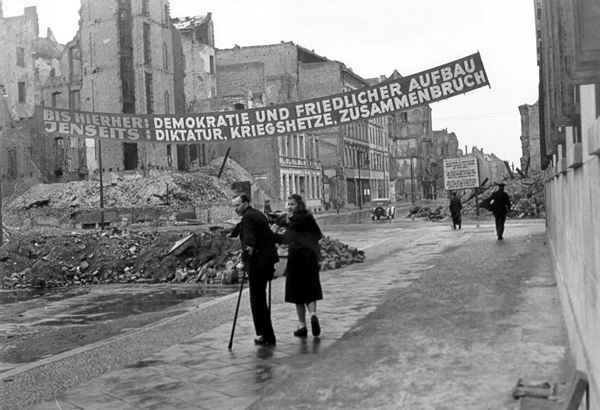
That's Berlin in 1948: https://4.bp.blogspot.com/-7m4GWloP444/WMF6AVrgs-I/AAAAAAAAD...