but both germany and japan had great recovery, despite also having lost a lot in the war due to bombings and population deaths.
The difference is the economic system - USSR always felt that they're under threat from western powers, and devoted a lot of work in heavy production (which translates to military production), and very little civilian production. And even technological growth was kept militarily separate - e.g., they actually had computing but did not "give" that tech up for civilian use, after expending the R&D on it.
Mean while, the US's defence spending on R&D does spill over into civilian use (often due to profit seeking motives, but still this produces good results). Like the internet, GPS, etc. The thing is that centrally planned economies means those that aren't "central" to the planner's mind will be forgotten. But everyone in the country is important in reality - so those who get forgotten will decline.
In other words: $1 in 1945 Japan goes much further in terms of development than $1 in 2000s Afghanistan.
Not necessarily. If you ignore the (in reality rather important) "ongoing war" aspect, investing in more backward region should give you better return on investment, not worse. That's because investment, like anything else, suffers from diminishing returns. In backward regions, there are a lot of low-hanging fruits to pick, and small amount of money can go very long way. That's why all the NGOs are talking about microlending etc: even trivial amounts of capital make a huge difference.
FWIW I'm no expert on Germany post-war, but from a personal POV my father was born in 1944 and grew up in post-war Germany (Mainz) and my Opa worked for the city in post-war building reconstruction (knew the story of every building in the centre of the city by heart and when I visited told me everything he knew). So I've some interest in the topic.
As for the rest of your points, plenty of valid observations for the period of the 50s, 60s, 70s but we are talking 1948. The war had barely ended.
It's ridiculous to compare a country recently ravaged by brutal total war which lost 26 million people, millions of which were civilians -- to a country which lost just 400,000, almost all in the armed forces (and, again, was a destination for immigration both before and after).
> but both germany and japan had great recovery, despite also having lost a lot in the war due to bombings and population deaths.
Japan at least didn't have many cars in 1948. This is a central part of Tokyo in 1946: https://c1.staticflickr.com/9/8453/7975138441_b82cdd4372_b.j...

You won't be caught in a traffic jam for sure.
That's Berlin in 1948: https://4.bp.blogspot.com/-7m4GWloP444/WMF6AVrgs-I/AAAAAAAAD...

In other words: the GP is saying that the Soviets didn't have the money or human resources to do the things the US did, and you're responding with "look at all the things the US did with its money and human resources." It's true, but not really a response.
SK is one of the biggest economies in the world, NK is literally starving to death right now. I don't think some US intervention decades ago really explains why NK isn't able to build much of anything, or why their allies still can't help them even manage to feed themselves.
The claim is much simpler: if you're looking to compare the US and USSR during the postwar period, you need to consider the raw resources they had available. The US triumphed, and achieved a wide range of humanitarian successes in the process, but the why of that boils down to an intact workforce and a roaring industrial base, not some definitive dustup between Communism (tm) and Capitalism (tm).
You can probably make that claim in 1975, though. Unfortunately people are not reading that far down into my comment to get the distinction.
https://en.wikipedia.org/wiki/Marshall_Plan
And yet the German Miracle happened in West Germany, not Britain.
https://en.wikipedia.org/wiki/Wirtschaftswunder
And West Germany was practically leveled in WW2, unlike Britain.
In other words: a decent chunk of the Marshall Plan money that the US dropped on Britain was in effect cover for existing debts, meaning that it not directly applied to industrial production or reconstruction in the ways that boosted West Germany (and France, Greece, etc.).
And yet W Germany rose to the most dominant economy in Europe by 1970. Britain was not and did not. The key difference was Germany embraced free markets, and Britain turned away from free markets.
How about Japan? Bombed, burned, and nuked to the ground. An island nation with no natural resources. By the 1970s it rebounded to be the leading industrial powerhouse behind the US.
Have any communist countries achieved such success? Any socialist ones?
> Have any communist countries achieved such success? Any socialist ones?
I don't know why you're fixated on this. Again: nobody in this thread has made this claim. The only thing under discussion is whether it's reasonable to naively treat postwar Europe's recovery as a triumph of capitalism, which it isn't.
Why is it that nobody can point to a successful communist society, now or historically? At some point, one just runs out of excuses. Meanwhile, free markets undergo prosperity again and again and again.
Here is the totality of the argument: comparing the immediate postwar economic outcomes of the US and USSR is intellectually embarrassing, because everybody here understands that they aren't comparable. If your goal is to demonstrate that capitalism produces prosperity, you can point to literally any other period after the postwar one.
SMH
[...]
>The Soviet Union on the other hand bore the brunt of losses in WWII. It suffered massive deaths in the war, especially among its young men of working age. It was invaded by NAZI Germany, and some of its largest cities occupied or put under siege. Its agricultural and industrial lands were ravaged by war, its people by wartime famine.
All that and not a word about the Molotov-Ribbentrop Pact, of course. When two criminals fall out with each other after a joint robbery and murder, one ordinarily does not overly mourn the one whom the other killed in a dispute over the spoils.
>The Soviet Union on the other hand bore the brunt of losses in WWII. It suffered massive deaths in the war, especially among its young men of working age. It was invaded by NAZI Germany, and some of its largest cities occupied or put under siege. Its agricultural and industrial lands were ravaged by war, its people by wartime famine.
"bore the brunt of losses"
"suffered massive deaths"
"invaded by NAZI Germany"
"ravaged by war"
"wartime famine"
I.e., "Soviet Union = victim", as opposed to "Soviet Union = one of two criminals that together committed a crime, was attacked by the other criminal, and barely survived and killed the attacker with the help of others"
Let me repeat:
>When two criminals fall out with each other after a joint robbery and murder, one ordinarily does not overly mourn the one whom the other killed in a dispute over the spoils.
So you can wave away massive death -- justified? And all conversation about the matter must be redirected to this allocation of blame. "Mommy, Johnny hit me first."
I think you need to give your head a shake. The way you're talking about war and death, it's like you don't really grasp the level of tragedy at all.
Those 26 million dead suffered because Stalin signed the pact with Hitler.
>So you can wave away massive death -- justified?
Not at all, and I have never given any indication that I think so.
Those 26 million dead also shouldn't ever be cited by Soviets, or apologists for same, as some sort of hard-earned virtue or proof of nobility, yet they have been used for precisely such purposes for 80 years and counting. To return to my earlier analogy, that'd be like the criminal who survives the attack by his coplotter now calling himself a hero for having killed the attacker.
https://upload.wikimedia.org/wikipedia/commons/c/cc/Soviet_U...
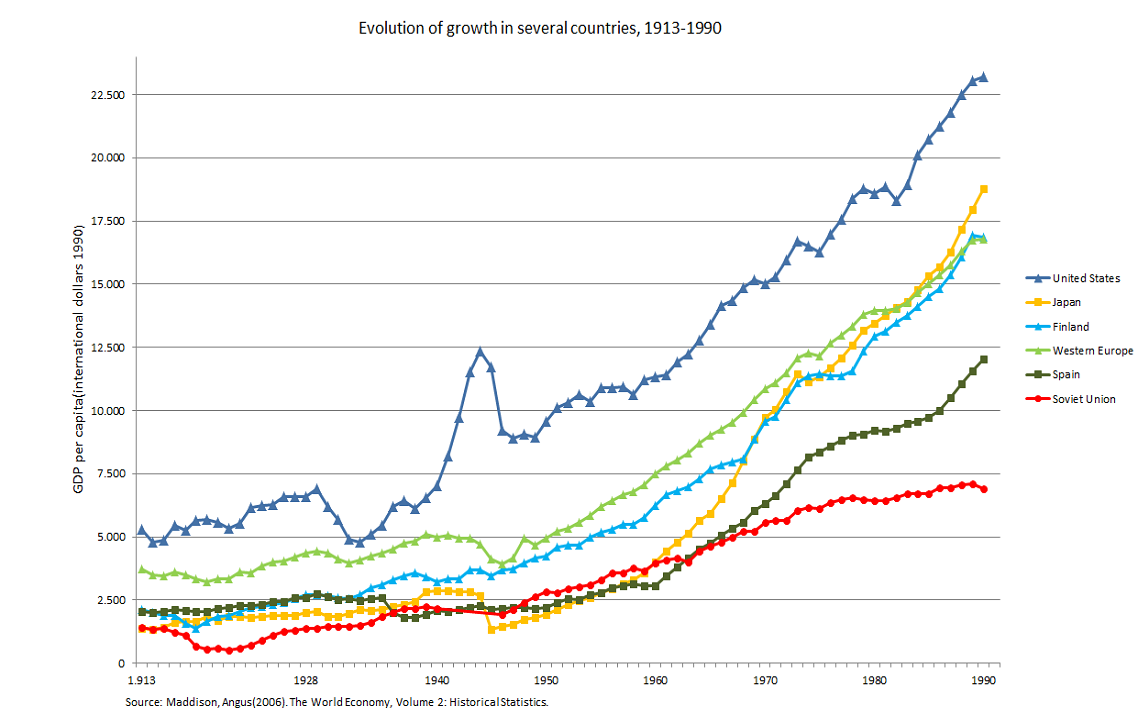
Maintaining an empire ain't cheap.
Which we eventually witnessed.
I mean you send millions of farmers to factories and yes farm output declines, these things are related.
For a country trying to rapidly industrialize, redirecting available labour from farming to factories and hoping that your productivity increases will make up for the reduced labour supply seems like it could be a good faith best effort to uplift the lives of as many people as possible as quickly as possible. Sitting back and letting the economy continue to be agrarian means passively killing many people through lack of access to medicines etc..
I remember getting a ride as in the back of my great-uncle's Volga and my uncle's Zhiguli. They lived in Moscow while we were in a suburban town (akademgorodok) where a Zaporozhets was a luxury that less than 10% of households could get. The reason I remember is the ride was a yearly treat. This was during perestroika. A few years later glasnost allowed people to see enough movies to conclude that the system was unworkable.
The Soviet Union was an evil empire start to end, built on the bones of its "brother nations" as much as their own citizens. Its troubles can't be explained away by WWII.
Meanwhile, the economic conditions in 1985 were just as broken as in 1945. I know because I was there, as a brainwashed oktyabryonok, being sent to stand in a bread line with a talon (a rationing ticket for bread). In Moscow Oblast, the most prosperous in the country.
The level of naivete and pedantry in this whole discussion is amazing to me, on so many levels.
Largely because Stalin refused to listen to anyone and didn't defend his western borders and wouldn't admit the Germans were invading until they were practically half way to Moscow, and the Soviet system didn't allow for any other path of action.
> It was invaded by NAZI Germany
Who Stalin foolishly allied with, knowing at the time that Hitler would betray him.
> Its agricultural and industrial lands were ravaged by war
Was that before or after collectivization caused a famine and the purges wrecked all of the engineering talent?
If anything, the Soviet modernization efforts accelerated what would have been possible under the czars. Because of Soviet growth during the Great Depression, communism was seen by many in the industrial world as a viable alternative during the 1930s.
Command economies are great at catching up (just ask Park Chung-hee) and terrible at expanding the economic frontier. Not a fan of command economies by any means, but history is more nuanced.
This isn't entirely fair and is actually pretty flippant and tone-deaf given the situation of the time after the war.
In 1948 the US had been industrialized for much longer than the USSR. It was a destination for immigration, and had a vibrant young population. The two world wars it participated in were fought on foreign soil, far away from the homeland. After (and even during) WWII it benefited from a massive influx of European scientists and intellectuals. Industrial capacity from the war was redirected back to consumer goods.
The Soviet Union on the other hand bore the brunt of losses in WWII. It suffered massive deaths in the war, especially among its young men of working age. It was invaded by NAZI Germany, and some of its largest cities occupied or put under siege. Its agricultural and industrial lands were ravaged by war, its people by wartime famine.
While the Soviet planning system was a failure, and Stalin an evil tyrant -- in 1948 a working class person in the USSR not being able to afford a car had very little to do with the different economic models, but with the completely different situation of the two countries.
(Even if the movie/book was set in the 30s, the context it was being look at was post-war USSR. And even in the context of the 30s, the USSR had only just come out of civil war, revolution, and WWI)