Math as a whole may last longer, but this list reminds us how far we’ve come in a mere few millennia: https://usercontent.irccloud-cdn.com/file/SaI50Q1d/166786520...
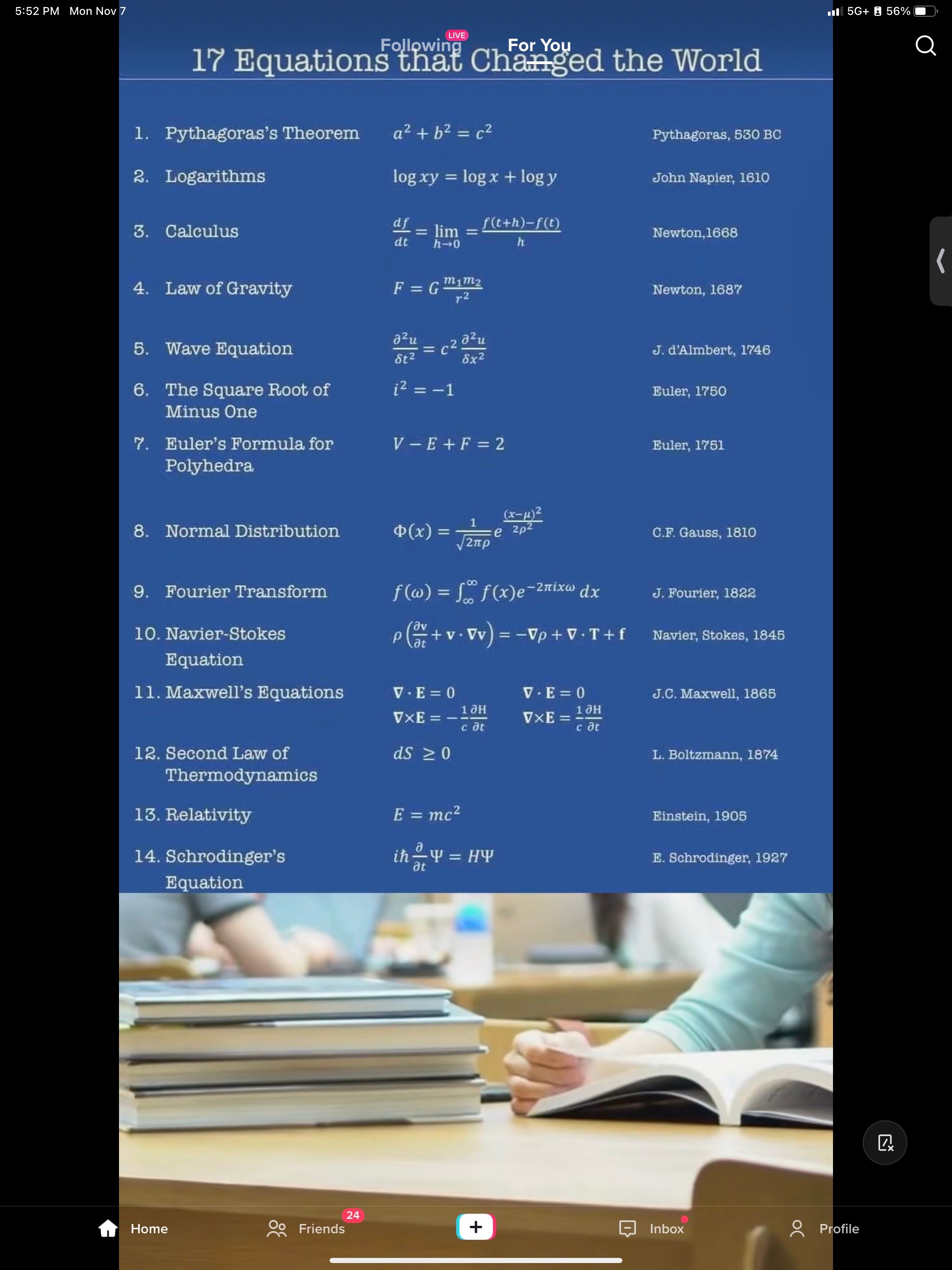
On the timescale of civilization, it seems less and less likely that lone mathematicians can revolutionize the field.
We’re fortunate to have been born so early, relatively speaking.
Mathematics is not just a small integer multiple larger than this.
It's not that math is vastly larger (or more sophisticated) as a field. Both fields infinitely large in many senses. Rather, the number of respectable starting points where you can do interesting things is much larger, orders larger in math.
Looking from the outside, physics suffers a lot from fashion/hot trend tendencies, where you need to be doing the "hot" thing to make the jumps necessary to the coveted Tenure Track — and otherwise, you get kicked out.
Which inspires the question: how much can cutting edge math be parallelized?
Maybe some CAS-assisted work gets us into feedback loops allowing us to go indefinitely, as in a technological singularity.
But the "shallow" part is also quite wide.
You can teach people what you've learned forever, for instance.
I don't know what field you are in so it may or may not be helpful to you.
Yes, but the shallow areas aren't very interesting, which is why people work in the deep areas.
The simplest example that comes to mind is that you can learn group theory without really needing to know anything about Galois theory. I also imagine there's a lot of good math that has shed vestigial physics...
Maybe we will keep forever discovering new shallow areas but I suspect this is not the case. In any case this is a phenomenon that I think will play out in the next few hundred years, not sufficiently impactful in the next few decades but more and more noticeable.
People talk about this a lot. While I think it could happen for certain subdisciplines (it already takes essentially an entirely PhD's worth of time to learn all the necessary background to be an algebraic geometer, so most algebraic geometry PhD students publish nothing besides their thesis during their PhD studies), it can never happen to mathematics as a whole. If one part of math gets too deep, you can always go somewhere else, where the water is still "shallow."