(I know all these values from homebrewing, where water temperature plays a big role in how long it takes to cool)
Also of note, ~25feet of one inch pipe holds 1 gallon of water. So there can be quite a bit of lag involved, but water is unlikely to spend that long in these pipes to change temperature. Thus the ground temperature would need to be extremely different to make a significant difference once the temperature equalized.
Agree on the pipe volumes.
That said, municipality’s will often be overly cautious and they do need to consider property siting abandoned.
I'm not in the country shown on your map. The area of Canada I'm in would be somewhere roughly around the 90" line on that map. It's between the 2000 and 2500 lines on this map [1] (the seasonal property is around a 1500 contour)
The municipalities pay for the main to be installed. They wouldn't spec it to be 8' (2.4m) deep if it didn't need to be.
edit: the contours in my source are not mm of freezing depth, but degree-days of freezing. However, 2500 DDOF corresponds[2] with 70" of frost penetration, while the 1500 DDOF corresponds with 55". So the required bury depths are slightly but not significantly conservative
[1] https://www.urecon.com/applications/images/canadian_map_lrg....
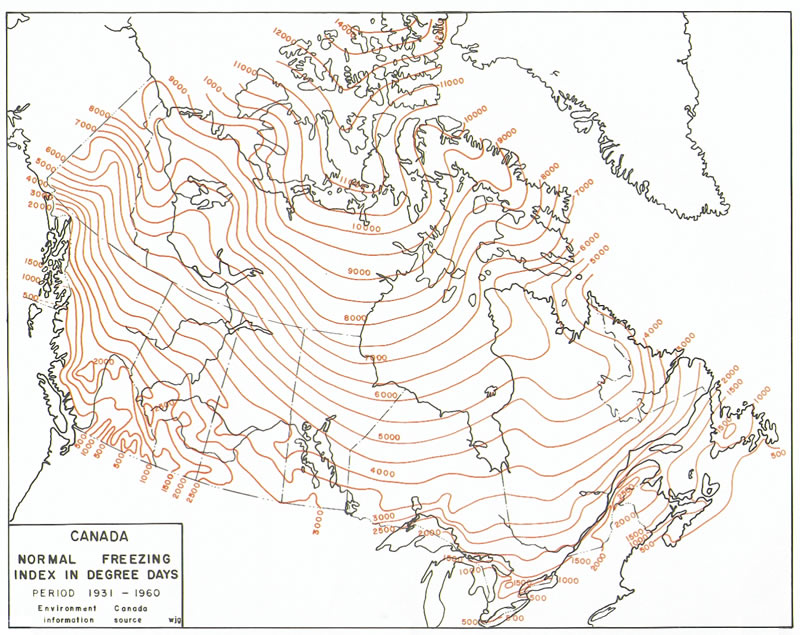
[2] 1962 source: https://nrc-publications.canada.ca/eng/view/ft/?id=15f6f5eb-...
I don’t know much about how Canada does things.
My comment was simply in reference to well water which has very consistent temperature and will warm or cool the soil surrounding pipes at any reasonable depth if you are using water regularly.
A poster mentioned failing to get a cold shower in Singapore, but Singapores ground temperatures are much higher than we are used so well water is going to be ~25C year round and tap water can be significantly warmer than that.
Trivially people in the tropics don’t have a winter, but well water can similarly have very consistent temperatures independent of seasons.
It's a simple calculation, but very location specific. In my particular case, if the water heater is set to 50C, and tap water is 22C in Summer, it has to impart a ΔT of 28C. If your tap water is 4C in winter, the ΔT is 46C. Not quite double, but close to it. If your water heater is in a poorly conditioned space, then it would lose considerably more heat to the surrounding space when outside temperatures are -15C than when outside temps are 35C. All told, hot water energy usage for my particular situation is between 2x and 3x. Other situations would vary, but still significant.
I lived on the top floor in a newer building in Dallas that pumped water the entire way and the pressure was noticeably less in my apartment than in the gym on the ground floor. The water was "cold" though!
Some municipal systems vary more depending on where they get it and how they store it. Water towers used to smooth out water demand for example can noticeably impact water temperatures.