It is easy to say that on average nuclear energy is not so terrible, when you were never personally confronted with what happens when you lose the bet. Then an abstract idea is becoming very real. You realise that one day someone else will have to pay the price, or you yourself again: What if the next accident happens not in the Soviet Union or Japan, but in one of the power plants next door?
This experience, shared by millions of people, has done much to cast doubt on the claims that such risks are technically controllable. And the climate protection argument also appears to many to be nothing more than propaganda, because it comes from the same parties and companies that supported likewise nuclear, coal and gas, but downplayed climat change and other environmental issues for decades. Their actions and lobbying helped to create our current situation by slowing down the switch to renewable energies and postponing stricter regulations on energy saving. -- Shall we trust them now after so many failures?
[1] Mushrooms in some areas of southern Germany are still highly contaminated. But that was one of the least of our concerns in those days.
[2] I found an old article from Der Spiegel from 1986 reporting 500,000 Bq/m^2 filter: https://www.spiegel.de/politik/dicke-luft-um-verseuchte-filt... (in German)
> What if the next accident happens not in the Soviet Union or Japan, but in one of the power plants next door?
That would be terrible. But how does it compare to other terrible events such as the flood of last year, arguably caused by global warming?
You were victim of the fear propaganda of the 80's, but people today are victim of the energy crisis in Germany, which is partly caused by the choice to discontinue nuclear.
Thousands died of thyroid cancer but for the population that is easily described as "almost no consequences" due to scale.
https://unis.unvienna.org/unis/en/pressrels/2018/unisous395....
The death of a man is a catastrophe. A thousand deaths is a statistic!
> About 20,000 cases of thyroid cancer cases were registered in the period 1991−2015 in males and females, who were under 18 in 1986 for the whole of Belarus and Ukraine, and for the four most contaminated oblasts of the Russian Federation. The Scientific Committee now estimates that one in four of those cases is attributable to radiation exposure.
This is not about Germany, but about the area much closer to the power plant. Also thyroid cancer has a 98% survival rate according to Wikipedia. So that would amount to 20000 * 0.25 * 0.02 ≈ 100 death caused by the accident in the most impacted area. Which is a catastrophe, but also not an apocalypse
But I was talking about Germany anyway where the most alarmist messages were delivered about the danger on the German population.
The threat was real. It is like saying that after someone put a knife at your throat, that it was nothing, because you are still alive.
> but people today are victim of the energy crisis in Germany, which is partly caused by the choice to discontinue nuclear.
It depends how you tell the story. It was the choice to discontinue nuclear, but pospone renewables. The companies in the coal and gas energy sector were mostly identical to those in the nuclear energy sector (3 out of 4 large companies). They did not have much of a problem getting out of nuclear energy if they could stay in the coal and gas business or even expand it and pass on the financial risk of their nuclear waste disposal obligations to the taxpayer[1] -- as long as they had not to fear too much competition from renewables.
It were the very same people in industry and politics that supported nuclear whenever possible, that supported coal and gas as a replacement and constantly downplayed the impact of climate change. The people from the environmental movement who warned about all this were not politically strong enough to push through a better agenda. That is what has brought us to the current situation. Guess who I trust the most to find the best way out of this situation ...
[1] They threatend bankruptcy if not, and got away with a one-time payment of only 24,1 billion Euro.
Are their lives less valuable than the right of the so called environmental activists (mainly referring to the ones from the 80s and 90s) to impose their irrational views on the rest of the society? If nuclear expansion continued at the same pace it did in the 60s and 70s we’d probably have CO2 emissions under control by now. Instead we just wanted several decades waiting for renewables to become cost effective.
> This experience, shared by millions of people, has done much to cast doubt on the claims that such risks are technically controllable.
Yes, people are irrational. I mean nuclear isn’t 100% safe but it’s objectively safer than burning fossil fuels. So it seems absurd to me to be fine with burning diesel and coal but now with nuclear.
Worldwide we have roughly 10% nuclear energy for electricity. And we had roughly 20 to 25 years between nuclear disasters (Sellafield, Harrisburg, Chernobyl, Fukushima). If we had had 100% nuclear, it would mean such a disaster would occure approx. every 2 to 2.5 years.
We also cannot close the books about this disasters. They still are going to hurt and kill people. Ask the Russian soldiers that camped at Prypiat this spring. You might say: They should not have done this and known better. But this is how things play out in reality, while in theory they should not happen.
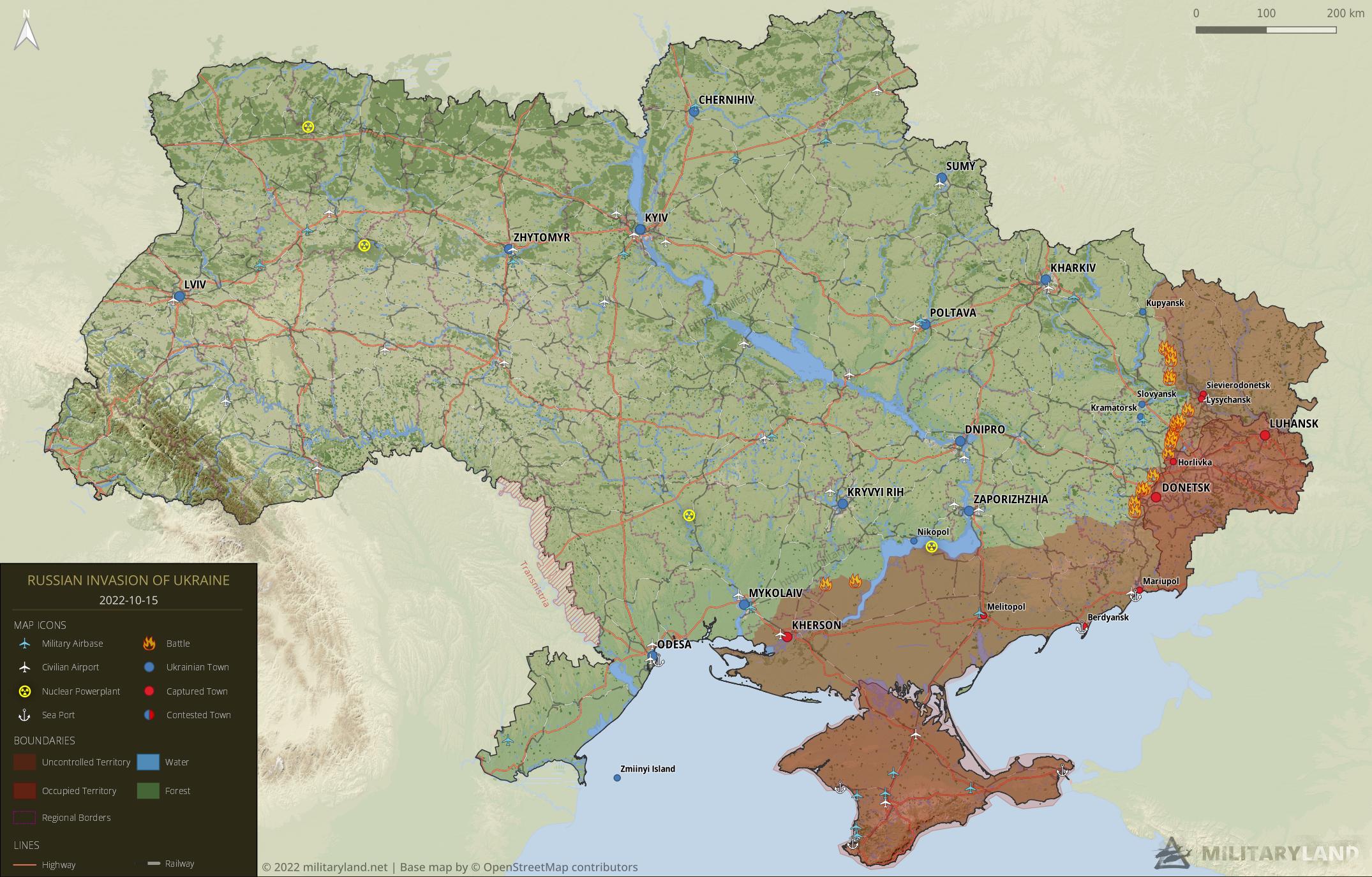
And then there is the strategic problem in a war. It is no wonder that on maps of the situation in Ukraine like this https://militaryland.net/wp-content/uploads/2022/10/day_234_... the locations of nuclear power plants are emphasized. Renewables would provide a far better situation for a nation that needs to defend itself, because they are decentralized.
https://ourworldindata.org/safest-sources-of-energy
Nuclear is often compared to flying: accidents can happen and are crazy scary, but on average flying is the safest way to travel.
Coal and gas plants produce pollution that kills thousands every year, and that's how it's supposed to work.
Meltdowns are next to impossible at correctly designed and built plants, which the German ones are.
This is not true. The German nuclear industry did not even manage to store low and intermediate level radioactive waste even remotely safely. Here is a report from July 2022 about the failure from German public television: https://www.ndr.de/geschichte/schauplaetze/Marodes-Atommuell... The report is only availablöe in German, but you may run the accompanying documentation through the translator of your choice, to learn what happened.
> Coal and gas plants produce pollution that kills thousands every year, and that's how it's supposed to work.
Wrong alternative. We need 100% renewable.
> Meltdowns are next to impossible at correctly designed and built plants, which the German ones are.
People like you would have said that about Japan too, before 2011, and actively ignore what happend in Harrisburg in 1979 or Sellafield in 1957.
Civilian nuclear waste can absolutely not 'devastate wide regions'.
And civlian nuclear plants in the waste can also not really do that.
What actually can happen is that over a large region you measure slightly higher radiation but not actually enough to be dangerous to the people there.
> I was a victim of the Chernobyl fallout myself, and would not like to experience this again.
There is no measurable impact of Chernobyl. All the claims about all the disabled children were literally all lies. Its all fear mongering.