That's because science doesn't work by "consensus". It works by building models that make accurate predictions. The models climate scientists currently have don't make accurate predictions. So people who are skeptical of the "consensus" are right to be skeptical (though that in itself doesn't necessarily mean they are skeptical for the right reason--see below).
> You can't challenge the consensus without becoming an expert on the matter yourself.
That's way too strong. You don't need to become an expert in the sense of being able to build your own models. You just need to have enough knowledge to be able to judge whether the models scientists have make accurate predictions. That's a much easier job.
I think you are right, though, that many people who are skeptical of various scientific claims aren't skeptical on the basis of what I said above, but for other, invalid reasons.
Have climate change models been shown to be making poor predictions? From what I've seen, it appears they've predicted temperatures should warm and we've seen average surface temperatures generally increasing over time. It seems they've predicted stronger hurricanes and those have also been happening more frequently over time. They've predicted increasing amounts of droughts and those have also been happening more frequently over time.
Weather is a complex system and there's always going to be some amount of variance. Are you claiming that people have trouble understanding how statistics work? If so, that seems to be the same argument that the OP is making (that you need to understand how things work before you have informed skepticism). If you don't understand how statistics work, you might have trouble following statistical predictions that have generally been show to be correct for several decades. That doesn't appear to be a problem with the predictions of climate change models, but with the interpretation of said models by people who haven't bothered to understand them.
Yes. Even the IPCC admitted that in the AR5, though you had to look carefully at footnotes to see it.
> it appears they've predicted temperatures should warm
No, they predicted that temperatures should warm at a particular rate based on a particular rate of CO2 increase. More precisely, there are three groups of climate models, each based on a different rate of CO2 increase: basically, a "business as usual" rate of CO2 increase, a "some reduction" rate of CO2 increase, and a "drastic reduction" rate of CO2 increase. The output of each group of models is averaged to come up with a prediction of warming based on the rate of CO2 increase that the model assumes. The "business as usual" models predict the most warming, the "some reduction" models predict somewhat less warming, and the "drastic reduction" models predict less warming still.
Actual CO2 increase has been about the same as the "business as usual" scenario, but actual warming has been less than the amount predicted by the "drastic reduction" set of models. If the models made accurate predictions, actual warming should have been about what was predicted by the "business as usual" set of models. But it wasn't; it was well below the 95% confidence interval for that set of models. (Note that, whenever actual warming is compared to models, it is compared to the average of all the models--all three sets, with different assumptions for CO2 increase. That actually makes no sense, but climate scientists do it anyway to obfuscate how much the models have overpredicted warming.)
> It seems they've predicted stronger hurricanes and those have also been happening more frequently over time.
No, they haven't. Studies of frequency of storms show no change in frequency over time. The amount of damage done by storms has increased, but that's because of the huge increase in the number of people and the value of housing and other property that are in the paths of major storms.
Right. Which is why I said the models predicted stronger hurricanes. Which is what you're saying. Looks like we'll have to agree to agree here. The models are making accurate predictions and you'd need to know a lot about the domain to suggest there are flaws. No one would argue a lay audience would be making those arguments. Temperatures are getting warmer, storms are getting stronger, droughts are happening more frequently. The models aren't perfect but that's why they're called models and they're generally predicting what's happening.
No, it's not. I said that the damage due to storms has increased, but I gave the reason why, and it has nothing to do with hurricanes getting stronger, any more than it has to do with hurricanes getting more frequent.
Studies have not shown any increase in the average strength of storms either.
“On average, there have been more storms, stronger hurricanes and increase in hurricanes that rapidly intensify,” NASA reports. In 2020, the world saw a record-breaking hurricane season. The facts show what the models predicted. You can continue to argue that there's no evidence, but you'll continue to be wrong.
The OP's argument seems not be refuted here. You need to be an expert and know a lot more than a lay audience would to find any criticisms with existing models. The vast majority of climate change deniers are science skeptic and not going so deep they have a valid basis for their skepticism (and in some cases, it's becoming clear it's not just skepticism but willfully ignoring the actual data for whatever reason).
[citation needed]
https://www.ipcc.ch/site/assets/uploads/2018/02/WG1AR5_Chapt...
"There is very high confidence that models reproduce the general features of the global-scale annual mean surface temperature increase over the historical period, including the more rapid warming in the second half of the 20th century, and the cooling immediately following large volcanic eruptions."
https://www.realclimate.org/index.php/climate-model-projecti...
Physicians in the early 1800s were taught many medical practices and concepts that had no basis in fact (the dynamics of Hippocrates' 4 body humors, the value of bleeding, germs were not the basis of disease, miracle elixirs abound, etc). You'd think all medicine practiced in that time would be worthless. But in fact, a small number of heterodox doctors recognized the contradictions and limits inherent in the dogma of the day and chose to think and practice largely independently of it, testing methods themselves to retain what worked and discard what didn't, and sharing lessons learned with peers they respected. They personally employed the scientific method and learned from it, despite the established orthodoxy.
Each of those experimental revelations did not depend on expertise, only on a rigorous determination to be methodical and fair-minded and refrain from employing or spreading unfounded claims. That's more a matter of discipline and personal integrity than expertise.
I think the biggest problem is that category I mentioned: skepticism on the basis of simply not liking the scientific conclusion, because it negatively affects me.
This lazy skepticism has been suppressed for good reasons, but probably has gone too far. An extremely authoritative approach that is dogmatic and doesn't tolerate the slightest of deviations has only emboldened conspiracy theorists.
All of this in a backdrop of extreme political polarization. A perfect storm.
For example, I have no epidemiological credentials, but I am an expert in information/media literacy as well as digital information dissemination and retrieval. So watching many aspects of the US's COVID response was like watching a train wreck. But in a lot of places, disagreeing with the/a government response meant you were a scientifically illiterate rightoid(TM) anti-vaxxer.
"I respect epidemiologists but most of them are terrible science communicators and our institutions are making tactical and strategic errors because our current information system is not suited to what they're doing," wasn't really seen as a viable opinion. The Overton Window did not allow it. That's less than ideal.
Thing is, there's a lot of angst about why people don't trust "experts", but not nearly enough on what these experts are doing to be trustworthy.
"scientist" is the new "priest", and many in that field expect to be treated as such.
Also, around the same time I remember seeing several people comment about how people like me that used masks were "as bad as antivaxxers" for "not trusting the science" by not removing all precautions other than the vaccine. As someone well versed in reading actual scientific papers, it was painful to read these comments.
> “People just laughed at me,” Shechtman recalled in an interview this year with Israeli newspaper Haaretz, noting how Linus Pauling, a colossus of science and double Nobel laureate, mounted a frightening “crusade” against him, saying: “There is no such thing as quasicrystals, only quasi-scientists.”
He was ridiculed and apparently even lost his job, or lost potential employment, for insisting on his finding. 30 years later he got his own Nobel prize in Chemistry:
https://www.reuters.com/article/idINIndia-59724820111005
but then - what about those people who weren't vindicated and recognized for being correct after all?
No. The business model is to feed people false information, that if believed, will allow for wealth and power extraction from the masses.
Eg, if climate change is accepted by the masses, all sorts of corporate friendly legislation will be/is being enacted, with Al Gore et al ready to benefit, and with loss of freedom and money for the individual. And at the cost of the environment they are purporting to save. (Electric cars anyone?)
Control of the narrative is powerful stuff, that plays to people's embarrassment at their apparent ignorance in the face of 'expert' opinion. Where we should just remember experts are invested via education, work, status in their expertise and that what they say may have little to do with the truth. Especially when it conflicts with the golden source, personal or anecdotal experience.
And it has always been that way, even for long running narratives.
*skepticism is confused for intelligence or insight.*
It's rampant in application towards ML. People don't want to seem like they're 'hyping AI' because that is associated with immaturity, so they run the other direction and claim "very little has been done, nothing to see here" - which is actually far further from truth. These people often don't have a great deal of knowledge or experience within the field their bashing; however they're well received, simply because *skepticism is incorrectly received as insight*.
There may or may not be a fix that can be engineered for this, but at least reminding our community that pointing out the things a post does correctly (perhaps using theory that isn't explicitly stated there) is a more academically challenging task than pointing out flaws can be helpful.
You can escape it by training yourself in rigorous critical thinking. But why would you do that? It's a lot of work and only leads to painful conclusions. Nobody else is doing it so your superior and truthful insights will be rejected.
If you show me a battery you say lasts longer, I can verify your claim quite easily. If it doesn't last longer, without knowing a single thing about batteries, I have every reason to believe I'm right and you're wrong. There's a chance I am in fact wrong, but I'll be expecting you to put in the effort to convince me otherwise.
If someone tells me to significantly change my life based off their climate models, and they laughably fail [0], I have every reason to believe they don't have a good climate model. If they don't have a good explanation, and even worse, get angsty when asked for one, I'm out.
It's perfectly possible some small group of people or even an individual possesses knowledge that could save the world from imminent destruction or produce some great benefit. But if there's no way to verify such knowledge, there's no reason to care about it.
[0] https://www.drroyspencer.com/wp-content/uploads/ICCC13-DC-Sp...
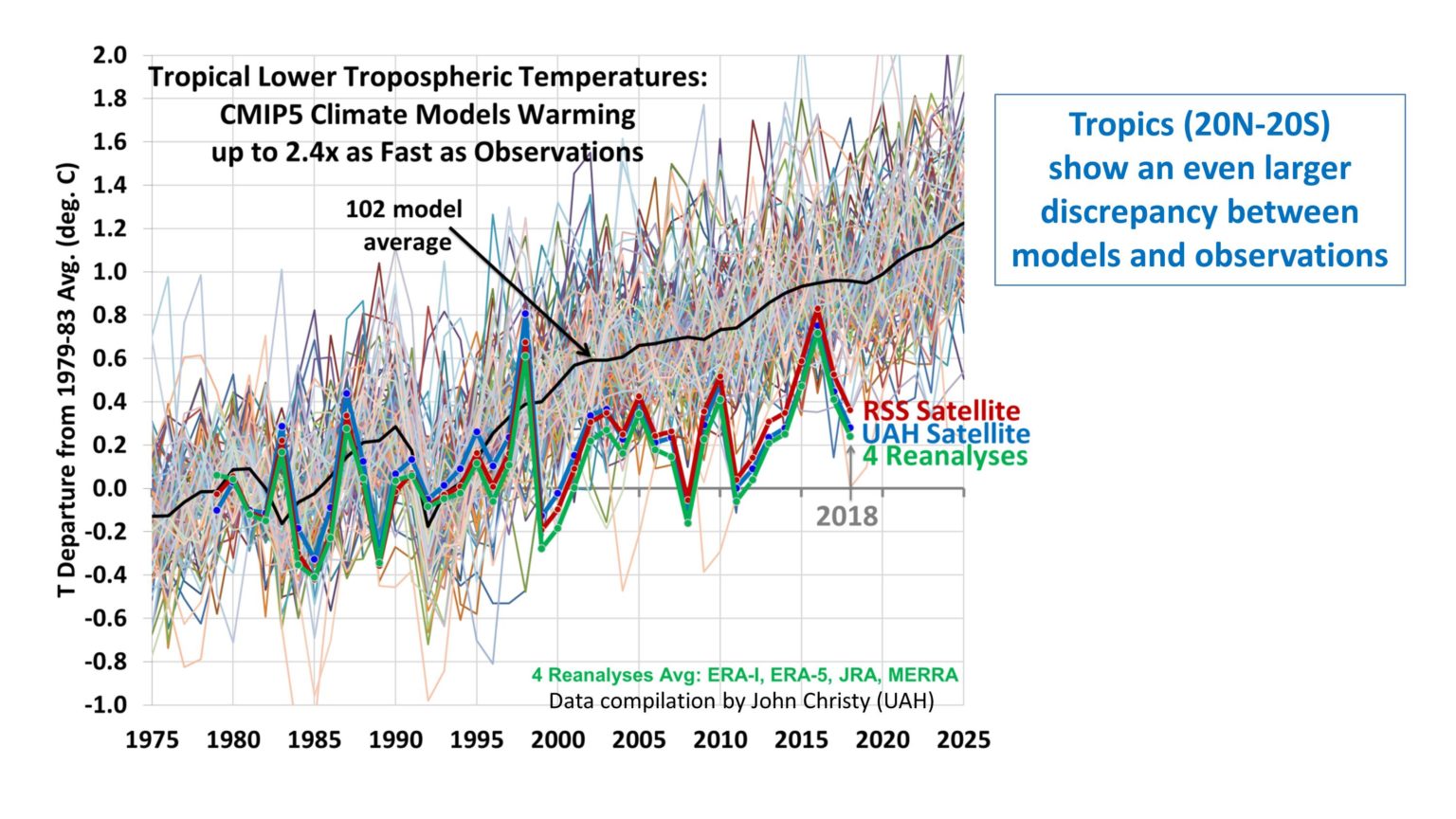
What changes do you consider significant? What's your threshold for a climate model good enough to justify lifestyle changes?
It seems obvious to me that we live on a finite planet with little hope of escaping limits on its resources. So looking only at potential arable land and current oil usage I'd say we're obviously not operating with sustainable lifestyles in most of the west. After all, that oil represents hundreds of millions of years of solar energy, converted to oil. We are depleting it much faster than it's being generated.
   - better temperature measurement tech (even the data can be controversial, big problem)
   - better measurement tech for all potentially relevant factors
   - a well-reasoned model that can better predict what's "variance" today, the more precise the model the quicker you can prove it right
I don't think all Malthusian concerns are of the same kind in terms of epistemic controversy. I could see humanity dying because of something that could have been prevented with collective action. What I don't see happening is humanity saving itself by collectively choosing to defer to the right people. It almost seems like a logical contradiction. If we do save ourselves from catastrophe by collective action I except there to be collective conviction. If we die because we were too stupid to listen to somebody then we were bound to die either way.
But it doesn't really work that way, the cost of good faith skepticism is so high as to not be in reach of most people.
For example, a lot of people are skeptical of climate change and reject the scientific consensus. This starting point of skepticism is to be encouraged, if only it would be done in the way the article describes.
You can't challenge the consensus without becoming an expert on the matter yourself. At the absolute very least it would require some hundreds of hours of reading and analysis.
Most people do not have the time, will or expertise/education level required to seriously and in good faith provide any type of challenge at all, other than outright denial. And it obviously doesn't help that there's many rabbit holes encouraging lazy skepticism: denial, conspiracy theorists, it's a business model to be anti-science.
In the end though, the general population doesn't care about science or the pursuit of "real truth". Only about its outcomes. When science invents a better battery, that's great. Yay science. When science tells me to eat less meat, that's bad science, has to be false.