I'm sorry but this flies in the face of my experience. Most landlords I have met buy properties and then outsource their administration to property management companies. I have never seen or spoken to my last three landlords, none of whom lived anywhere near the same city as the property.
Landlordism is parasitic in the literal sense of the word. Landlords get rent and capital appreciation for doing nothing but possessing an ownership title. The propertyless pay the propertied a premium to live.
In light of both those observations, I would say any enrichment in this case is "silly", and that landlords don't tend to do much - or any - work.
>"If it were so profitable, then tons of capital currently being spent on other uses (tech, medical, finance) would instead go into buying up more housing."
This is a non sequitur. If X is profitable and the market knows X is profitable then it should, in theory, be attracting exactly the amount of capital it merits already. In the UK, where I live, the rental sector has exploded, jumping from 2.8 million households in 2007 to 4.5 million in 2017. [1]
[1] https://www.ons.gov.uk/economy/inflationandpriceindices/arti...
And the cost of buying a property and outsourcing its maintenance is 0 right?
The landlord magically pulls a home out of thin air and some group of people maintain for them for free?
>>Landlordism is parasitic in the literal sense of the word. Landlords get rent and capital appreciation for doing nothing but possessing an ownership title. The propertyless pay the propertied a premium to live.
This applies to any investment, including things like 401K, pensions, getting an education, or even taking care of one's health.
Why should anybody in an economy be better off than the other part of the population by being disciplined, making routine and early investments?
Good news is you can plan and start working to go over to the winning side by taking action on it today. Or you can call others 'parasites' for making smart decisions you don't make. Calling others names might mask your own failure, and downplay their achievements, but is unlikely to change anything for your or for them.
The building-lord should receive some return for their investment, as they have created value and added to it through maintenance.
The land-lord receives return for doing no work, no addition of value, and only through extracting the excess economic rent from their tenants.
Unfortunately, conversations around property investment and land taxes and so on tend to derail because the land-lord and building-lord are often the same person. The response to "the landlord is a leech on society" is "no, he built a house and maintains it!", but in reality it is "the land-lord is a leech on society, the building-lord is a contributor to society".
Note these extend to things like 401k, or a retirement savings scheme in the same way.
You feel like you are salty that you couldn't get a hold on such a resource in time.
Owners of monopolies stand to benefit from not just a reasonable return on investment, but an excessive return on investment proportion to their contribution to society.
Many countries and societies have handled this in different ways, such as the idea of the commons, or Norway's taxation of oil extraction, or land value taxes and land leases.
> You feel like you are salty that you couldn't get a hold on such a resource in time.
I am a software developer, and as such am able to comfortably acquire land in a good location and provide for my family. However, many of my generation are unable to, unlike previous generations, because the good locations have all been taken by the previous generations. This is why we see enormous poverty next to enormous progress, because late comers to the party are so far behind as to be basically unable to "get on the ladder". The ladder is being pulled up before their eyes.
A great solution to this is to tax the excess economic rents that monopolies create, rather than taxing labour and capital. Henry George is the most famous proponent of such a system, and you can find out more here: https://www.gameofrent.com/ or at astralcodexten's book review of Progress and Poverty.
This means that those who contribute to society through labour and capital are not discouraged from doing so, but those who leech off others through monopoly rent extraction return that rent to the society that created it in the first place. This is a far more just and equitable solution.
Of course, many existing monopoly owners (e.g. landowners, and particularly property investors) hate the idea, because people tend to act in their own self-interest to the disadvantage of others.
Hm - the same could be said about your 401(k), but you probably expect to live off of it at some point in your life, right? At worst, buying and renting properties is a (risky) investment.
Next, instead of picking a window wrapping the biggest housing bust in a century, pick various decades and see how normal volatility behaves - and you might find this variability not uncommon.
In fact, from your own source, Figure 1 - the percent of rented properties is, well, nearly constant over the entire window (31% rented in 2007, 37% rented in 2017). And somewhere in there mortgage laws got significantly tighter - no need for pesky investors to be the cause of less mortgages.
So go figure, right? Lots of reasons and complexity in there.
There was a slight slump in rentals after the financial crisis, not before. So if anything it would depress the subsequent growth. In England the population grew over that period from about 51 million to 55 million. That's a 7% increase. Privately rented households, as per the link I posted above, rose by 63%. Hardly compelling.
>"In fact, from your own source, Figure 1 - the percent of rented properties is, well, nearly constant over the entire window (31% rented in 2007, 37% rented in 2017). And somewhere in there mortgage laws got significantly tighter - no need for pesky investors to be the cause of less mortgages."
Figure 1 shows private rentals increase from 13% in 2007 to 20% in 2017. Social rentals, which you are bizarrely conflating with private rentals, refers to social housing, and is exactly what I think should take the place of landlords. So its decline reinforces my point.
And a significant decline in mortgages over that time, likely due to mortgage law changes as a result of the crash. Making it slightly harder to get a mortgage would, over time, move people from mortgages to rentals, which is exactly what the data shows, right?
UK added Basel capital rules, the affordability test, and changed capital ceilings in banks, among other changes. Academic papers list these as being major drives in declines in UK mortgage rates. Those people rent instead.
All with no need for speculators to drive the market up - the laws changed.
>Social rentals, which you are bizarrely conflating with private rentals
Ah, so now we're only taking a subset of renters. Good idea.
Who do not actually pay for any repairs or upgrades to the property (that is the landlord's responsibility, and who in addition take an extra 5-20% of the rental upfront. Yes, it "outsources" actually dealing with the rental property and renters, but has no impact on the costs other than making them higher.
>An no one will now rent, since your building has an effective value of $0 since it has become crap.
Are you really in good faith trying to argue that nobody will rent a house that is 30+ years old?
I know we like to give the benefit of doubt here on HN, but that crosses a line. Landlords are known to perhaps not take the best care of their property, but in general, even if a tenant totally trashes the place it isn't too hard to strip down whatever got abused and rebuild it. Same thing happened to us when we rented a property. Tenant did as much damage as you can imagine with pets and abuse short of ripping wires and pipes out of the walls. It was really annoying to fix, but not hard. In the [late] 2020 real estate market it was easy to sell it and the house appreciated like 30-40K since we sold it easily.
So you either left them out of your math, or you planned to do zero upkeep (hence, "nobody would rent it")
- a new roof (maybe two if they are 15 year rooves)
-new siding (unless fiber cement siding was installed originally)
-new exterior paint
-new windows
-major repairs to the driveway
-2 new furnaces
-2 to 3 new water heaters
-2 to 3 full new sets of appliances
-1 cosmetic kitchen remodel
-1 cosmetic remodel of each bathroom
-1 to 2 cosmetic relandscapings
-1 to 2 new floors (depending on the flooring material chosen)
-new exterior doors
-new garage doors and openers
None of this includes any repairs the home may have needed at the time of purchase. Nor does it include any upgrades. Nor does it include any unexpected repairs that may not be covered by insurance (there are many). Nor does it include any of the dozen or so minor repairs you either have to do yourself or get a handy man for.
I'm not going to symp for the landlords but maintaining property is brutally expensive. I know because I bought a 40 year old house. Since I bought a home I've become very convinced that there are a ton of landlords losing their ass out there. Some have been saved by the ridiculous property valuations we've seen lately. But that is not the norm. Houses typically increase in value at a pace with inflation.
Personally, I would only ever rent housing I had specced myself because the design choices and material choices have a huge impact on the cost of maintenance.
My house is 25 years old (bought it new) and from your list, the only things I've done is exterior paint and water heater.
I've also done cosmetic landscaping but that was strictly optional, as I like to work on the yard.
A new house will have much less costs to maintain over 25 years than a 50 years old house.
Having owned a few houses (both relatively new), and having gfs with houses and seeing the stuff they've done, and with helping my mom and sister with their house decisions and fixing, the list above is not far off.
State Farm says to budget 1-4% of the value of a house for annual upkeep costs. You're significantly below that it sounds.
Certainly far below, maybe like 0.1%
Although basing it on the market value doesn't make much sense since housing prices cycle wildly up and down, whereas maintenance just increases with inflation.
No one wrote that either. You're reading what you want to argue into what is written yet again.
> which would be 30% of the property value over 30 years
Ignoring increasing property value, compound interest, opportunity cost, that plenty of places put this between 1 and 4%, and that pretty much all places indicate the rate increases as the property ages, and that this rate is for owners whereas tenants are statistically worse on property, then sure.
For example, State Farm [1] recommends between 1% and 4%, which would vastly increase your estimate. And tenants are statistically worse on property than owners
In reality it's a far larger cost over 30 years than 30% of the original price.
[1] https://www.statefarm.com/simple-insights/residence/how-to-b...
Nope, pointing out that in order to keep the house rentable, the landlord has in put money into over all those years, which the OP left out.
A house that has had no money spent on for 30 years would not be rentable, right?
So depreciation is not a free ride.
Over 30 years all sorts of things would break, pipes, leaks, batteries corroding and leaking out, animals move in, windows broken, doors removed....
Detroit ruins show what zero money put into a building for 30 years looks like - gutted shells.
Show me an ad for a rentable place that has had zero money spent on the building for any maintenance for 30 years and I'll believe you.
If the landlord spends a single penny in paint does that make up for getting an asset that’s considered zero value but still gets to be sold for hundreds of thousands?
Any number of things can result in houses being destroyed and become worthless prior to that time, including damage from earthquakes, fires. Additionally poor initial building standards, or changing building standards, or new regulatory barriers can make certain properties become not just worthless, but have an active cost to their owners and therefore have negative value.
Long term rentals - the gains are minimal given how much capital is completely locked in that property and not doing anything else. If you are lucky, you have long term nice tenants and stuff generally doesn't break (ie heating/wash machine bursting and flooding everything, including 5 apartments below). If unlucky, 1 bad accident that needs to be fixed asap will wipe out any income you have for given month, if not more.
Utterly random example - I got locked out (if thats the proper term) last sunday evening, went for a walk and big weird key wasn't turning in our old very massive (15cm thick & heavy) doors that look like they could handle a nuclear blast. Called some emergency services for this and they opened it, but showed me the lock basically disintegrated and I was lucky they didn't have to drill huge hole in those doors to get in and pay tripple the cost. The cost for new lock in those doors with all work? 2400 Swiss francs (cca 2500$), and that was work week rate of one of the cheaper agencies doing this, albeit in Geneva, one of the most expensive places to live. For a freaking lock that is just old design, fitting some 50 years old doors. Guess who pays that? Well me but I will get 100% reimbursement from agency who will get it from owner.
Properties are great if you inherit them and suddenly have a nice passive income (and management worries). Or if you are lucky with timing and in 10 years they jump 3x with value. Thats over now. I wouldn't invest in properties now unless its for primary residence and then a lot of emotions and other concerns come into equation, but financially its not great.
Obviously that wouldn't actually happen in real life, which I think is the GP's point.
The house depreciates while the land appreciates. In the US for the last 50 years has been net appreciation for most homes.
> If it were so profitable, then tons of capital currently being spent on other uses (tech, medical, finance) would instead go into buying up more housing.
Hedge funds have been buying houses at scale since the great recession.
> Historically, housing has performed quite similar to the stock market for returns
Which increases faster than incomes. Hence the way each generation has a declining rate of home ownership.
Zillow tried that and lost over a billion dollars - I'd expect lots of those purchases are not the money makers you think they are.
>Which increases faster than incomes.
Not for the same size houses - the median house now is many times the size of a median house from 1950, and a few times the size of a median house from 1970. If you buy the same house previous generations bought, you'd find prices relatively the same.
>Hence the way each generation has a declining rate of home ownership.
That's not what historical data shows [1,2], going all the way back to 1900. Each generation has had higher ownership rates at equal points in life than each previous one, except perhaps a recent one due to the 2008 crash, but they're catching back up again.
Certainly there is no way you can claim each generation declines and see the same data FRED and Census post.
For example, FRED shows that Q2, 2022, at 65.8% is higher than all of history except the decade before the crash, and it is trending up again.
[1] https://fred.stlouisfed.org/series/RHORUSQ156N
[2] https://www2.census.gov/programs-surveys/decennial/tables/ti...
> Not for the same size houses
Anecdotally, the price per square foot has also gone up in the places with the most jobs. To be clear, the whole context of the article is that we're talking about the (sub)urban areas that have seen substantial job growth. If zoning prevents large houses from being split then you're describing an increase in mansions while others can't afford a home.
Despite younger people moving to less prosperous regions where they can afford a home, yes, home ownership rates for younger generations have declined. Specifically, in the family and peak earning years from 30 to 50. https://ipropertymanagement.com/research/homeownership-rate-...
More clear example https://res.cloudinary.com/apartmentlist/image/fetch/f_auto,... from https://www.apartmentlist.com/research/homeownership-by-gene...
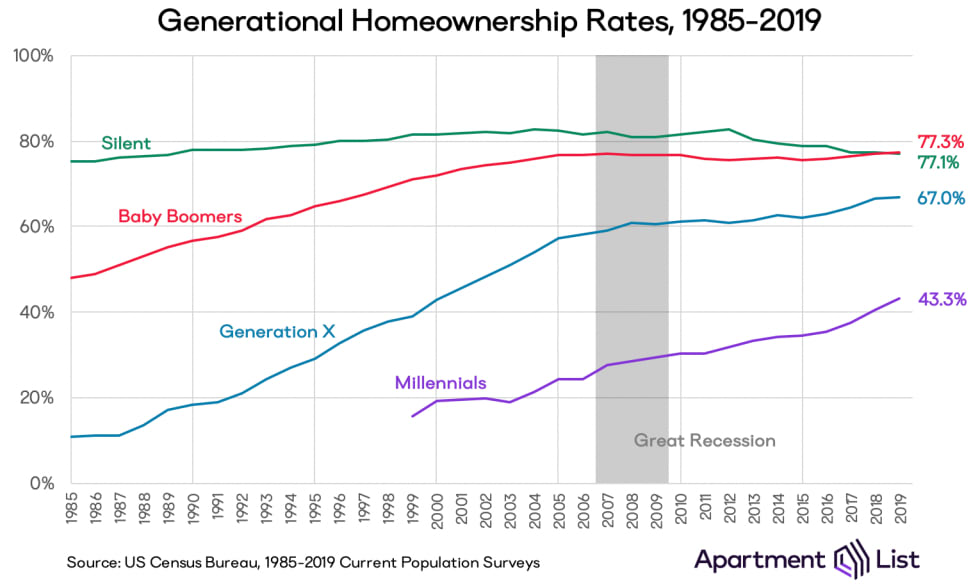
This isn't true. You will have put money into the property to keep its value up, also writing off all of those expenses, so that you can still rent it out.
You're ignoring what was written: if the building has value 0, then it is not maintained to keep the value up. Of you kept the value up, then it would not have an effective price of 0.
Of course most people put money into properties exactly to keep value up.
>also writing off all of those expenses
Writing off expenses does not make them free - you are still paying for them - out of otherwise profit. It just means you get taxed on net profit instead of taxed on property gross income. But you are still losing money.
Writing off expenses is not some free money giveaway.
The point was to illustrate that OP ignored costs involved for landlords in the thought experiment.
Or/and just refuse to pay rent for years while you try to evict them.
https://rentprep.com/evictions/when-can-i-evict-a-tenant-for...
"Thus, the eviction process can take from five weeks to three months, assuming there are no delays. If there are delays, the process can take as much as a year."
[1] https://www.findlaw.com/realestate/landlord-tenant-law/how-l...
And are losing value on the property, which is the point of depreciation.
>~30 years later, you've deprecated it down to an effective value of $0
An no one will now rent, since your building has an effective value of $0 since it has become crap.
All throughout your list you ignore all the costs involved in being a landlord. Have any friends that have tried it? (I do). Did they become silly rich? Or did they quit because it is a major problem to actually make it very profitable versus other uses of capital and time? I'm a decently saavy investor (in many things), and have watched multiple friends start up rental properties, only to stop once it became clear that tenants destroy things, costs to maintain properties are volatile and astronomical, the work required is significant, and so on.
I have done the math on real estate investing many times, and each time have decided the returns are not worth it.
>The net result is that rental properties generate a ton of income for the owners
If it were so profitable, then tons of capital currently being spent on other uses (tech, medical, finance) would instead go into buying up more housing. But the fact is that being a landlord is not very profitable, so capital doesn't flood into that market - it is still mostly elsewhere.
Historically, housing has performed quite similar to the stock market for returns - as it should be. If housing were a better investment, money would flow in until they balanced. If housing is too poor an investment by screwing with taxes, then money will flow out into other more productive places. And if money flows out, people wanting housing will then have to pay even higher prices for less stock.