I think a majority of people in NL would sacrifice the local nature (to some degree) to solve this crisis. The reason this isn't being done is because these are European rules. Which Dutch democracy cannot simply overturn.
Point being, it's European rules rather than concern for nature, that is the trigger.
Maybe, but that is just because the farmers have a great PR machine going. It does not make sense to sacrifice local nature for an billion dollar industry that mainly (70%) produces for export. Its not like the Dutch food supply will suffer from this in any way.
We are stuck between the option of having a government being an untrustworthy partner, or breaking European laws and sacrificing nature.
Is it really decimating citizens though? There's 35 billion euros available to compensate them. From what I've seen of the protests/blockades, it seems farmers are mostly upset they can't continue farming the way they currently do. I understand having to change your business practice and/or career sucks, but it's not the end of the world, and it has happened to millions of people that were working in declining industries before.
Furthermore, lots of Dutch farmers have a difficult future ahead of them anyway. Half of the farmers are over 55, and 30% of them don't have a successor lined up. To me it seems like taking the government buyout and retiring is a pretty good way out for them.
As for insect population, that is to do with pesticides, and horticulture. The farming problem causing these protests is nitrous compound emissions caused by keeping livestock. That is a totally different group of farmers.
The only crisis is that farmers have known for years they're absolutely major polluters and something would have to give, and as far as their concerned what has to give is the country.
> Point being, it's European rules rather than concern for nature, that is the trigger.
Bullshit.
The EU set aside money for financing nature reserves in member countries. The netherlands were happy to apply for 150 of them or so, and take the money.
It seems that farming isn't even mentioned in the issue of nitrogen compounds produced. Maybe they should work harder on the elimination of oil as an energy source.
However, farming emissions have plateaued: https://www.rivm.nl/sites/default/files/2022-06/Grafiek%20Em...
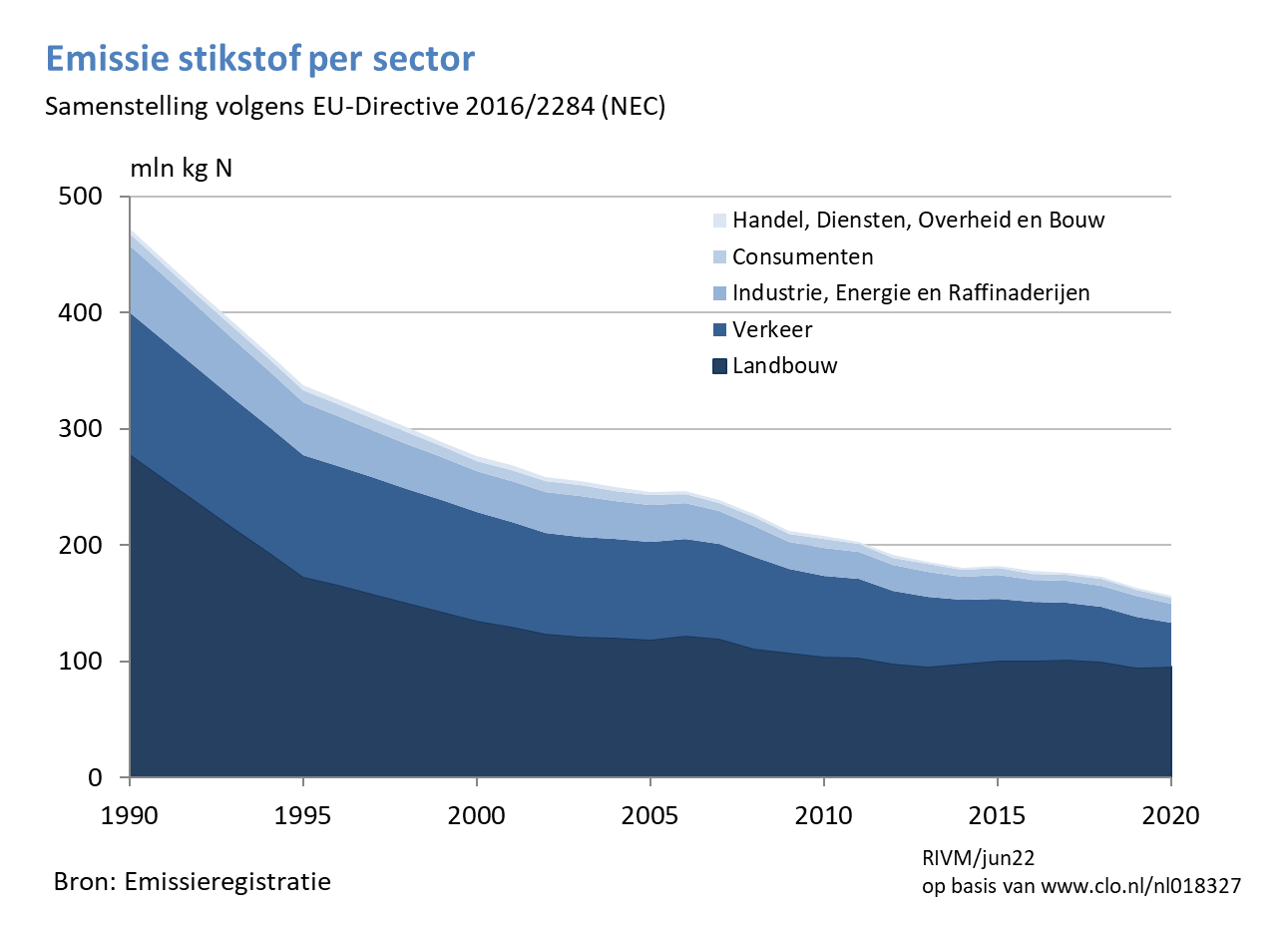
https://www.cbs.nl/nl-nl/dossier/dossier-stikstof/stikstofem...
This is not true, and the article you're linking to doesn't support your claim. The majority of the nitrogen containing emissions are NOx. About the differences in harmfulness between both gasses not much is known, at least not when it's about soil pollution. NOx is a powerful greenhouse gas though, while NHx is not.
Only by weight, but one molecule of NO (30 u) and especially NO2 (46 u) is much heavier than one molecule of NH3 (17 u). If you read literally the next sentence in the article, they convert the gross weight into amount of nitrogen, and the ammonia contains twice the nitrogen content.
If anything, higher concentration of nitrogen sources in Netherlands could make it easier to solve the problem, centrally.
So is farming more a scapegoat for these emmisions?
[1] https://so2.gsfc.nasa.gov/no2/pix/regionals/scripts/sliderav...
Thank you.
Anyone with a dog and a yard learns how devastating their waste can be to plants. Now multiple that by 10,000.
https://www.esa.int/ESA_Multimedia/Images/2019/03/Nitrogen_d...
And most of it is from agriculture (landbouw) 46% and abroad (buitenland)
https://www.rivm.nl/sites/default/files/2019-09/grafiek_herk...
Because the Netherlands is the second largest food exporter in the world after the USA:
https://medium.com/the-global-millennial/how-the-netherlands...
So something has to be done to lessen output of Ammonia and Nitrogen Oxides as they are destroying the local nature ecosystems.