Discovery of services (what can I help you with? what can you do for me) and trust (can I trust you to do task <x>? Can you trust me to pay you) are two of the biggest person to person transaction costs I see nowadays.
Maybe this just hasn't shown up in the numbers yet, because there's a delayed effect? Or do SaaS and remote work tools benefit firms internally just as much, or more, than someone contracting out work on the open market?
[0] https://marginalrevolution.com/wp-content/uploads/2019/01/HN...
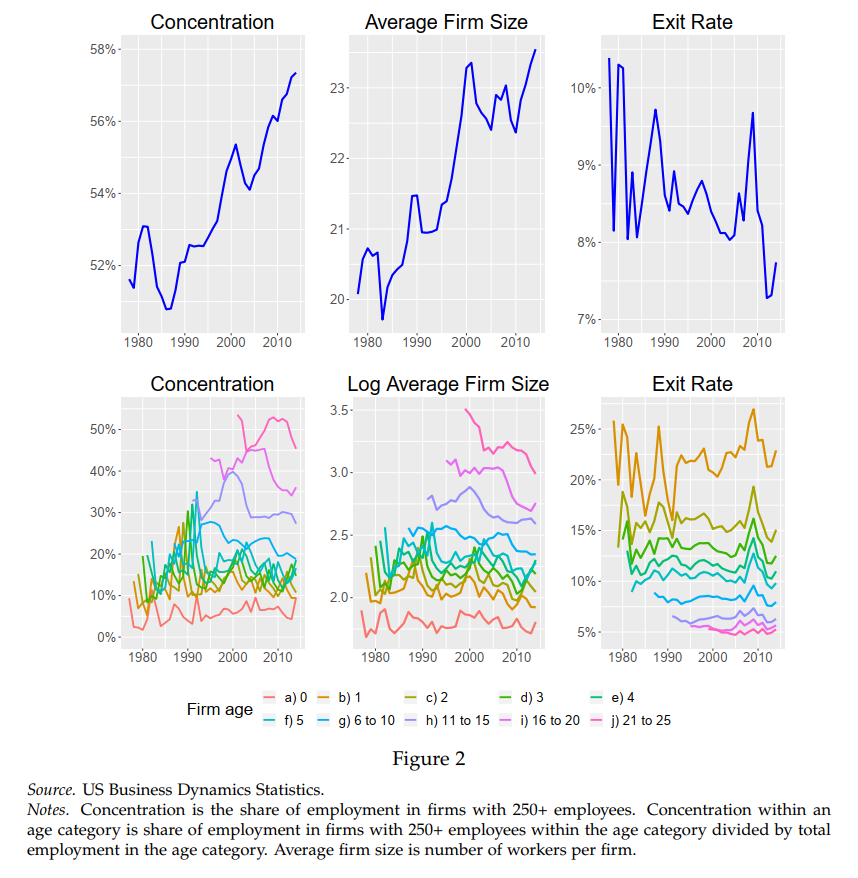
All of that being said, SaaS and remote work tools should reduce the cost of transactions in the firm, which means expanded control of capital and more productive monitoring systems. In effect this means that the company can coordinate restrictions on output, monitor agents, and curb the costs imposed by the agents on the firm.
Theory is ambiguous when it comes to markups, what the company charges versus the price that consumers pay. This might go up or go down. There is a lot of current debate on this. But the theory does suggest that markets should get more monopolized.
Let me know if you need more. This is one of my research foci.
Just rode through a startup and acquisition in a space I’d never thought much about (way underserved but all kinds of money sliding around) until I worked there with a smaller than I would have thought possible team.
I have skill-a , you have skill-b. Skill-a plus skill-b would make a device that would solve a big problem in the world. Company solves the transaction cost of finding two people with complementary skills.
Costs of organization can also drop, making firms more competitive compared to individual contracting.
This paper is the first economics paper I ever read (a long time ago, excuse my if my summary is awful lol), and still one of the most thought-provoking and interesting papers I've encountered.
The fun-to-think-about questions that it leads me to:
1. What sort of transaction costs between people today are _practically_ the most important to leading to a creation of a firm?
2. What if we built technology that reduced those transaction costs to near zero? E.g. what would it mean for there to be less incentives for a firm to form?
3. How does questions of transaction costs relate to market structure and monopoly?
I guess mostly this paper is amazing b/c it made me realize I never really thought to ask the question "why companies in the first place?"