There's also the aspect of "how much sun is there?"
https://en.wikipedia.org/wiki/Solar_energy_in_Finland
There are a number of issues with photovoltaic solar cells that close to the Arctic Circle.
What they need up there is a way to generate electricity from darkness.
Nuclear takes longer, is more expensive, has lower ROI, and higher risks. Solar has a lower capacity factor, but having 1/3 the availability at 1/15th the cost is a net win. Especially as we need vastly more power in the daytime and idling Nuclear is really expensive.
Currently 3% of global electricity comes from Solar and 16% from hydro with Nuclear only proving 10%. Scaling Nuclear to a significantly on a global scale take not just massive construction and new regulations, but also training etc, we simply don’t have the time.
1. https://www.statista.com/statistics/494425/death-rate-worldw...
Which is misleading in several ways, both because it ignores the majority of solar power and ignores how safe that power will be over time.
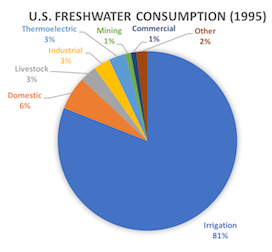
“Nuclear Energy consuming roughly 400 gallons of water per megawatt-hour, 320 billion gallons of water were consumed by United States nuclear power plant electricity generation in 2015.” And that’s direct consumption in cooling towers, nuclear indirectly uses power in other ways.
By comparison the 550-megawatt Desert Sunlight project in Riverside County estimated 2/3 cup of water per megawatt hour.
The notion that nuclear power is going to significant affect water supplies is without merit.
1. http://large.stanford.edu/courses/2017/ph241/styles2/#:~:tex....
2. http://large.stanford.edu/courses/2017/ph241/styles2/images/...
3. https://en.wikipedia.org/wiki/Palo_Verde_Nuclear_Generating_...
However, wastewater is just water. Look at a long river and towns upstream dump their wastewater into rivers that towns and cities downstream collect as municipal water.
Does this include the higher security needs around nuclear facilities?
I left out the construction costs, the Arkwright Summit farm, $125 million.
The Solar Star project was $2 billion.
This Finnish Nuclear site appears to have cost $12 billion.
That makes wind look really good, and solar at least on the same order (and still safer).
The other thing is the land. Solar and wind each need a substantial % of landmass to have 100% of our power come from those sources.
The ongoing costs of running nuclear are also way higher than solar or wind, which matters.
Reliability comes from solar and wind power redundancy and geographic distribution. If your collection area is over a few thousand square kilometres it is very rare for there to be no wind and no sun. Make it a few tens of thousand square kms (which modern high voltage transmission achieves) and your reliability is higher than coal.
That there is North Sea wind power, howsoever intermittent, is a pure good. Tying it into a larger network makes it better. The solution to local deficits is more localities.
Transmission lines are not expensive at all compared to nuclear power. This nuclear plant cost $12B and it is a cheap one!
Compare that to the SunCable is budgetted at $14B, (AU $20B in the article = US$20B) which is an undersea(!) HVAC cable all the way from Australia to Singapore (3,800km!) AND a 3GW(!) solar farm[1].
By comparison, the distance from Spain to Scotland is 2400km. And when the wind stopped in the North Sea, Spain was setting records in terms of the amount of power generated from wind farms[2]
[1] https://www.intelligentliving.co/australian-undersea-sun-cab...
[2] https://www.evwind.es/2021/12/03/27-8-of-electricity-came-fr...
Significant public investment in wind energy announced to start construction in... 2026. That is a glacial pace in the face of an ecological and geopolitical crisis situation.
It does insofar as it matters for capital. Who wants to invest in a plant that will take at least ten years (but probably more with cost overruns in the billions) before they see a ROI? Especially when the cost per MWH from a renewable project that will be online in 2 years with less risk is already comparable if not more competitive.
Who wants to invest in a plant that will take at least ten years
We're absolute crap at thinking long-term.
Look at you, talking about ten years as if it's eons. You're not wrong, of course! Capital doesn't like to invest in projects ten+ years before ROI.
But ten years is not a long time. We should be thinking about many, many things at least ten years in the future. Hell, forget ten years. We should be plotting our energy strategy with an eye to the next hundreds of years.
Of course, we won't, because we're humans and we really struggle to think past next week. And those of us in democracies have designed a system that literally punishes politicians for thinking beyond the next election cycle.
Who in 2000 would have guessed solar and wind would be radically cheaper than coal? No 100-year plan would have mentioned them.
If small-scale hydrogen-boron aneutronic fusion becomes unexpectedly practical in 20 years, all the other plans go out the window.
you gotta compare like-for-like. If the solar project that takes 2 years only provide power half the time, then you need double the size to provide the same amortized level of power at night. You also need some form of storage. And that's if you don't have a spate of bad weather preventing it from working - so to amortize that problem you'd need to build yet larger...
It's mostly (>60%) a mix of solar and wind power, with some gas that fills in the gaps - as well as batteries for grid stability. Still importing some coal power from interstate, but that is decreasing too.
The investment has been incremental - so much smaller amounts, with much less risk and therefor more attractive to investors.
A large part of this (since 2018) has been done by a conservative state government, who have been highly supportive of the renewable transition.
https://theconversation.com/against-the-odds-south-australia...
To answer more directly though, yeah the power is the same cost. Perhaps when renewable penetration into the energy market is saturated, there will be a greater demand for base load at all those times renewables aren't producing at peak, and that will be reflected in those nuclear MWHs becoming very profitable even at a higher unit cost.
I would absolutely never invest in a nuclear project but I sure am glad they are there to keep the lights on when the weather doesn’t cooperate for wind and solar.
A mix of different sources is the key to a robust grid, and nuclear is a great part of that mix.
As a side note on British Columbia site C 1000 MW a hydro dam is currently looking like it will cost 16 billion and take about 10 years to build, those numbers could easily be for a nuclear plant.
Markets are interesting for economic dispatch based on marginal cost, but then real world constraints such as rivers that must flow and a lack of infinite transmission capacity in all directions kick in and it starts to look a lot like what it replaced. I guess it works where it works
The worst case of nuclear, it is worse than the worst case of solar/wind. So even if it were rational for humanity, it might not be rational for a country.
I'm having trouble picturing how it is safer than solar though.
https://www.nextbigfuture.com/2008/03/deaths-per-twh-for-all...
Nuke fuel cost is huge compared to operating cost of solar and wind.
Nuclear power plants produce maximum power 92.5% of the time. Compare that to other energy sources:
- Geothermal: 74.3%
- Nat gas: 56.6%
- Hydropower: 41.5%
- Coal: 40.2%
- Wind: 35.4%
- Solar: 24.9%
Batteries are a joke. Consider the 409MW / 900MWh battery at Florida Power & Light: this is only enough to power 329,000 homes just over two hours. What happens after the juice runs out? In a day the RE Ginna Nuclear Plant in New York operates at 582 MW--in 24 hours thats 13,968MWh guaranteed! [3] That's powering over 329,000 or more homes without fear of outages. Battery systems in conjunction with renewables brings the capital cost per kwh of nuclear vs renewable to closer to 2:1 (6k $/kW vs 3k $/kW) too. So you're essentially getting 3x the reliability for 2x the cost when using nuclear and outages that exceed a few hours are a non issue. [4]
[1]: https://www.energy.gov/ne/articles/nuclear-power-most-reliab...
[2]: https://www.energy-storage.news/worlds-biggest-solar-charged...
[3]: https://www.eia.gov/tools/faqs/faq.php?id=104&t=3
[4]: https://www.eia.gov/analysis/studies/powerplants/capitalcost... page 28
Energy prices can be negative when there's not enough load but too much supply. Not every power source can be just switched off.
The person I responded to claimed that nuclear plants run at close to 100% because they bid low because the marginal cost of their electricity production is low, but the same is true for renewables like wind and solar. Yet these renewables run at much lower utilization rates - because of weather and daylight cycle, not "because they can", except in rare cases of negative prices as you mentioned.
1. Bad management of construction project, almost near corruption level stupidity. Many constructions tasks outsourced to contractors who outsourced them to contractors who outsourced them to contractors, making it easy to take "cost-saving" shortcuts and difficult to supervise.
2. Failure of corruption to speed things up: Finnish nuclear safety authorities are not easily bribed, so when issues with bad quality of welds, concrete, boiler valves and safety electronics were identified (all this from memory, these were separate incidents), the issues could not be smoothed over and ignored with well-placed thick envelopes. The authorities would demand the construction crew to tear stuff apart and do again, properly. And if it didn't pass, then again. And again.
Most of the issues I have read about do not sound like "nuclear technology" failures, more about failures in building a big pressurized boiler power plant. The nuclear part comes in by authorities requiring high quality. They couldn't make good enough concrete bed on a first try, that isn't some super novel space technology.
It mostly reminds me of similar kind of mismanagement that plagues many big construction projects run by big corps managed by suits. During same time frame city of Helsinki wasted amazing amount of money in a "automated metro car" subway upgrade project they bought from Siemens, which ultimately didn't work and had to be scrapped.
(edit. City of Helsinki decided to "automate" city subway metro system in 2006, contract signed with Siemens in 2008, originally planned to be completed in 2011. Project was postponed several times and effectively scrapped in 2016. Tried googling most recent news, the lower district court had given judgement in 2021, parties likely to appeal.)
Funnily enough, the 2nd and 3rd EPRs in China both opened before this one, taking "only" 9 years from start to production. They're also the world's largest reactors now.
One of them is shut down since mid-2021 after an incident (leak).
Which seems to topple most of your argument.
As for wind turbines on land, they require a lot more space for the same yield, space which is stolen or irreversibly destroyed for the local fauna. Here in Norway, wind turbines near settlements are also forced to run on diminished capacity at night because of the health problems people associate with the 24/7 humming and whoosh noises (not kidding).
To produce 1 gigawatt of power you need 1000 square kilometers of wind turbines or 300 sq km of solar elements or 3 sq km of nuclear power plants. How much land do you have in your country that you are ready to deforestate in order to build renewables?
Predictability.
Renewables depend on weather. They only work when the wind blows or the sun shines. Are you ready to be able to heat your house only when the weather forecast is good?
On top of that, some solar installations are actually compatible with some foods, here's one article on that: https://www.dw.com/en/farmers-reap-double-benefits-with-sola...
Point being, land use doesn't need to be single purpose in your example.
In terms of the weather, this is why it important to have balanced installations and associated battery storage.
There is absolutely no need for single-use solar or wind area, anywhere.
Predictability: spreading out production units, using a mix (wind, solar...) and storage are key. https://www.imperial.ac.uk/news/180592/european-cooperation-...
Essentially, building a nuclear power plant in 2022 means you are betting we won't have workable storage for renewables by 2052.
If you add in batteries with todays technology the nuclear plants are competituve with solar or wind.
So the alternative is coal or natural gas plants. Which then have their own drawbacks.
Solutions that are built today need to use technology available today.
Nuclear is fine, especially when you are not buying the first reactor of its kind from a vendor who has never fully built a plant on its own. Areva got a tad too greedy and cut out the middleman in the form of doing 100% of the work themselves instead of the usual 30% and contracting out the rest. They ware not helped by the fameously strict Finnish regulatory authority (STUK).
Add that in and the equation looks substantially different.
https://en.wikipedia.org/wiki/Yucca_Mountain_nuclear_waste_r...
The method is Swedish, they seem to have good pictures of it here: https://www.skb.com/future-projects/the-spent-fuel-repositor...
https://www.npr.org/2022/03/11/1085427380/ukraine-nuclear-po...
Other forms of generation that require GHG-emitting backup generation.
By comparison, this wind turbine project near my parents was approved in 2016 and completed in 2018, providing 78 megawatts of power. Yes that's significantly less than the 1.6 gigawatts of this Finnish power plant. But, consider that in the same time period, 10 of this wind projects could be completed.
On top of that, solar projects are also much faster. Look at the Solar Star solar installation which provides .5 gigawatts of power, started in 2013 and completed in 2015. So 10 of these could have been completed in the same time as the Finnish system. No, I'm not suggesting that Solar is a good option in Finland. And yes, it would be important to work on massive battery storage systems, to make these work.
This just points out just how uneconomical nuclear power is. On top of that, with nuclear facilities coming under fire in Ukraine and Russia making (probably bluffing) threats against Finland, it really makes nuclear an unappealing option. Can someone point out why these projects are so attractive to so many people when it would appear that a combination of renewables appear to both be faster to bring on line and overall safer?
Edit: forgot the links,
Arkwright Summit https://en.wikipedia.org/wiki/Arkwright_Summit_Wind_Farm
Solar Star https://en.wikipedia.org/wiki/Solar_Star