And uh, does the genocide of the Uigher population somehow not count as an evil? I mean I know they are Muslims and not Jews but seems like we should be concerned about them being forced into camps and sterilized...
This is not to say TikTok is some wonderful, innocent thing. But the harm done by it compared to Facebook is just not remotely comparable, at least not yet, and that may be partially due to the nature of what the platform pushes and to whom.
I do wonder if ByteDance does really just want to chase profit here though, and letting TikTok be weaponized by the party would hurt that.
Facebook's numbers are falling despite a growth in world population, and I'd bet a larger growth in the internet-connected population. That's worse, especially for a platform heavily reliant on network effects.
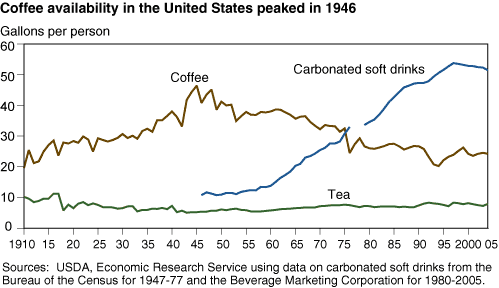
Peak coffee is in 1946, but what have consumers moved onto from then? Alcohol, Tea, Energy drinks, Soft Drinks ?
Coffee 1946: 46.4 gallons per person
Coffee 2005: 24.2 gallons per person
Soft drinks 1947: 10.8 gallons per person
Soft drinks 2005: 51.5 gallons per person
Total caffeinated consumption in 46/47: 57.2 gallons / person
Total caffeinated consumption in 2005: 75.7 gallons / person
The chart seems to indicate tea has stayed relatively flat in the same time period. I'm not sure the history of caffeine pills or ADHD medicine, but those may also contribute to an increased consumption in 2005.
[1] https://www.ers.usda.gov/amber-waves/2007/june/coffee-consum...
Wow, no wonder Diabetes has skyrocketed.
51.5 gallons is almost 900 ml a day. That is about 100 grams of sugar per day.
This is like a epidemic of sugar addiction.
I don't say this to condemn these drinks (if people like them that much, they're free to spend money on the little things in life they enjoy), but I'd like to square my experience of not caring for them versus their clear popularity from statistics.
But this is the thing about addiction, to the person who isn't hooked it seems odd.
As a kid I used to wake up at night and drink Coke. I just craved it, that's how it was. I still like something sweet to drink but I control it these days, and my taste is not quite the same as an adult. Still, there's no accounting for it, you want something because you want it. Best explanation I can find is that it triggers something connected to reward paths in a way that isn't how that reward path evolved.
This is the crux of the matter. Whether something is too sugary is a matter of taste and habit. It tastes too sugary to you, but great to other people.
Your logic is sensible adult talk ..
ps: my body crashed I'm now borderline allergic to processed foods and sodas, it's still strange to me :)
My parents forbade me from soda growing up, but my cousin once snuck me some sugary orange pop once (I didn't like the fizz when I first tried it, but I liked it more when I tried it again). I still have a preference for it sometimes due to the memories (along with root beer, which I also tried when younger) if it's free, though just a small cup. I never tried Coca-Cola or Pepsi until an abnormally older age, so that's probably why these two never stuck for me.
I find the coffee at 46 gallons stranger. 570ml a day of coffee? What's even more wtf is that in Central Europe during and after the war coffee was very expensive/difficult to get so people were drinking coffee substitutes (chicory root for example) while people in the US drank half liter a day.
>Coffee 2005: 24.2 gallons per person
24.2 gallons per person.. so that is 24.2 gallon / 365 days * 128 oz/gallon / 8oz/cup = 1.06 cup / day.
1 cup per day? That seems crazy low. I guess that must include kids/young adults..
https://www.ers.usda.gov/webdocs/charts/58920/finding_buzbyf...
- Gatorade and similar stuff - A movement to drink water (HydroHomies) - High caffeine energy drinks (Red bull and the likes) - Healthy alternatives (juices, smoothies, etc)
Perhaps the US used to drink espressos in the 1940s, I'm not sure. That's if this fact is even accurate.
US consumption in 1946 was apparently ~20 pounds of coffee beans annually per capita, or an average of around 2.5–3 (8 oz?) cups of coffee per day for the ~3/4 of adults who were regular coffee drinkers.
Per https://www.retrowow.co.uk/food_and_drink/coffee/coffee.html
> Most people [in the UK] made coffee in a jug. You boiled the water and added it to ground coffee already in the jug. You let the ground coffee settle and it was ready to pour through a strainer and drink. Some people then boiled the coffee again.
My impression is that coffee preparation was comparable in the USA. Neither paper filters nor instant coffee were common until decades later.
Espresso was unknown in America back then. Rumor has it that GIs, when exposed to it, diluted it with hot water, giving us the modern Americano. [0]
This one interested me. We're at a local maximum in terms of coffee consumption in recent years. After WWII coffee fell off in popularity and due to the substitute of carbonated soft drinks. Most likely in simplest terms it was a cheaper energy drink for the poor.
Hardly the best example of America getting over an addiction.
I'd say it is actually remarkable just how long Facebook (the site) has been able to maintain relevance, whereas people should have been bored and migrated to something newer and shiner a long time ago (as is now finally happening with apps like TikTok).
Facebook is the least of my problems when it comes to addictive substances. Youtube, Reddit, Hackernews, TikTok. They're all the same even if they don't go out of their way to insight addiction.
Coffee consumption begin 15th century
Tobacco 18th century
Oil: 347 AD
Social Networks: circa. 2002.
And the indians of America consumed it much earlier.
Just to clarify.
Peak cigarette consumption (per capita/US): 1963
Peak oil production (global): unknown, maybe 2020-2030
Peak Facebook: ??
That's an incomplete peer group, but I find it interesting that at some point, society does start to unplug from addictive substances. The tapering off is quite slow, though. Unclear whether heavy users cut back, or new generations just don't develop the habit as older ones die off