https://cdn.substack.com/image/fetch/w_1456,c_limit,f_auto,q...
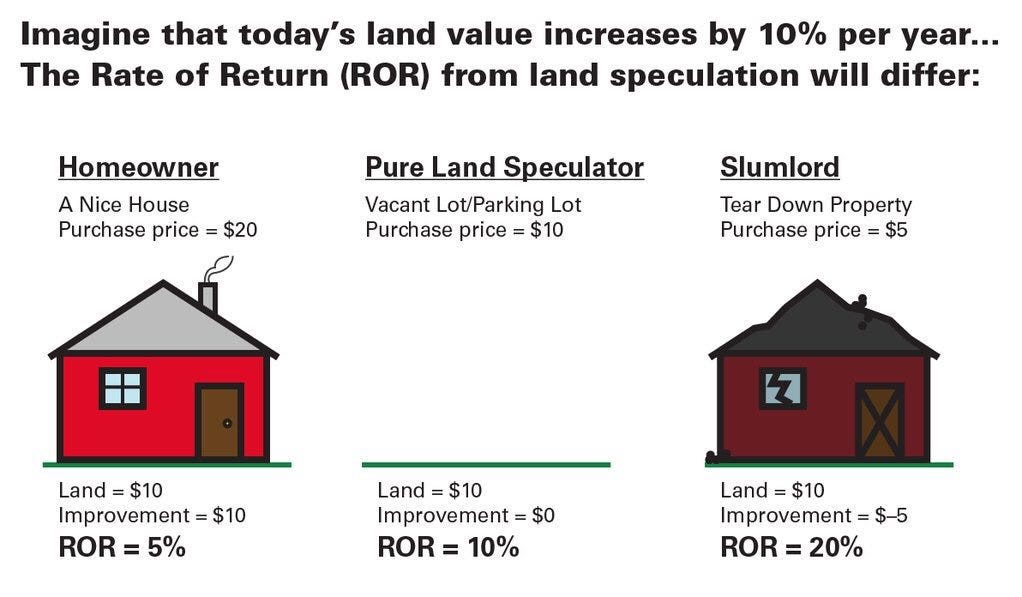
So imagine that the return from land was taken away. The only thing a landlord can charge rent on now is providing a nice building (capital) and good service & maintenance (labor).
The first property, "a nice house" would be able to charge rent -- because it now has value above the value of an empty field.
The second property, an empty lot, would be able to charge approximately nothing (the government collects the land rents, and this is capitalized into the price such that you can't charge any additional rent above that).
And yes, the third property (teardown property) you'd have to actively pay people to occupy, because you can't charge for access to the land, and the place sucks and is hazardous to your health.
What's the incentive in this situation for a landowner who wants to make money? Build something good (capital) and provide good service (labor), both are things we want to encourage.
Of course, the above assumes that land value taxes are fully capitalized into land prices and thus can't be passed on to tenants. This isn't discussed in this article (Part I) but will be discussed tomorrow in Part II.
A few follow up questions:
- I'm interested to see how this affects multi-family housing. Do the same mechanics come to play? In an apartment complex, I assume that the positive or negative value of the property would be way greater than the land value, no?
- Do the resulting effects of the 3rd property only apply for teardown and straight up unliveable properties? Or would it be the blanket bottom x% of all houses in SF? If it was the latter, could this count as an inefficiency under the proposal? As "bad but livable" units today are now taken off the market?
- Does the "good house" now lose re-sale value now simply by virtue of being next to a "bad house"? Let's say that the house issues are internal, and the outside is fine. Is this okay?
Looking forward to part II. If these questions get answered then, I'll just wait until I read it and ask more questions.
- As far as I know, yes, LVT would definitely incentivize multi-family housing over single-family housing.
- I'm not sure exactly where the threshold would be. Under current market conditions where landlords can collect land rents, it'd be any place where the property is so bad that the rent is less than you'd be able to collect if it were, say, a parking lot. This might still be a good investment for the slumlord because the presence of the teardown property has negative value and makes it cheaper to buy than if it were just an empty lot, and then they just refuse to fix anything and collect the land rents.
- Not 100% sure what you're asking but maybe I can answer it this way -- So locational value comes from the activity of your neighbors. That's why "location, location, location" is a thing. If you're in a good neighborhood, your land value goes up because it's a nice place to be and people will pay more for that privilege. If there's, say, a crackhouse next door that will depress your land value for obvious reasons.
To clarify the last question, my house value would be affected if it was known that my neighbor will undergo a construction project. So I was just wondering that if the rise in propensity to teardown increased under LVT, that it would have weird ripple effects of devaluing the land of the good house by virtue of it being next to a future construction zone.
Currently you charge tennant a as much as you can until they no longer live there. That works out to be as much as they can pay for the benefit they get. If you charge 1k a month now, the reason you don’t charge 1200 is because they won’t pay it.
If you have a LVT, and try to increase the rent, your tennent wouldn’t be gaining any more value from the land that they currently are, so you still won’t be able to charge 1200.
>If you have a LVT, and try to increase the rent, your tennent wouldn’t be gaining any more value from the land that they currently are, so you still won’t be able to charge 1200.
This only holds if there's no competition between landlords - so the landlord extracts the maximum possible rent from each tenant. If I'm a tenant and living in this area is worth $1500 for me; but there are two landlords competing to have me pay them, I might end up paying $1000. If then both landlords raise their prices to pass the LVT, my rent ends up higher.
It's an empirical question and not easy to answer as to how much of the economic surplus is captured by the tenant vs landlord
On the opposite situation where properties are empty, they are empty at any price, LVT won’t change the price. They currently can’t be rented out for $50 a month, so why would they be rentable with LVT
The only properties which will be flakey are those where the cost of renting it out (maintenance etc) is lower than the current asking price, but higher once you include LVT.
However as LVT will cost whether you’re renting out or not this will simply increase incentive to sell (if you can’t get enough to rent out), reducing the purchase price, and allowing people to live there.
Given that in cities where rents and land values are highest the number of empty properties is minimal, increasing the cost of owning an empty property won’t increase that number.
> this will simply increase incentive to sell (if you can’t get enough to rent out), reducing the purchase price, and allowing people to live there.
But that means less supply for rental, and presumably lower impact on the demand for rental given how different the renting versus buying populations are. Even in a maximally efficient model this should result in raising rents?
>What kind of effect will this have on the rental price of the bad house? What will dictate the floor of it?
The bad house would have the same rent it would without LVT. The only difference is that the landlord would be making a loss if the house is too shitty or too low density.
The landlord is then faced with 4 choices - 1) make eye watering losses by not renting it out. 2) continue to make losses renting it out, 3) sell up to somebody who will redevelop, 4) redevelop themselves.
LVT should put upward pressure on the quality of housing (and density in big cities) because landlords will eat losses if they don't.
You'd probably need separate rules for historic buildings (e.g. an LVT discount) since it will become an amplified driver to knock them down and replace them with high rises without some impediment from doing so.
What would change is that the land-owner would make less profit. Potentially, a unit which is currently renting for $1100/mo in Manhattan might be assigned an LVT of $1500/mo. In that case, the landowner will lose $400/mo. However, if they stop renting it out, they will lose $1500/mo.
The rational thing to do would be to improve the accommodations so that someone would be willing to pay $2000/mo to rent it. Then the landlord would profit on the improvements they made (rather than profit on merely owning high-value land). They would be rewarded for the value they added on top of the land.
But that doesn't mean that the maximum rent (whatever the market can bear) will remain the same if all landlords had their costs go up by the same amount at the same time. It could fall as landlords get out of the renting business because the costs are above what the market will bear, but I think that it is equally likely that landlords will first raise the rents to try to stay in business.
What makes an area expensive to rent/buy in is not "greedy landlords", it's primarily the fact that the demand is high. Any solution that doesn't involve matching the demand to the supply is bound to fail in the long term.
Land may be a scarce resource, but that's only in select places. It might be better to spend the effort making the undesirable places more desirable than by knocking down existing buildings and replacing them with high-density buildings.
A non-CBD area that has high-speed internet, quick+cheap public transport to the CBD, electricty and clean water supplies should be fairly desirable to live in. Those who want an address in the middle of the city shouldn't expect to pay the same as those who are prepared to travel to the middle of the city.
I don't think that building more housing units in the middle of the city is going to solve the problem of expensive housing in the middle of the city. The middle of the city is always going to be expensive.
They might try and they certainly would threaten but if they jack up rents and as a result can't get any tenants then they're in an even worse position than before as they have an LVT bill and no income to support it.
Without a restriction in supply or an increase in demand (neither of which would happen), rents can't go up.
It would cause a precipitous decline in property values and a lot of landlords (mostly amateurs) would scramble to sell up and get out of the landlording business as it became more like an actual business and less of a license to print money.
Why won't they get any tenants? Do people have somewhere else to stay? Will they leave the city altogether?
Indeed. Proponents seem to argue that most of that high rent paid by tenants will be captured by taxes and redistributed.
Proponents goal is to make "similar" improvements provide the same net profit across the country, even if the rent for it is $800 in Detroit and $4000 in Manhattan. The taxes would be $300 in Detroit and $3500 in Manhattan. Therefore a developer looking for $500/mo profit could just as easily build in Detroit as in Manhattan.
After the demand for housing was satisfied by supply rents would fall, and LVT would fall as well, such that landlords continue making $500/mo profit on each of those identical units.
At least, that seems to be the ideal situation presented by proponents as I understand it.
Thanks, I understand a little better now. I'm still not convinced that such a thing will be viable, though.
The end result is still going to be that people will be willing to pay more to live in Manhattan rather than Detroit ($4000 vs $800, for example), and thus the effective rent being charged is not going to change.
> After the demand for housing was satisfied by supply rents would fall, and LVT would fall as well, such that landlords continue making $500/mo profit on each of those identical units.
Maybe; I remain unconvinced that simply replacing low-density houses with high-density houses in the middle of (for example) Manhattan is going reach a point where supply:demand ratio is the same as Detroit.
It would be interesting to see how this plays out, so I'm quite happy for this to happen :-)
Could it be possible in areas like Detroit where the cost of renovating the house for profitability is just too prohibitively expensive that the house itself just isn't sellable? Could home-owners now somehow be stuck in situations where they are forced into debt by holding a property that just sucks money out?
Especially if implemented too suddenly?
If you were fabulously wealthy, you could choose to maintain your single-family brownstone there and simply pay the millions in annual taxes. The local school district wouldn't notice a difference. But most landowners would decide to partner with a developer and build a skyscraper so that they can earn more than the LVT, which should lower rents for the laborers in that city.
> Could home-owners now somehow be stuck in situations where they are forced into debt by holding a property that just sucks money out? Especially if implemented too suddenly?
Yes. As could large commercial real-estate holders. The reason is simple: if you raise taxes, the resale value of the land will be lower. A graduated implementation could help a bit, but the final "price" will still get instantly priced in with a bit of a time discount.
Proponents of Georgian LVT are generally comfortable with lowering the resale prices of real-estate. They may underestimate the degree of the change, or misjudge the wider effects of most properties suddenly being worth less. However, proponents generally don't like the idea of people earning their retirement just by holding land. So the first-order effects on resale prices of land are more of a feature than a bug.
I'm not entirely convinced that second- and third- order effects wouldn't be potentially devastating. I believe if the nation had been founded with a Georgian LVT things would have worked out much for the better! But I'm afraid of how much of our economy we have precariously perched on infinitely rising land prices.
Could there be a case where existing unpleasant rental properties in highly dense urban cities suddenly have negative rental value?
For example, imagine there was a run-down house that is livable, but is one of the most undesirable in SF. Adjacent to it, let's say there's a shiny desirable house with the same land characteristics. If I understand correctly, these 2 apartments would have the same land value tax right?
What kind of effect will this have on the rental price of the bad house? What will dictate the floor of it?
- Would it be the cost of the LVT? - Would it be the lowest rent transaction that occured in the market? - Would it be zero?
If it is one of the last two, I can't imagine the land-owner renting it out except for speculation on the desirability of living in SF right?