News for hackers. Stuff that matters.
Re:Yamaha DX7 Technical Analysis by metaphor on Thursday October 21, 2021 @02:29AM (#28941073)
> In mathematical terms, FM synthesis is achieved by using the instantaneous amplitude of a sound wave (the modulator) to adjust the rate of change in the phase angle of another wave (the carrier).

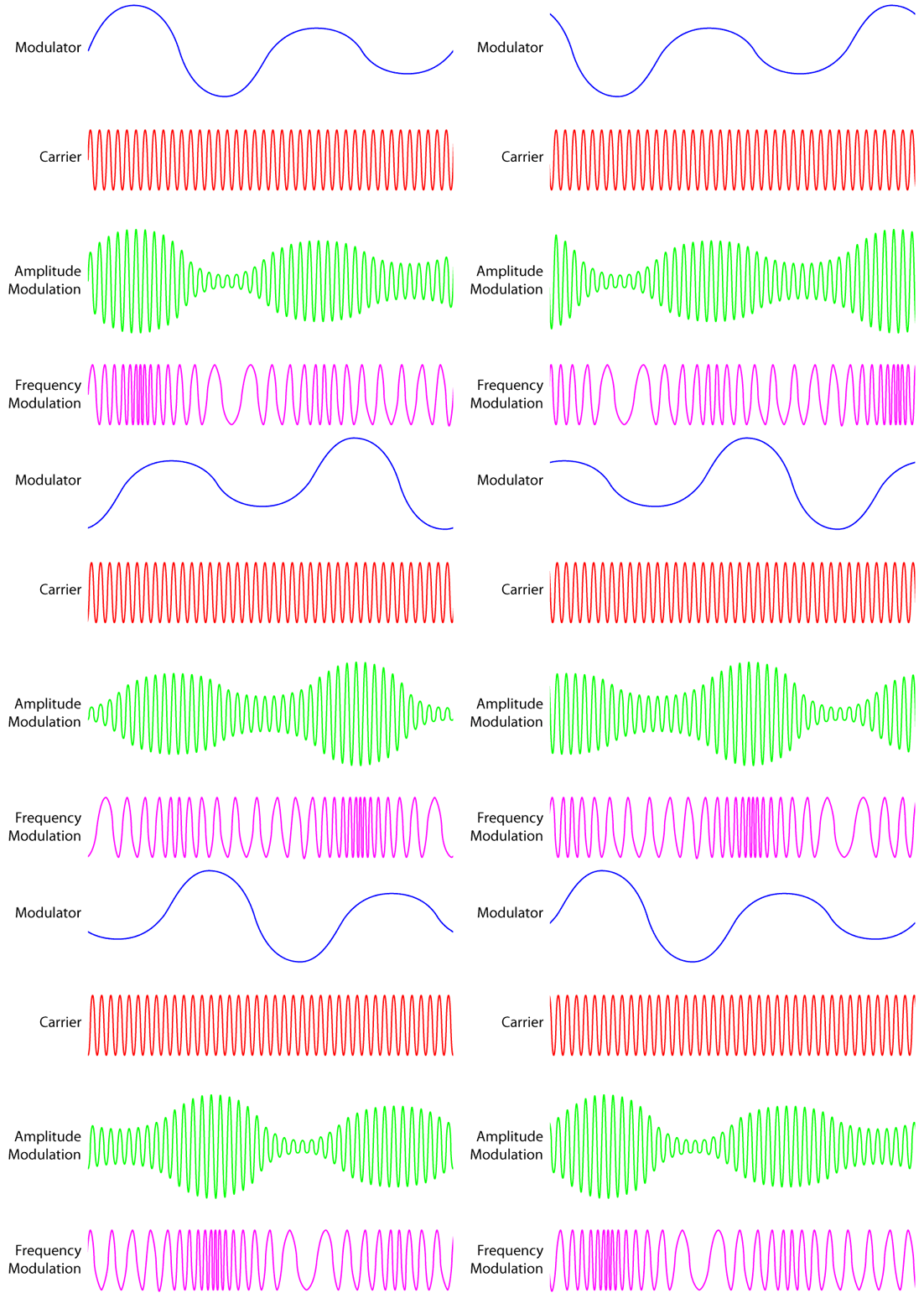
> As convoluted as this sounds, it makes more sense when visualised: [1]

...but does it??

[1] https://ajxs.me/static/img/articles/dx7_technical_analysis/f...

Re:Yamaha DX7 Technical Analysis by armchairhacker on Thursday October 21, 2021 @02:50AM (#28941198)
Idk what's going on with the modulated carrier in that image. Here's a better visualization: https://flypaper.soundfly.com/wp-content/uploads/2017/09/AM_...

Notice how, when the modulator wave is at its top the FM wave is very short, and when the modulator wave is at its bottom the FM wave is very long.

FM = adjust the frequency (width) of the carrier based on the absolute value of the modulator.

Re:Yamaha DX7 Technical Analysis by ajxs on Thursday October 21, 2021 @03:40AM (#28941512)
Author here: Thanks for pointing this mistake out! I'm not sure how I didn't validate this. I believe the mistake lies in the absolute value aspect of the formula. Unfortunately I can't find the script I used to create those diagrams. I've been meaning to revisit this article, and update it with some of my more recent discoveries. I'll make sure to update this when I do so!
Re:Yamaha DX7 Technical Analysis by metaphor on Thursday October 21, 2021 @04:12AM (#28941733)
Link to the Chowning paper[1] is broken too; hazarding a guess that neither AES nor Prof. Fessler would mind.

[1] https://web.eecs.umich.edu/~fessler/course/100/misc/chowning...

Re:Yamaha DX7 Technical Analysis by ajuc on Thursday October 21, 2021 @04:51AM (#28941985)
> ...but does it??

I think in this case the clearest explanation is the equations + graphs:

    1. modulator(t) = sin(t)
    2. carrier(t) = sin(t*4)
    3. result(t) = sin(t*4 + d modulator(t)/dt) = sin(t*4 + cos(t))

http://www.fooplot.com/#W3sidHlwZSI6MCwiZXEiOiI0K3NpbigxMCp4...

EDIT: it's wrong, see below

Re:Yamaha DX7 Technical Analysis by MauranKilom on Thursday October 21, 2021 @05:55AM (#28942336)
I'm pretty sure you need an integral in there somewhere, no?
Re:Yamaha DX7 Technical Analysis by rcxdude on Thursday October 21, 2021 @04:04AM (#28941683)
"rate of change of the phase angle" is just a convoluted way of saying 'frequency'
Re:Yamaha DX7 Technical Analysis by jacobvosmaer on Thursday October 21, 2021 @04:48AM (#28941960)
I'm not sure. Intuitively I would think "phase angle" means "offset into the sine wave lookup table".

If you step through the lookup table with constant size steps, you would get a sine wave. If the steps are not constant size then you get a distorted sine wave. The "rate of change of the phase angle" would then be the step size.

Re:Yamaha DX7 Technical Analysis by HelloNurse on Thursday October 21, 2021 @05:25AM (#28942188)
What matters for FM is an instantaneous quantity: the derivative or increment of the instantaneous phase, i.e. how the phase changes from sample to sample.

What is usually called frequency, and has the same value in boring cases like an unvarying sinusoid, is the inverse of the period of the resulting sound as someone would hear it, which is not instantaneous and needs on the order of one period's worth of samples (usually more) to estimate, for a certain definition of period (e.g. interval between zero crossings) or a certain mathematically reasonable calculation (e.g. estimating the frequency of the strongest component from a fixed-length window of past samples).

Re:Yamaha DX7 Technical Analysis by ajxs on Thursday October 21, 2021 @05:20AM (#28942156)
Author here: This is one reason why I used that term. I was definitely thinking in terms of the 'phase accumulator' looking up the sin table.

Everyone is absolutely right that this is the same as frequency. I think I was used that particular poetic flourish to emphasise how complicated the academic, mathematic explanation is, in contrast with the diagram. Quite likely I picked up that exact phrasing of "phase angle" from some academic literature in particular.

Re:Yamaha DX7 Technical Analysis by joeberon on Thursday October 21, 2021 @05:24AM (#28942184)
> This is exactly why I used that term

That's a lie, because:

> I think I was used that particular poetic flourish to emphasise how complicated the academic, mathematic explanation is, in contrast with the diagram

is a totally different to what the person you are replying to said

Re:Yamaha DX7 Technical Analysis by ajxs on Thursday October 21, 2021 @05:29AM (#28942214)
I've edited my post to clarify. It's a reason why I used that term. The second part of my post is not directly addressing what GP said. One of my aims in writing this article was to create something that could be interesting to read, with someone like myself as the target audience. Part of that involves using some artistic flourish.
Re:Yamaha DX7 Technical Analysis by rcxdude on Thursday October 21, 2021 @05:03AM (#28942062)
This is exactly how direct digital synthesis works and the 'step size' is labelled 'frequency' (specifically, frequency in HZ = step size / size of table * update rate)
Re:Yamaha DX7 Technical Analysis by joeberon on Thursday October 21, 2021 @04:59AM (#28942035)
"frequency" would mean the same thing in your weird practical analogy.
Re:Yamaha DX7 Technical Analysis by 8bitsrule on Thursday October 21, 2021 @04:20AM (#28941790)
It helps me to think of the difference between AM and FM radio.

In an AM radio signal, the frequency of the carrier is constant; the amplitude of the audio modulates the amplitude of the carrier.

In an FM radio signal, the amplitude of the audio modulates the frequency of the carrier. That's the difference!

In musical terms, I very much like some analog, and some FM, synthesizers. But certainly, back in the day, getting some rich sounds out of FM synths was a lot cheaper than analog. (Just in terms of the cost of patch cords alone ;-) Without Chowning there wouldn't have been a synthpop era!

Re:Yamaha DX7 Technical Analysis by buildsjets on Thursday October 21, 2021 @02:43AM (#28941161)
If you understand Bessel Basis Functions, or the design and tuning of motorcycle carburetors, then it makes perfect sense. If you are uneducated on these and similar arithmatic summations of wave functions, then it will make no sense.