In particular, Yggdrasil's mobility performance is far better than anything provided by the likes of BATMAN-Adv, Babel etc, making it ideal for roaming users and ad-hoc/mesh networks. https://yggdrasil-network.github.io/assets/images/latest/mob...
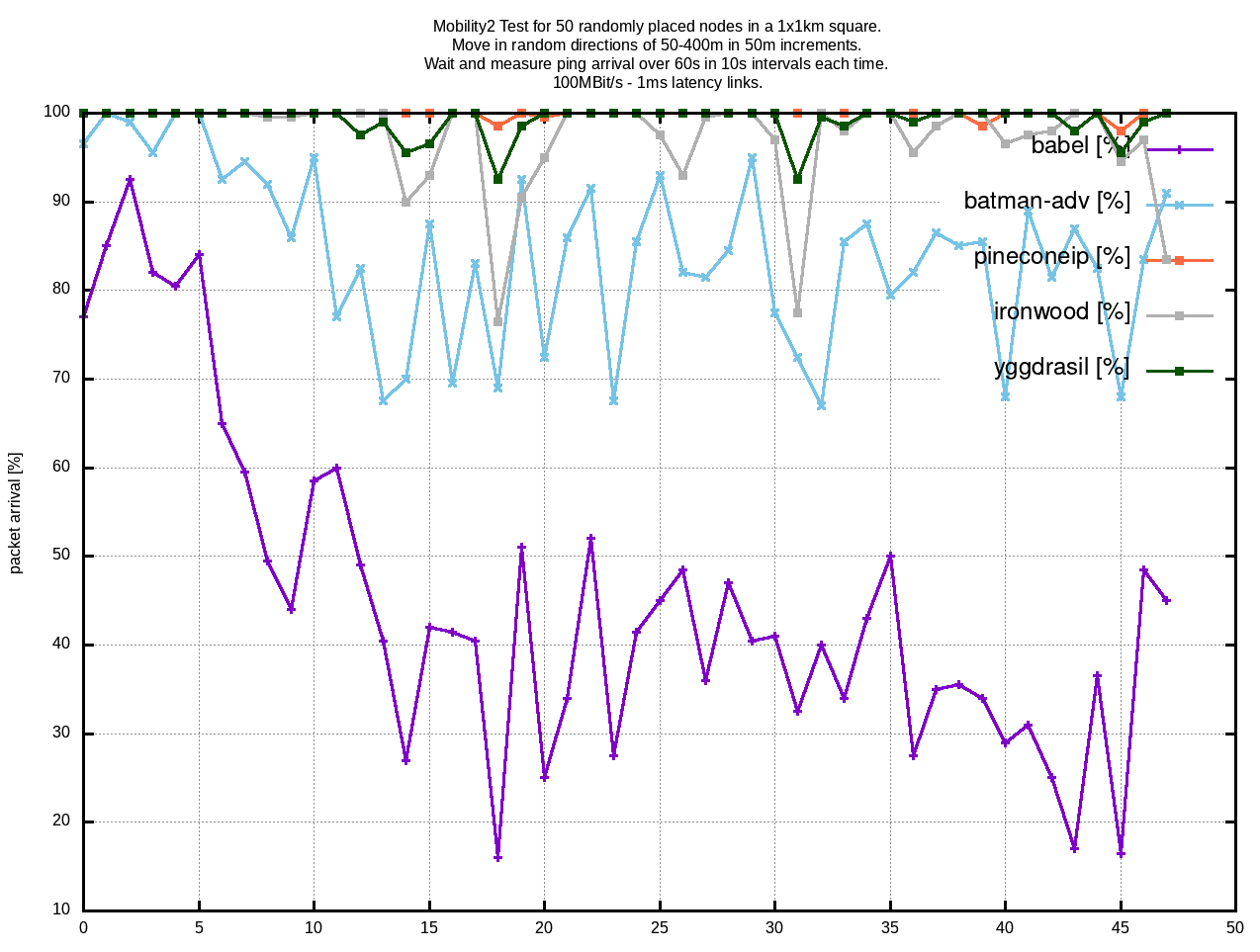
There are some higher-level tools that can manage your peerings, but at that point, yggdrasil just offers a unique IPv6, derived from your crypto key, and end-to-end encryption, both of which can more or less be achieved with wireguard alone.
INET256 is working on exactly that. It's a set of APIs for connecting to addresses derived from public keys.
- universal human-assignable names
As long as you're replacing IPs, replace DNS, too. When you tell a friend about this great new site, make sure you can tell them with something closer to "pasciencia y fe" than "fe88-2533-a210-dead-b33f-3301-3412-4dc1"
Big services will need scale and distribution; if it's built in early and well, that makes it easier to adopt.As far as human-assignable names go, I am not sure. "pet names" would be a good fit: you "pin" a service using your name or someone else's.
Sure, you can also use a ready-made mapping from words to binary like https://what3words.com/inferior.chapels.nerve for instance, but I feel like picking one is a separate endeavor with its own pitfalls (not everyone speaks English, etc).
You're asking for a solution to Zooko's triangle: https://en.wikipedia.org/wiki/Zooko's_triangle
"You should check out correct horse battery staple" vs "You should check out news.ycombinator.com" -- one of those requires me to maintain a meaningless mapping in my head, and the other contains structure and clues even if it isn't "Hacker News".
Then, similar to HSTS, the browser could remember the mapping and use the DNS name as a pet name for the target.
Another alternative would be to use "phonebooks". One could trust a few trusted websites for the initial handshake: "oh, just google battery horse to find my blog". Or: I'm linked on John's blog. That goes well with pet names, but is a bit more involved.
In any case, as long as the underlying identifier is secure and unique, you can just share that trough other means (links, Qr codes, messages, etc).
> - universal human-assignable names
Seems like if we wanted to add human names, DNS would work just fine--it could just be a new record. And IDK if there really is a better way to manage multiple people wanting the same names, other than our existing system. These systems can remain orthogonal too.
dig SPORK news.ycombinator.com
dig YGGDRASIL news.ycombinator.comAny implementations of this you'd recommend? I write a lot of hash (content addressable/etc) code in my spare time and i'd be curious to toy with identifiers (256bit hashes) being provided to humans in human-friendly ways.
However, I haven't done any serious roaming with such a configuration; has anybody tried it?
IPFS p2p is more similar to that project, with a DHT, though I am not sure about encryption.
To me, this is the future. I wish we had a set of APIs to allow connecting to a public key instead of an IP adress... however that requires reinventing most of the network stack (subnets, etc). That could be a base for IPv7. As a bonus, this could run on top of IPv4 or IPv6.
Creating ephemeral, E2EE addresses has a lot of nice properties: you can roam with the same address (making it easy to move a server around, even behind cellular internet). Browsers could use a different key for each site. Sites could use that as a session identifier to authenticate against.