News for hackers. Stuff that matters.
Re:World food prices hit 10-year peak – FAO by Thorrez on Monday October 11, 2021 @03:26AM (#28825735)
The reason I find that confusing is that cars keep getting new safety standards, emissions standards, fuel economy standards. Adding those new features isn't free. But somehow cars managed to decrease in price in inflation-adjusted dollars. Have there been significant technological advances that would allow car prices to decrease in inflation-adjusted dollars?

Additionally, from my own point of view, it doesn't feel to me car prices dropped in inflation-adjusted dollars. This could be a mistaken feeling though.

This graph seems to say cars increased in dollars pretty steadily from 2014 to 2021:

https://wolfstreet.com/2021/05/27/the-whole-mindset-has-chan...

Maybe that's just people switching from sedans to SUVs though. That could also be responsible for my feeling of the inflation-adjusted price not changing, if I was looking at sedans in the past but SUVs now.

Re:World food prices hit 10-year peak – FAO by nradov on Monday October 11, 2021 @09:48AM (#28828250)
The cheapest new car in the US today is a Mitsubishi Mirage for about $14K. Back in 1985 the cheapest new car was a Yugo for $4K. In inflation adjusted terms that $4K in 1985 would be equivalent to about $10K today, leaving a remaining difference of about $4K for the new Mirage. So is a Mirage $4K better than a Yugo in terms of safety, comfort, and reliability? I would say yes but that's a matter of opinion.
Re:World food prices hit 10-year peak – FAO by Thorrez on Tuesday October 12, 2021 @02:02AM (#28836570)
Your comment illustrates exactly why I'm confused. You say cars went up in numerical dollars from $4k to $14k. But nimos's second link says that cars stayed the exact same price in numerical dollars, meaning cars should cost $4k today. There's a contradiction.
Re:World food prices hit 10-year peak – FAO by blagie on Monday October 11, 2021 @08:02AM (#28827376)
The increasing standards are a part inflation, at least as perceived by consumers.

Younger generations keep citing cheap housing of older generations. One of the differences is that in 1800, I could chop down some wood, and put up a home, with no electricity, plumbing, or much of anything else. Basic shelter was available to anyone willing to do the work of building a log cabin, and who can afford an axe.

In 2021, the baseline cost includes everything from inspections and licensing, to fancy manufactured insulation, to sophisticated plumbing, to meeting fire codes. It's worth reading about the legal troubles of people trying to live off-grid.

Same thing with cars. If I could, I'd buy a 2021-equivalent to a VW Bug, but I can't.

There's a mandatory minimum standard of living.

This has all sorts of cascading impacts, not the least of which are the power dynamics of wage slaves lacking a BATNA.

Re:World food prices hit 10-year peak – FAO by Thorrez on Tuesday October 12, 2021 @02:05AM (#28836584)
This basically supports my confusion.

nimos's second link says that cars stayed the exact same price in numerical dollars, meaning cars should the same price they did today as they did in the past. You seem to be saying cars have gone up in price. There's a contradiction.

Re:World food prices hit 10-year peak – FAO by blagie on Tuesday October 12, 2021 @05:47AM (#28837879)
It's not a contradiction.

A 1980 Dodge Aspen cost under $5000, and was a large sedan capable of carrying 6 passengers. From a consumer's point of view, a comparable car today -- something suitable for transporting a family with three kids -- is around $20,000, so about 3% annual inflation.

http://blog.consumerguide.com/wp-content/uploads/sites/2/201...
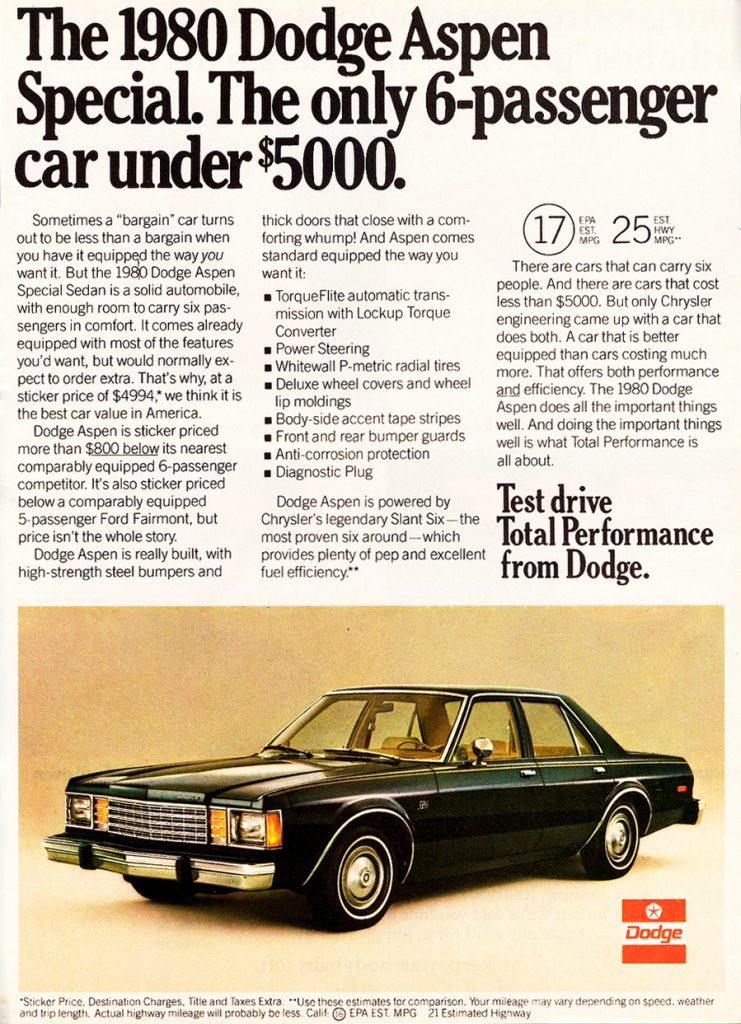
On the other hand, a 2021 Kia Soul or Chevy Trailblazer have features which wouldn't exist on a 1980 vehicle, or only be available on super-luxury models, so if they sold in 1980, they'd probably be $20k. Zero inflation. They have:

* Crumple zones

* Air bags

* AC

* Much better gas mileage

* Power windows

* Touch screens

* Various driver-assist systems

* Cell phone connectivity / bluetooth

* ... and so on

It depends on how you squint; data can paint either conclusion. On a related note, if you wanted a 2021 car with the same amount of steel as a Dodge Aspen, you'd be looking at a lot more than $20k; cars back then were built in ways which required a lot more material (an upside being maintainability; you could pop the hood and do a lot of work yourself).

Re:World food prices hit 10-year peak – FAO by Thorrez on Wednesday October 13, 2021 @01:01AM (#28848404)
Ok, so the graph isn't showing the price change of actual cars that people buy, buy hypothetical cars invented based in feature set.

It's kind of a weird comparison, because it makes it seem like people less in inflation-adjusted dollars, when in fact that's not true.

Re:World food prices hit 10-year peak – FAO by blagie on Wednesday October 13, 2021 @05:08PM (#28857759)
That's a universal problem in estimating inflation. People buy different things, and products come and go.

How do you compare a house build to 1900 standards to one build to 2020 standards? How do you compare fresh foods from the local farmer to factory-manufactured ones?

People shift preferences based on prices too. Manufactured goods started out as premium products, and now, fresh foods are increasingly a premium product.

It's an impossible problem. People either do their best, or lie with statistics, depending on the domain.

Re:World food prices hit 10-year peak – FAO by garmaine on Monday October 11, 2021 @06:23AM (#28826723)
They haven’t decreased in price. The feds instead say, essentially, “hybrid cars and airbags didn’t exist when this metric was invented, so to compare apples to apples we’ll guess at what a 1960’s car would cost if it were made today today” and then invents a number.
Re:World food prices hit 10-year peak – FAO by rsj_hn on Monday October 11, 2021 @09:52AM (#28828302)
A better description of what they do is to make a list of the features that car Modern has and car Old doesn't. Say the airbag. Or anti-lock breaks. Then they look at how much it costs car Modern to add the airbag, using manufacturer's cost of producing that feature. Or how much it costs to have anti-lock breaks. Then they subtract that from the price of car Modern to try to get an apple to apple baseline of how much it would take to produce car Modern without the feature.

Note that this process is not a hedonic adjustment, it's a production cost adjustment, which is what is used to deflate the price of cars.

Re:World food prices hit 10-year peak – FAO by garmaine on Monday October 11, 2021 @11:15AM (#28829271)
It’s not how costs and prices work though.
Re:World food prices hit 10-year peak – FAO by Thorrez on Tuesday October 12, 2021 @02:07AM (#28836592)
Then nimos's second link is pretty useless to me. I want to know for example the price in dollars of a typical TV over time. I don't want to know the price in dollars/pixel of a typical TV over time.

A graph comparing dollars/pixel of TVs to the price of college doesn't make sense to me.