http://video.glath.com/view/southpark.Make_Love,_Not_Warcraft
I suspect most of the millions of people who play Warcraft have fun and are not addicted to it.
People want "gold coins" or whatever.
So and so wants a job.
A middleman arranges for an exchange of "gold coins" for real money by setting up an apparatus of technology, labor, marketing, and sales to allow it. (THIS ISN'T EASY.)
Everyone is richer for it, with the possible exception of the people buying the "gold coins" who are high-class cheaters. But the guy who buys a Porsche is an extra-high-class cheater on the dating market, and I'm more worried about him any day of the week.
The important thing is: Everybody is free, and it's this freedom (and not the FSF's "freedom") that took Ling or Wang or whoever out of the rice field.
Incidentally, pages 6 and 7 makes it sound as if working in a good RMT outfit is actually fun and challenging. Apart from the exaggerated description of the time and effort it takes to reach the "maximum number of experience points," it's a very accurate description of what it's like to play Warcraft. I'd certainly rather spend 12 hours a day as part of a 40 man team solving Warcraft raid encounters than spending 12 hours a day packing sneakers or something.
What's sad is the hundreds of millions of Chinese people that would kill to have a standard of living as high as a city-dwelling gold farmer.
I'm with Milton Friedman in thinking that Sweatshops are a good thing, in that they provide a job for people who've got no place else to work. Remove the sweatshops and they starve.
Incidentally, the Chinese wouldn't starve without sweatshops. They'd be peasant farmers. The reason they work in sweatshops is the same reason workers chose to work in the "satanic mills" of England in 1800: being a peasant farmer is a very hard life.
In fact the history of every country that industrializes is the same. People work on farms till jobs appear in factories, and then they move to the cities-- not because it isn't possible to work on farms anymore, but because it's such a grim life.
And incidentally, feudalism was over in England centuries before the Industrial Revolution got started in the late 18th century.
Feudalism ended in England in the 16th century, hundreds of years before the industrial revolution http://www.tiscali.co.uk/reference/encyclopaedia/hutchinson/m0006447.html
Sorry I don't have the books with me right now (until next week), and I didn't learn them by heart. I seem to also remember that there were machines before the "revolution" - maybe it still was a change of political circumstances that permitted the revolution (free trade between countries, possibility of ownership giving incentives for entrepreneurs etc.). Certainly several factors worked in combination, it's not like the invention of a particular machine triggered it all.
I also seem to remember that China has the fewest farmland per person of all countries in the world. I don't think anybody can simply be a farmer. I know I couldn't just be a farmer in my country.
http://content.answers.com/main/content/wp/en/thumb/6/64/375px-Index2006_EFCapita.gif

Also the gap between rich and poor has been essentially static for the past 50 years, and shrinking since the 80s http://www.imf.org/external/pubs/ft/fandd/2005/12/images/walton3.gif
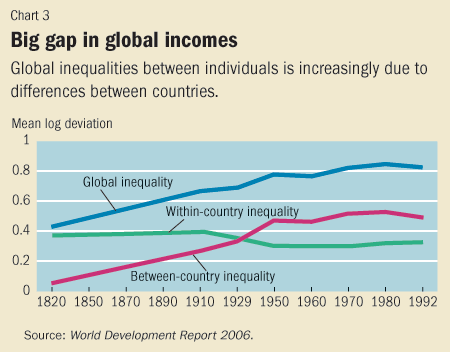
http://www.fraserinstitute.ca/shared/readmore.asp?sNav=pb&id=859
Yet more proof is in the Economic Freedom index. All rich countries have free economies, and all poor countries have un-free economies: http://www.heritage.org/index/countries.cfm for me that's the smoking gun that capitalism works.
http://web.archive.org/web/20060111094731/truckandbarter.com/tb_images/ef_in.gif

"Unfortunately, no one's figured out a better way of distributing wealth."
There are only 2 choices in economics: Capitalism, which is really just people trading freely (and seems to distribute the wealth the best) and communism/socialism, which doesn't allow anybody to trade (and has the worst distribution of wealth). The only other options are systems which are somewhere between, and evidence (from the Economic Freedom index) shows the freer the economy the better off everyone is.
Further China isn't particularly capitalist, it's still very heavily socialist: http://www.heritage.org/index/country.cfm?id=China (although that's changing year by year). So if people are starving in China it's not really capitalism's fault.
It's also a myth that capitalism causes starvation. In fact there were no famines in the 20th century in any capitalist countries. All the famines were related to Marxism (China, Russia, Ethopia, North Korea etc.)
(This has an indepth look at famines through the ages: http://www.mises.org/books/conquest.pdf)
I think the rebuttal to rms' comment that "Capitalism has this nasty little problem of all the wealth getting concentrated in the hands of the few" is very simply this:
http://en.wikipedia.org/wiki/Zero_sum_fallacy
While some kinds of wealth are limited, it's generally not a zero sum game.
Startups are all about capitalism though aren't they. They are capitalism in action.
I just can't get past this feeling that there's something horribly wrong with our society... from pharmaceutical companies keeping AIDS medication locked away to an invasion of the Middle East to take their energy. This can all be explained through rational self-interest but it's pretty horrific to contemplate. Is there a better way? Will we ever achieve real Globalization?
Can and will global poverty be solved before humanity achieves a post-scarcity economy?
They live in poverty because of a lack of capitalism, not because of capitalism. You might find this hard to believe but every poor country has a lack of capitalism. Check here: http://www.heritage.org/index/countries.cfm there's not a single contradiction.
If you really care about the poor I challenge you to take a few hours to read this PDF just to hear the other side of the argument: http://www.mises.org/books/conquest.pdf
Feel free to email me at lockster 4T gmail d0t com if you feel like a friendly debate ;)
Some other discussion of options here:
http://gojomo.blogspot.com/2005/03/cross-browser-invisible-word-break-in.html
They're getting paid to play video games.
Not to mention the sheer irony of spending their lives to increment a number in a remote computer representing virtual gold pieces. Not exactly efficient.
Out-of-game virtual goods trading can kill meaning of progress in a game- whether there was much meaning to begin with is another debate.
This economic link between worlds breaks the "magic circle" that separates game from real life. This can hurt or kill the experience of a game, depending on how much it relies on suspension of disbelief. Then again, this also opens opportunities to explore, both in game/experience design and in business.
The future seems like it's going to be a balance between freedom to entertain and moral standards. With the way movies are going, games are in danger of becoming morally questionable too (think of a Saw game or a Hostel game where your main objective is to torture someone). Time is a valuable human resource, and a game like World of Warcraft wastes a lot of it. But it does give people satisfaction. So if it's morally wrong to waste a valuable resource, is the game morally wrong?
Maybe everyone has ways of perverting everything, and we shouldn't worry about it. But it must be painful to watch your creation destroy lives like that.