https://www.manhattancontrarian.com/annals-of-poverty
Basically the "poverty rate" that makes it to the headlines is a very misleading metric. On particular flaw is that it excludes the value of many anti-poverty programs, for example the value of food stamps and public housing is not counted! So you could double cash outlays for those programs and the "poverty rate" wouldn't change.
This is absurd. This is like saying that you can no longer consider yourself a gunshot victim if you've been treated and recovered.
How do you characterize the converse of your scenario? How would the "poverty rate" change if the cash outlays were eliminated? Do we get to blame the politicians that eliminated the outlays for putting people in poverty?
    * assume 20% of people need public assistance
    * assume that that assistance has been provided via government programs
I do agree that you might observe that 20% of people still need assistance and want to think about ways to make them more self-sufficient, but you can't use that number to obscure the fact that the assistance has indeed been provided.
Part of the problem is that there are two different statistics that need to be measured
  - the percentage of the population that could not afford food and shelter before assistance
  - the percentage of the population that still could not afford food and shelter even after assistance
You seem to be complaining that some percentage of recipients have moved past the arbitrary line, while ignoring that they still can't afford food and shelter.
How is this not a No True Scotsman argument?
The label you apply to a recipient (above/below an arbitrary line) is irrelevant. What matters is whether or not they can survive.
No that isn't at all what I was trying to point out (or "complain" about).
If I can refer to the two stats you listed as "before-assistance" and "after-assistance", then all I'm saying is that is terribly misleading to use the "before-assistance" statistic to assert that we aren't doing enough to help people. At least use the "after-assistance" statistic in order to measure the effectiveness of the programs.
If you don't use the "after-assistance" metric then it doesn't matter how much assistance you give, the "before-assistance" number won't change and you'll continue to have people "living in poverty" even though that really isn't the case (because they have received assistance).
I think the relationship between fertility and income generally goes the other way: the richer you are, the fewer children you choose to have. You can see this broadly by comparing different countries.
There are serious structural problems with the American economy that make class mobility difficult. Two obvious ones, healthcare and child care, should be treated as urgent crises. We have policies that discourage the poor from working. And that's before even getting into the sexism and racism. (The child poverty rate is MUCH higher in female-led households or black households.)
https://upload.wikimedia.org/wikipedia/commons/3/36/Nonmarit...
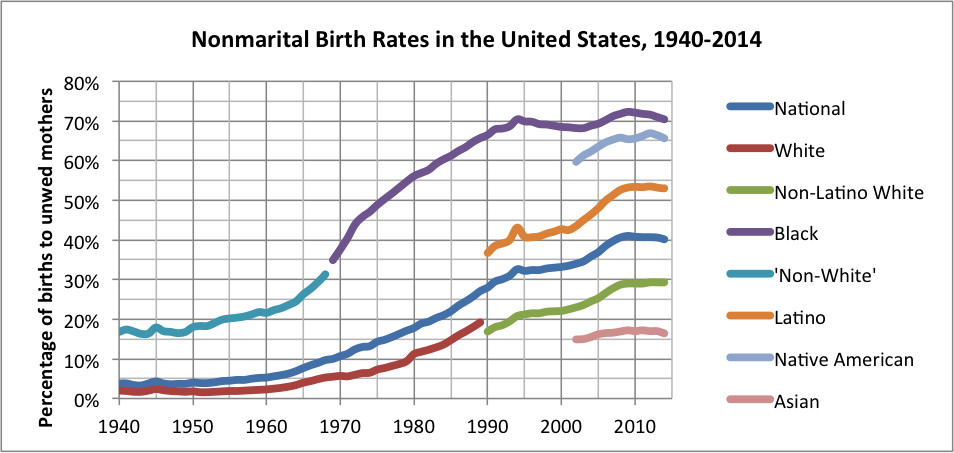
Which is driven by a welfare system that punishes married couples with lower payments (witness the huge rise in out-of-wedlock births since the welfare schemes of the 60s/70s).
35% of African-American children live in poverty:
https://www.nccp.org/wp-content/uploads/2020/05/wpc10-fig3.j...

Creating a subsect of society which is endlessly reliant on transfer payments to avoid poverty is not a good outcome for society. It would be better to encourage family planning and marriage.
http://marripedia.org/effects_of_out-of-wedlock_births_on_so...
"The evidence is clear and disturbing, being born outside of marriage lowers the health of newborns and increases their chances of dying; it delays children’s cognitive (especially their verbal) development; it lowers their educational achievement; it lowers their job attainment; it increases their behavior problems; it lowers their impulse control; it warps their social development; it helps change their community from being a support to being a danger to their development; and it increases the crime rate in their community.
To make the situation worse, the government has instilled powerful incentives in the welfare system which makes illegitimacy a community way of life, particularly in very poor communities. The widespread incidence of illegitimacy in turn passes on all these effects to the next generation in an even more malignant form.
While the government cannot instill virtue, it does not need to subsidize this rejection. Government policies have subsidized illegitimacy, and the evidence of its serious effects are steadily growing. Congress must adopt policies friendly to children. But to do that Congress must first become more friendly to married fathers and mothers."
Is this true? If you're not married, then doesn't only one person get to claim the benefits? Not benefits x2?
Edit: did some light googling and yeah there was nothing obvious that being single parent is better than being married, financially. So I think the above claims will need some qualification.
> I've been primed by media ...
The media isn't responsible for what I believe; I am. If I know I'm being "primed", then I don't believe it. Also, I'm not sure what media the parent refers to, but it's much different from what I read.
If one merely finds flaws in his hypothesis, he'll realize he's wrong, but will be no closer to the truth.
Pointing out that he hasn't backed up his theory is reasonable, but it doesn't bring him closer to his goal.
A relevant quote from Carl Sagan:
"If you’re only skeptical, then no new ideas make it through to you. You never learn anything. You become a crotchety misanthrope convinced that nonsense is ruling the world. (There is, of course, much data to support you.) Since major discoveries at the borderlines of science are rare, experience will tend to confirm your grumpiness. But every now and then a new idea turns out to be on the mark, valid and wonderful. If you’re too resolutely and uncompromisingly skeptical, you’re going to miss (or resent) the transforming discoveries in science, and either way you will be obstructing understanding and progress. Mere skepticism is not enough."
He also gave some good examples from the history of science of theories that eventually turned out to be true, but were originally on shaky (or even faulty) grounds for a long period of time. A culture of skepticism would likely have killed those theories. Unfortunately, I noted only this quote and not the examples.
Sagan also didn't write in an age of massive disinformation and misinformation. It's one of the critical issues of our time; it's important to do something about it, which includes pointing it out when it's happening.
That shows a great degree of ignorance about Carl Sagan. He did this several times - and one of the people he did this with later became his wife.
> Sagan also didn't write in an age of massive disinformation and misinformation.
Sorry, but I was alive when he was, and I had to deal with a similar level of nonsensical beliefs as I do today. The main difference I see is that there is more awareness about this phenomenon today.
> it's important to do something about it, which includes pointing it out when it's happening.
Sorry, but this is mere post hoc justification for your behavior. I would recommend you read the book "The Righteous Mind" which goes into the psychology behind it.
That is why I prefaced my comment about being "primed" by media.
Try shedding light instead of nit-picking. Your proposed question is not as superior to OPs as you think.
If you don't want to be banned, you're welcome to email [email protected] and give us reason to believe that you'll follow the rules in the future. They're here: https://news.ycombinator.com/newsguidelines.html.
The question makes me think of Malthus. He argued that population grows geometrically, while agricultural production is linear, but the major restraint on reproduction would chiefly be access to food. You could extend that to say that the poor will be less numerous, but feeding them will cause their population to rise and result in inflation (I think that was apropos the Poor Laws).
That was the 18th century thinking, at any rate. Some explanations I've encountered for why it doesn't work out that way involve examining other checks on reproduction which include things like education level and rights of women, and rate of child mortality. I think you raised a great question that's worth examining -- hopefully someone else can shed light on the subject.
Meanwhile, in the reality we live in today, our economies are actually struggling because of a lack of population growth. Lots of economists simply assume endless exponential population growth to justify endless economic growth.
The dependence on growth relies on our insistence to work full time. Technology reduces the need for labor. So to give everyone full time jobs we have to grow the economy. It's quite stupid.
Imagine a simplified dishwasher economy. We have a replicator that generates food for free but it doesn't clean dishes. To increase labor efficiency keep building bigger and bigger dishwashers. For some strange reason we still insist on working 40 hours per week loading and unloading the dishwasher. There is something strange about this. Every time we build a bigger dishwasher, we have to eat more (=have more children) just to keep the 40 hour work week filled. This is the dependence on growth.
We have to keep growing just to stand still at full employment.
It's a weird, tautological statement. Only workin adults provide income to a family unit. Children and the disabled members of a household divide that income.
Given the same income, a family with more dependents is sent into poverty by the mathematics of division.
This is an alarmingly high number. I've been primed by media to blame this on an inverse relationship between income and number-of-children (i.e. poor people have many babies, rich people have few babies).
Does anyone have an alternative explanation for the surprisingly high child poverty rate?