http://en.wikipedia.org/wiki/Intellectual_Ventures
http://www.techflash.com/seattle/2011/05/intellectual-ventur...
Amazon, Apple, Cisco, eBay, Microsoft, etc. are also investors but they are not acting like whiny babies and acting all high and mighty going around preaching about how patents are destroying innovation.
Fact 1:
-------
Google was willing to pay for $3-$4 billion for the same Nortel patents.
Fact 2:
-------
Google's page rank algorithm is patented. if you don't believe in patents then why the hell do you own patents?
Fact 3:
-------
Let me quote another commenter on another blog: "How many small and innovative companies has Google killed off by replicating what they do and making it available for free? Great way to keep the next Google from springing up."
Message to Google:
------------------
You can use other people's technology, you just have to pay for them. You are being sued left and right not because there's some organized propaganda against you, it's because you STOLE from other companies.
Also, some of these companies, including Google and Cisco, have been investors for many years, and in the early years IV had a very different tone. Back then, the giant patent-holding company, which was founded by ex-Microsoft CTO Nathan Myhrvold, billed itself as a “patent defense fund.” (Clearly, it hasn’t turned out that way. ) http://paidcontent.org/article/419-giant-patent-holder-intel...
IV was founded in 2000 and they didn't file their first suit until 2010. Companies certainly change their business model ("pivot," if you will).
Regardless, I'd like to see Google (and many others) divest themselves of their interest in IV.
2) See #1. Stanford owns the patent on PageRank because it was developed by Stanford graduate students on an NSF research grant. Not really relevant.
Also, it is a mathematical algorithm in every sense of the word. A lot of patents aren't.
I'd agree it would be even better if Google never gave a dime to patent trolls but there's a little more to the story than just Google investing in IV.
See: http://www.businessweek.com/magazine/content/06_27/b3991401....
Those products that, to put in your don't-understand-software-patents way, STOLE from other people's innovations?
Because it's coming, and it's going to be ugly for everyone. The patent nuclear war approaches.
Your facts seems to opine that Google should simply suffer the system. They didn't make the game, but they are a young company in a industry of longstanding titans. Apple nor Microsoft nor anyone else has a right to billions in quarterly profits for perpetuity.
Google is a young company, but it's been in the phone industry at least since it bought Android in 2005. Apple created its iPhone and released it in 2007, so in the phone industry, Google's the senior.
No one has a right to billions of quarterly profits, but no one has a right to violate others' intellectual property, either. Apple and Microsoft are profiting at these levels despite the infringement of other companies.
They may be anti-competitive in other areas (although I don't know specifics). Can you provide some sources?
There needs to be significant patent/ip reform in this country, there's no question about that. Google isn't necessarily a "good guy", though. There is a lot of money to be made out there and all of the big guys are using everything at their disposal to gain the upper hand.
Google is a major investor in patent troll firm Intellectual Ventures.
http://en.wikipedia.org/wiki/Intellectual_Ventures
http://www.techflash.com/seattle/2011/05/intellectual-ventur...
Amazon, Apple, Cisco, eBay, Microsoft, etc. are also investors but they are not acting like whiny babies and acting all high and mighty going around preaching about how patents are destroying innovation.
The name "PageRank" is a trademark of Google, and the PageRank process has been patented (U.S. Patent 6,285,999). However, the patent is assigned to Stanford University and not to Google. Google has exclusive license rights on the patent from Stanford University. The university received 1.8 million shares of Google in exchange for use of the patent; the shares were sold in 2005 for $336 million.
Could be wrong, though, but I seem to recall a similar story in the news not too long ago.
But I don't think Google actually sued anyone when most other search engines started using that method. Correct me if I'm wrong.
Totally irrelevant to the current conversation. No one thinks all patents are good or valid. Contrast with what Google does: (1) copy exactly what the leader does as close as possible, (2) not license any of the innovations we're copying and (3) push propoganda that any patents we might walk over are "bogus".
It is a fact that nearly all software infringes at least some patents. I do not believe I could write any significant program that was entirely patent free. As a result, I would say that I believe every software company is "willfully infringing patents". After all, they chose to ship software instead of spending years and thousands of dollars in a combination of patent discovery and crippling their software to avoid patents.
As far as walking over patents -- Google is being sued less than many other major players at this point:
http://farm5.static.flickr.com/4128/5061246255_45a015568b.jp...
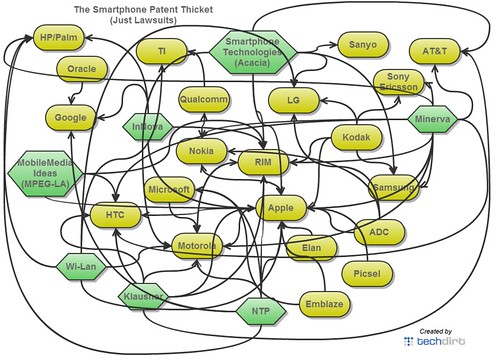
Well that's a different claim then you made earlier. At any rate as I said above I don't think Google is just infringing on silly, obvious and clearly invalid patents. I think they willfully infringe on clear, major innovations.
I'm also not seeing the difference between "It's nearly impossible to write a nontrivial program that doesn't infringe patents" and "I do not believe I could write any significant program that was entirely patent free."
Java ("everything else sucks" - Google), miscellaneous mobile innovations belonging to all sorts of companies via proxy (because they don't actually ship phones). They haven't been sued over VP8 yet but it's likely coming barring licensing.
...
"I'm also not seeing the difference between ..."
Well now you're putting words in your own mouth. What you originally said was:
"point to a single nontrivial piece of software that doesn't infringe on someone's patents."
And I pointed to every piece of software over 20 years old, /hangs mission accomplished banner. Again this is excessively derailing...
VP8: the fact that Google has been using VP8 in WebM for 14 months now, with no clear allegations of wrongdoing, kinda kills your "willful" argument. If Google was fully aware they were infringing on patents, don't you think someone would have brought this up and/or sued them by now? (I could also start ranting about submarine patents, but I'll leave that alone.)
The parent poster also didn't really ask the right question. "Point to a single nontrivial piece of software that doesn't infringe on someone's patents" may indeed be solved by pointing to anything written over 20 years ago, but how is that a useful measure? We're not going to just say that we only need software written by 1991 and everything written in the past 20 years is useless. So sure, maybe "mission accomplished", but that's like saying "mission accomplished" for successfully going to the bathroom. Sure, well done!
The more useful question is -- "can you write a nontrivial piece of software today that infringes no patents?" I don't know the answer to that, but I suspect it's hard to do.
I believe exceptions for prior usage are one of the things being messed with in the current "patent reform" legislation, though, IIRC, they're being influenced in a negative direction disappointingly and unsurprisingly.
VP8 was designed to avoid patents, but there's so much stuff patented in the audio and video fields that it's nearly impossible to avoid infringing.
Do I realize that Apple infringes patents? Yes. Are you aware that Apple doesn't cry about how it's the end of the world and we're all going to have to pay more for the next iphone because they had to write Nokia a check for Nokia's previous and substantial innovations to mobile?
Wow, seems like you have a pretty big bias here. That hurts your argument quite a bit.
Are you aware that Apple doesn't cry about how it's the end of the world and we're all going to have to pay more for the next iphone because they had to write Nokia a check for Nokia's previous and substantial innovations to mobile?
It's one thing to license a patent filed and wielded in good faith. Google already does that as well for lots of patents.
It's quite another to collude with other companies to buy up huge patent portfolios for the sole purpose of extorting your competitors and stifling competition. That's what Apple/MS/etc. appear to be doing here. Obviously I can't speak to their motivations with authority, but that's how it looks from the outside.
Wait I'm biased but according to you, Apple is using this for the sole purpose of extortion? Come off of it. Back here in the real world Apple has probably paid out many times more in patent suits then it has or will collect any time soon. Why can't Apple be using these defensively as well?
Patent litigation is simply a weapon used by companies offensively or defensively.
When in a fight with your competitors you look at your weapons and theirs. When evaluating the visible weaponry of their competitors they see patent litigation near the top of the list. When they look at their arsenal of weapons, they do not see patent litigation at the top of the list. Therefore, they have decided it's better to eliminate patent litigation as a weapon rather than to go into battle against it.
Their strategy is to change the rules of what weapons can be used in battle. :-) It's very smart.
1. Build innovative products that your customers want, and keep iterating and innovating to keep your customers coming back for more.
2. Use the legal system to force your competitors out of your market, or make it so expensive to stay that it's harder to gain market share.
Apple has a long and brilliant history of #1, which makes it even more disheartening that it seems like they're resorting to #2 here.
While both may be legally valid, which is more beneficial to consumers and society as a whole?
Bogus patents = military power
useful innovations = effective societies.
Trying to remove bogus patents/military power and shift the center of gravity over to useful innovations/effective societies, isn't nefarious despite advantaging one particular party.
This is nonsense. Google has a huge number of smart people working for them - if they wanted to enter a patent war they are extremely well equipped to do so. Everything I've seen from them tells me that they simply culturally biased against doing that. They'd just rather spend their time inventing cool new stuff than suing about old stuff.
Android is just a very small part of the open source ecosystem, and the platform was clearly not created to promote open source, but to use it as leverage to quickly spread a free (as in beer) mobile operating system.
And they claim that they aren't litigious with patents, and they haven't been yet. But to paint them as the victim is disingenuous -- while they don't use patents offensively, they have many other tools at their disposal that they do use offensively, market share in advertising and search amongst them.
Google is a massive company with massive resources. They happen to be exceptionally smart and know how to use tools outside of litigation to achieve their means -- but that doesn't make them any less a monopoly or anti-competitive company; far from it.
It's impossible to view Drummond's post in a box -- it's not just about how patents hinder innovation -- /everybody knows that/ already. But Google does everything for a reason, they are very strategic. Since Google knows it has better tools to be competitive outside of patents, it is in their interest to eliminate patents as a source of pressure from competitors.
And if you invent something amazing, and you patent it, and then Google decides to copy you -- you may not feel that patents hinder innovation as much as you do right now. But since they are a behemoth with lots of other tools at their disposal, they want to eliminate a favorite weapon of their competitors. Smart, but altruistic it may not be.