I'd be extremely sceptical of its use on medical images for this reason.
The result is impressive, but the moment you started to use it on someone you're actually familiar, it becomes weird very quickly for the obvious reasons. The teech, for example, are never right.
This kind of "believable but not truthful" results are rampant in all these machine-learning based tools. It's not very harmful in case of upscaling a few photos I guess, but I've been bitten by it in an acclaimed translation service called DeepL. I use it to translate Japanese to English frequently, and have found that it often (nontrivially) made up sentences that don't exist in the original paragraphs, sometimes have the opposite meanings, or totally ignore part of the text to make the result "more fluent". And unlike traditional translation tools, they are very hard to notice if you know nothing about the original language. I have to from time to time use some more "primitive" translation tools, and compare the results side by side, to avoid such issues. It's frustrating.
I can recall seeing a conspiracy get traction on Twitter a few months back, where it was claimed that a photograph of a famous person was actually a body double. Someone used an ML upscaler to "enhance" the image, and their followers began scrutinizing the result: "The teeth are different!", "The nose shape is wrong!", "It's not the same person!"
Not to mention what happens when some good-intending but ill-informed agency release an enhanced photo of a suspect on the run.
The more interesting situation is when such "enhanced photos" are used in prosecutions. I suspect that ML "forensics" techniques and questionable expert witnesses will be used to elevate hunches to guilty verdicts and raise (false) conviction rates.
This happens a lot with junior peer reviewers, they focus more on what the paper isn't or could be instead of what's actually there.
However for the rest of us, evaluating whether the work is relevant in the surrounding world really is important. And for that, resemblance to originals is critical in some use cases. I.e. we're evaluating a fit for specific use cases.
Do you believe that is not a useful discussion?
[0] https://iterative-refinement.github.io/
[1] https://iterative-refinement.github.io/images/super_res_exam...
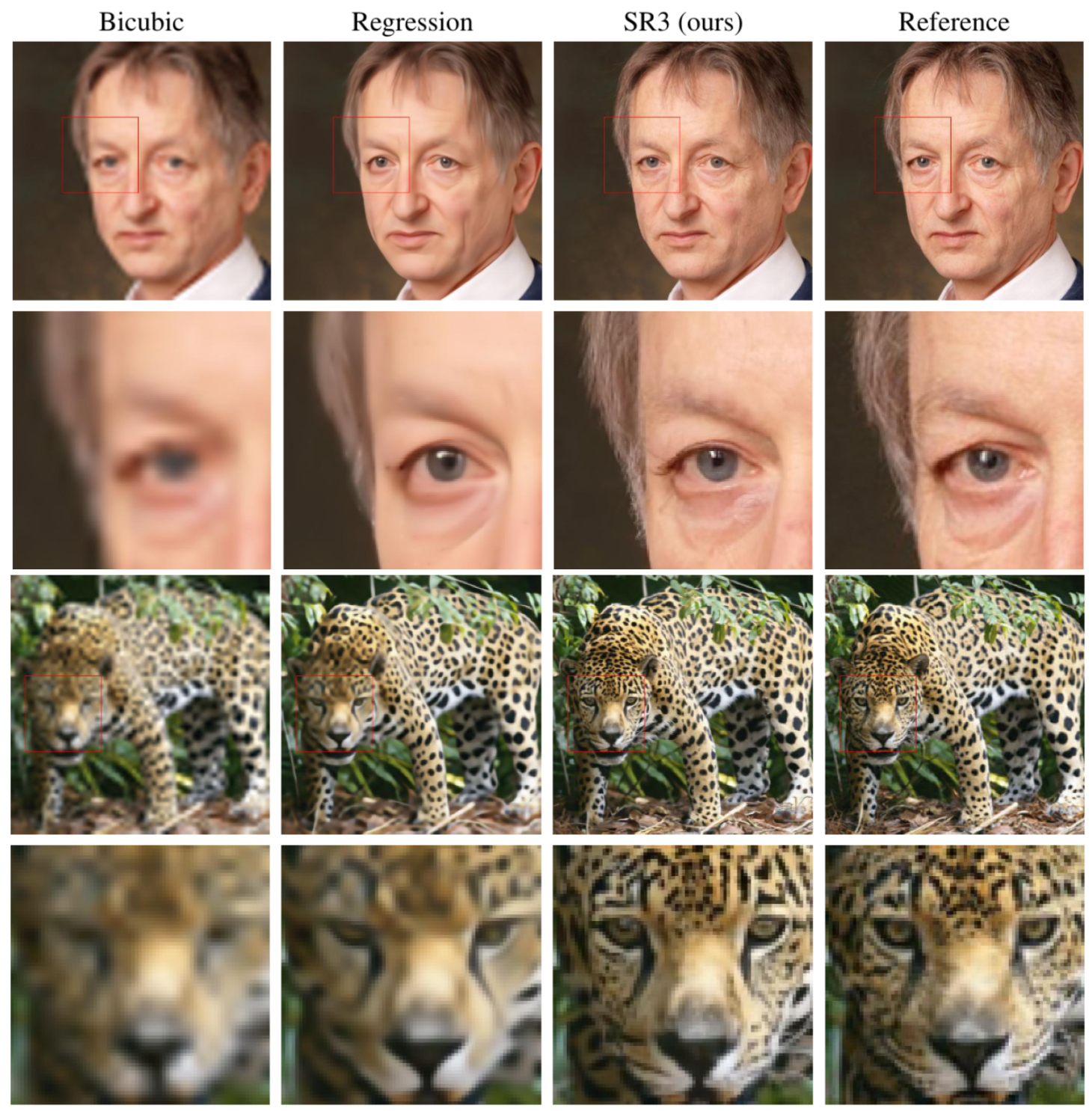
Probably a lot in some cases and a little bit in most others. I wonder how long before this gets used in court by an incompetent prosecutor.
Sure, in the extractive sense. But in the generative sense you can.
The fact that the extra information is 'synthetic' and not 'natural' doesn't mean that it isn't extra info, just that it may or may not (probably not) correspond with ground truth.
Another way to think of it is that super-resolution is effectively a (possibly benign) man-in-the-middle. If what you're concerned about is the information flowing from Alice to Bob, Eve isn't adding any info, and may in fact be drowning the signal in more noise. But you can also see it as Eve communicating more info to Bob than Alice is to Eve. Whether what Eve is adding should be considered noise or signal is highly context dependent.
Right. All the processes being used for these purposes are stochastic.
Edit: Actually they are deterministic, in the same way a pseudo-random-number-generator is, and typically rely on a 'seed' that would have to come from a random source to be non-deterministic, and doesn't, so users get to have pseudo-random but reproducible results. But that's really getting into the weeds.
Without comparing a high-res original photograph to the high-res output photograph, we do not know if this fine technique is capable of producing nice-looking high-res imagery, or if it is capable of reproducing how an image of the subject would have looked like had it been taken in higher resolution.
In other words, does the output of the technique match the actual object in the photograph?