We raise chickens, turkeys, ducks and geese completely free range. Our homestead doesn't really even have fence on all sides and most of it is virgin forest. All these sepecies can survive on their own in the forest here, although not in the same population density that they have on our homestead. We feed them, we take care of them when they are sick, and we provide some protection from predators... we also have dogs, and the dogs presence alone helps quite a bit with that. We also take some of their eggs, and sometimes we kill some of them. The birds know all of this, yet they stay, because life is better here than in the forest. Actually, some of the ducks (Moscovy ducks, they are fully native here) do leave, but they do so mostly when there are too many males and they end up fighting a lot.
The bottom line to me is this... we keep the birds for eggs and fertilizer (and because we like them), we really eat very little meat, but we have to manage the population. When we let it get too big they suffer more, there's more disease, more fighting, etc. In fact, sometimes when the population has gotten rather dense, there has been murder and infanticide among them! They can't solve the population problem non-violently on their own, but they do like the benefits of food and safety, so we have to solve the population problem for them. I'm not rationalizing, I love these animals and don't like killing them, and I have gone long stretches of time without eating any meat and don't mind that. But I kill them, because when the time comes it's the right thing to do, and after I kill some I eat them because that's also the right thing to do, not because I want to eat meat.
So you might say: well then don't keep animals! Maybe, but keeping them is the most ecological way to maintain the soil fertility around our homestead (poor tropical soils) and the food we can produce because of this reduces our overall ecological footprint. I think it's a win-win for us, the animals, and the planet.
I can’t say anything about maintaining soil fertility because I know nothing about it, but what is about chickens that preserves the soil, and why can it only come from those chickens?
Something about nutrients in the soil I imagine, right?
We're not really "farming" the animals. We're more co-habitating with them. The birds and humans here are part of a society, an ecosystem that needs both and in which humans play a role of both caretakers and occasionally predators. Predators are necessary in a natural system and what we're trying to do is to imitate nature as best we can. This all may sound a bit pretentious, but, like I said, the birds are actually free to leave, and generally they don't, so it would seem they agree. In fact, a couple of times wild ducks have even voluntarily joined our little society!
Also, I'm not trying to "justify" anything. What we're trying to do here is a live a bit closer to nature than people generally do, reduce our ecological footprint a bit, and treat nature and all life with a bit more respect. And what we've found is that you can't be close to nature without facing death in various forms every day.
So ultimately, I don't think that Pollan's conclusion is "weird" and I don't think that "killing an animal ... is always wrong". I think treating nature with respect and letting sentient beings live their life in a way that respects their nature is more important than simply "not killing".
There are alternative models, such as biocyclic veganic agriculture, or in the future, foods created through fermentation [1] (this almost require no arable land). I recommend checking them out if you are interested in cycles in nature. Using animal manure, opposed to "plant manure" from nitrogen fixing plants, it also has its downsides because of the high levels of ammonia it kills most of the soil creatures such as worms, and more tilling and maintenance is required (which releases more carbon).
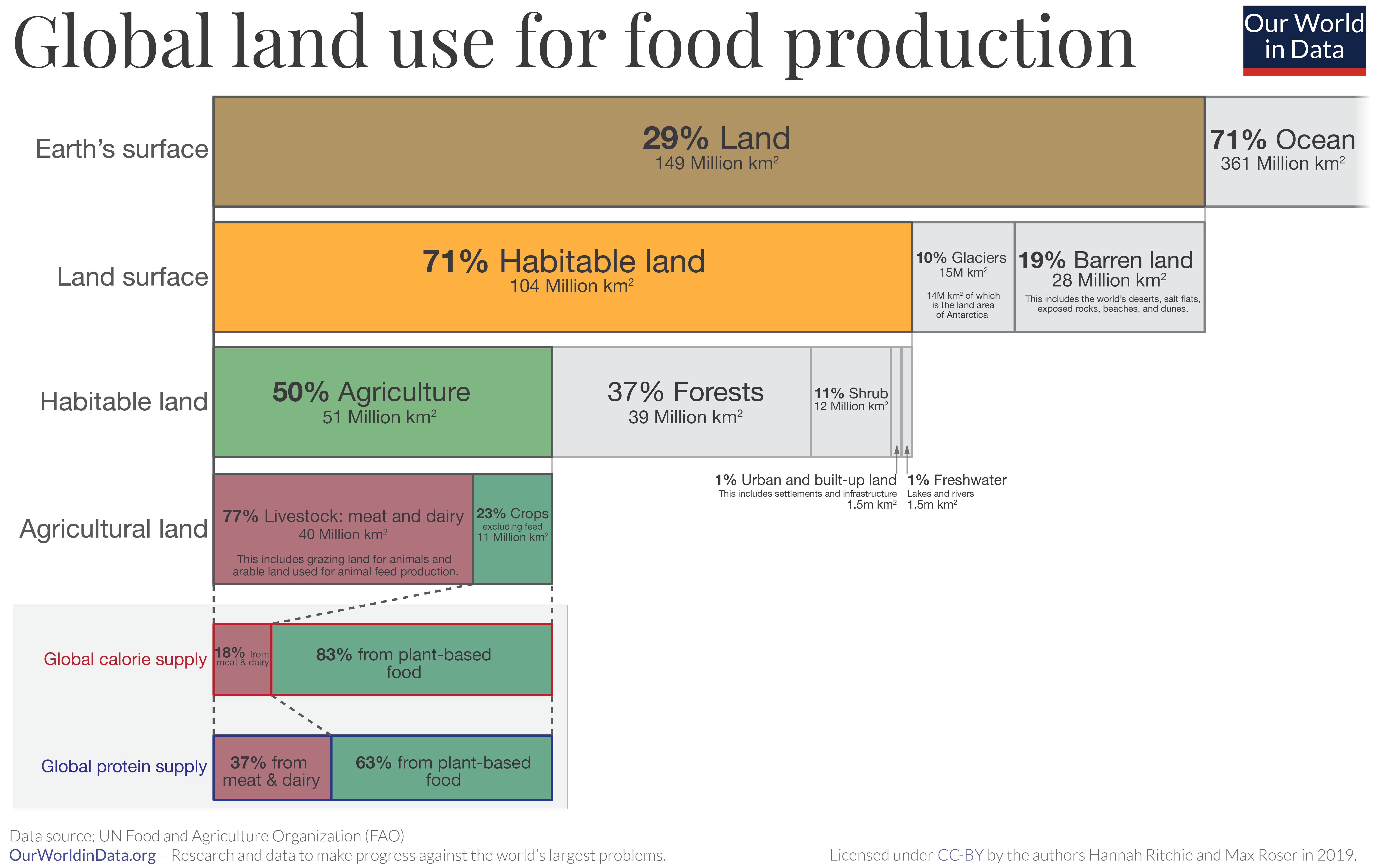
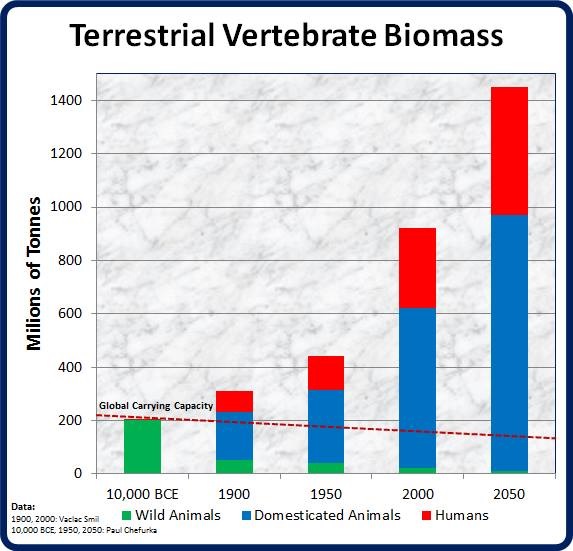
Personally I don't think that using livestock is living with nature, but is its antithesis. Since the earth is (at this moment) bound by the amount of biomass available through photosynthesis there is a limited carrying capacity for biomass. What we have done specifically is reduced the biodiversity by using more and more land mass for livestock and its feed. Of all habitable land, 50% is used for agriculture and 77% of that is used for livestock (while only providing us 18% of calories and 37% of protein) [2]. This has drastically reduced the number of wild animals and biodiversity, which I consider "nature" [3].
Ultimately, using livestock kills living beings (primarily in nature) somewhere else. If you're goals are living closer to nature, and reducing your ecological footprint, and your definition of nature is: "the phenomena of the physical world collectively, including plants, animals, the landscape, and other features and products of the earth, as opposed to humans or human creations.", then living closer to nature would mean rewilding your land and perhaps be a steward of that land. It would be a great means of treating nature and life with more respect :).
[1]: https://www.theguardian.com/environment/2021/jun/21/microbes... [2]: https://ourworldindata.org/uploads/2019/11/Global-land-use-g... [3]: https://peakoilbarrel.com/wp-content/uploads/2017/11/Terrest...
But isn't the best way to respect these animals is to avoid killing them when we don't need to in order to survive? I've talked to so, so many people who keep animals and ultimately kill them that talk about this reverence for the natural world, and they talk about how death is an intrinsic part of that natural world.
Sure, that's true, but that doesn't mean we need to contribute to that death (and suffering, naturally), when it doesn't need to take place. Will there always be gruesome, painful deaths? Of course. Will there always be animals that eat other animals? Definitely. But that doesn't mean it's totally fine for us to decide when animal lives or dies. An animal that has made no deals with you, has not agreed to any sort of symbiotic relationship which ends in it's death in order to feed you. Sure, the animals are treated well, and sure the birds at least can decide to leave, but them deciding not to doesn't mean they are agreeing to get slaughtered.
> and I don't think that "killing an animal ... is always wrong"
You left out the most important part of what I said in that quote, and mischaracterized it. I don't think it's always wrong to kill an animal. I said its always wrong to kill an animal when we don't need to do it in order to survive. That last part is really, really important.
At the end of the day, I'm not saying you don't care about animals, or want to live in harmony with them. You do, and I do as well. All I'm trying to do is get you to consider that maybe we can do that and also understand that animals don't want to die for us, and they don't need to. That's it. You want to live closer to nature? Hell yeah, that's great. You provide a safe place for animals to live and prosper and enjoy life? Amazing, I'm so in support of you for doing that. But then let's continue that respect and peace by deciding to simply not kill the animal.
> I think treating nature with respect and letting sentient beings live their life in a way that respects their nature is more important than simply "not killing".
In situations that are not life and death, i.e. you are not in a sitation in which you must kill one of these animals in order to survive, how are "treating nature with respect and letting sentient beings live their life in a way that respects their nature" and not killing them not the same exact thing?
Also I don't know that your "killing only when necessary for survival" is really a tenable argument. When exactly is it necessary for my survival? When there's a deadly pit-viper in the house, should I kill it for my survival? For our dogs survival (they are at greater risk because they think its their job to attack the snake)? I generally don't kill it, I capture the snake alive and take it away, at not inconsiderable risk to my life. I think that killing to maintain a well-functioning ecosystem is more ethical than a somewhat vague "killing to survive".
And yeah, we basically never need to kill animals to survive. Situations in which that is the case are extremely rare.
At the end of the day, every living thing on this planet - every tree, every plant, every mushroom, every fish, every insect and every mammal dies and is eaten. I absolutely agree with you on the factory farms though - humanity should strive to not cause other creatures to suffer.
But there's a spectrum between those two extremes. To set a boundary, you need to determine the reasons why one is acceptable and the other is not. Maybe you intuitively draw the line right next to the apple, eating plant life only - no fish, crustaceans, shellfish - or maybe you draw the line adjacent to humans, contentedly eating tool-using, communicative, emotional, social, familial, intelligent gorillas without feeling guilt.
But what makes it abhorrent to eat a person, and acceptable to eat a plant? As Bentham wrote, Singer quoted, and the article cites, I would agree that it has something to do with the animal's capacity to suffer. One might add positive capacities for joy, or broader ecosystem health needs, or other questions of relative utility for the victim and the farmer, but the point remains: A pig is a remarkably human-like animal. Not as intelligent or as emotional as a human, perhaps, but it's far closer to a human than that shrink-wrapped package of hot dogs in the grocery aisle might lead you to believe.
What qualities does a human have that a pig or dog does not? What metrics can you use to measure those qualities, and how do you set a threshold for where it becomes moral or immoral? Identify those, and you'll have a much more solid argument for why killing a pig is moral.
Observing the forest with my eyes and ears, waiting in still silence for hours in chemical and visual camouflage, lining up with its chest, making a slight sound to get it to pause... You feel a certain focused hunger as you gaze down the barrel, that you've never felt before. But the way it feels... It's something you know. Something that is deeply ingrained in you. The moment feels like forever, as you release a deadly projectile from your species' 'advanced technology'. Then, gutting it in the forest, dragging it out, hanging it up on the gambrel, cutting all the meat out, seasoning it, grilling it, and eating it...
Probably the most powerful, self-realizing, humbling, spiritual experience I have ever had. For the first time in my life, I actually felt like an animal! A real animal!
Did I have to kill that doe to survive? Absolutely not. I could have driven down the road to McDonalds and had a burger in my stomach in under 10 minutes.
Once I found the doe on the ground, I sat with it for a couple minutes in silence. I felt very thankful for it. "My God! I just killed this thing!" (I'm agnostic.) There is a certain realization - that we are all simultaneously frail, and immensely powerful. In that moment, you feel your place in the hierarchy.
I have a feeling that many among us today choose to actively fight this innate reality. People implicitly reject the concept that they are animals. They don't like the idea that they exist today because their ancestors killed things. Did things we now consider immoral. It can manifest in to a sort of self-hatred that is reflected on to others.
"Why do we even eat meat today? It's not necessary." Absolutely true! But to that, I say, because I enjoy it, and because I can. No other support is needed. My species has clearly evolved to enjoy consuming it, and to devise technology to acquire it. Become comfortable with what you are made of, animal spirits and all.
But above all, with great power, comes great responsibility. Hone your sense of morality, as we are in a position privileged to do so. Thanks for reading my rambling. :)
I'm sorry, you felt it was self-realizing to kill an animal? What the hell? There's nothing sadder and messier and more harrowing than having to kill an animal and you actually found it a "spiritual experience" to kill one when you didn't even have to? What kind of culture do you come from? I can't think of anyone from the western world ("your species 'advanced technology'? Not a native hunter, then) that seriously thinks it's cool to kill.
Actually, no, I can. Ugh.
I had something long typed out, but it's just not worth it. When I (rarely) comment, I am usually reminded how debilitating it is. It's probably an indication that I should just stay silent, so I think I'll stick to that more.
I'll try though: People eat meat their whole lives, but never feel the act of killing and consuming first-hand. I find that rather sad, like they have lived their life never emotionally acknowledging this innate drive that enabled their existence. If anything, the act forces upon you greater respect and compassion for life and what it means to be an animal.
Hunting in my part of the US is very common, and over 160,000 deer were taken in my state last season. The deer population is doing well, and the act is well-regulated by government. I don't see anything wrong with killing for sustenance, even though it's no longer remotely necessary.
Or, since you think the way you think about the connection of people with their food, maybe try to live on a farm for a few years and care for animals and then slaughter them, and see how "self-realizing" that feels, to kill a lamb that you stayed up all night to help give birth to, and nurtured and fed with your own hand. Try that! And tell me about the "spirituality" of killing something that feels like your own child.
But... the quality that the human is human and the pig is a pig? What else? Why does this even need to be asked, I don't understand. Isn't it obvious?
I don't know how you can make this argument. Does an apple tree feel pain, fear, or loss when it or another apple is plucked?
You exclaim in a panic, Why didn’t you save my pet!? To which the fire fighter says, Well plants feel pain too you know! And we’re learning a lot more about how advanced they are and how they communicate.
Do you really think you’d stand and their and consider, Hm that’s a good point, there is no relevant difference between my pet being saved and my plant?
No one who has ever made the argument that plants and animals deserves equal moral consideration due to this capacity to suffer has ever, ever meant it.
People want the fire fighters to prioritize saving whatever has the most value to them personally. That may happen to be house plants. Or perhaps photo albums. Or (likely most common) pets.
Let’s say that you’re a bystander at the fire, and you watch the firefighter rush into the flames. You walk up to your neighbor, whose house it is engulfed, and you ask, What are they going in for? Your puppy? to which your neighbor responds, Actually I have a really sentimental baseball glove that my dad gave me when I was a little kid. I couldn’t imagine losing the glove, but the puppy I could take or leave.
Would you understand the position, and agree that it’s better to safe the glove because it has more value to the neighbor? Or would you be appalled that your neighbor is opting to let a sentient animal burn to death in order to save a baseball glove? Albeit, a very sentimental one.
Except humans. Humans cremate their corpses.
While we might get into a debate about whether some forms of life somewhere on Earth technically consume your scattered ashes, it's quite the distance from hitting you on the head until you die and then chewing on your flesh.
https://en.wikipedia.org/wiki/Tower_of_Silence
Relatedly, animals still kill many humans every year:
> Philadelphia, February 28, 2018 -- A new study released in the latest issue of Wilderness & Environmental Medicine shows that animal encounters remain a considerable cause of human harm and death. Researchers analyzed fatalities in the United States from venomous and nonvenomous animals from 2008-2015. They found that while many deaths from animal encounters are potentially avoidable, mortality rates did not decrease from 2008-2015. The animals most commonly responsible for human fatalities are farm animals, insects (hornets, wasps, and bees), and dogs.
https://www.sciencedaily.com/releases/2018/02/180228112528.h...
Though most of the humans killed this way are not even eaten, which is arguably a waste. One reason is that many of the killer animals are herbivores, particularly cows:
https://www.independent.co.uk/news/uk/home-news/cows-officia...
In what context does an animal die when it wants to die? When do animals want to die? And how would you know what an animal wants?
Btw, I remember your username. The last time I communicated with your account, a person behind it threatened me with violence:
https://news.ycombinator.com/item?id=27534682
I will give your account the benefit of the doubt that this will not be repeated.
And no, my use of a common figure of speech is not a physical threat.
But remember, never willingly. It never wants to die. It can never agree to that trade. Killing an animal that does not want to die when we don’t need to do it to survive is always wrong, whether or not you gave it safe a life. I can’t raise my puppy up as a loving family member and then one day bludgeon it to death once I’m ready to consume (as is often done to pigs. See: “thumping”).
Pollan get so much right and the article is worth a read, but let’s be clear about two things: killing an animal that doesn’t want to die when we don’t need to do it to survive is always wrong, and ridding this planet of factory farms and replacing them with the idyllic farms he mentions towards the end still requires a MASSIVE cultural shift away from the amount of animal products we consume. We can’t meet current demand for animals products with those idyllic farms, so step one is massively reducing how many animals we consume. All vegans are saying is that we may as well shoot for as close to 0 as we can.