This makes perfect sense because most of the measurements of things we own or consume are counted in units like area, volume, and energy, which are inherently more tangible than an instantaneous rate like "power". Speed is a bit of an exception to this, but I think that has to do with the ubiquity of speedometers in cars.
To the extent that people broadly understand power as distinct from energy they tend to do so in a mechanical, not an electrical context, and in less precise terms ("That's a powerful truck"). However, some exceptions to this are light bulbs and electric space heaters, where people generally understand power as being proportional to brightness and heat output.
In a way, it's an incredible testament to the engineering of electrical systems that people have been able to largely ignore the difference between power and energy, or just need to flip a circuit breaker if something exceeds a limit.
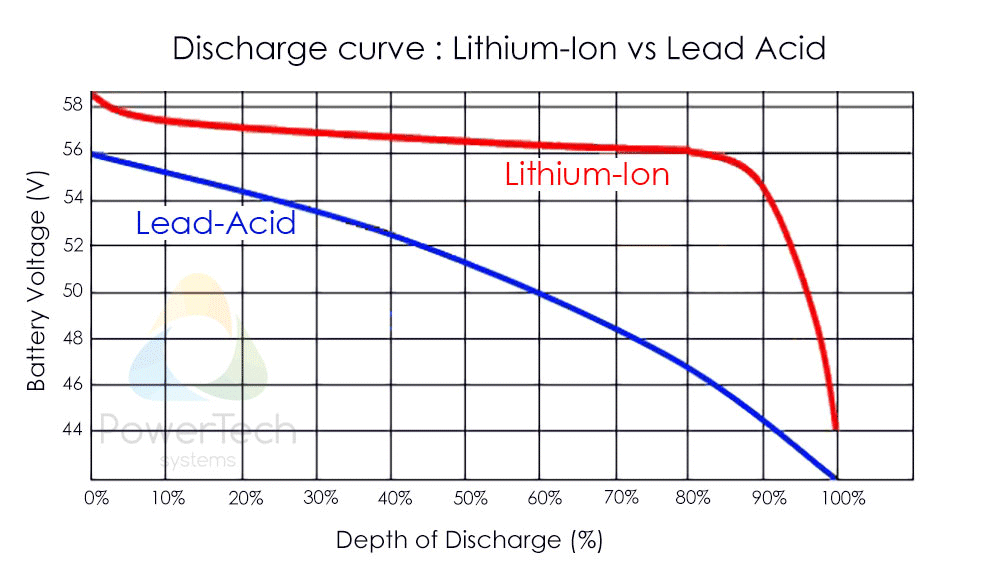
Also, Li-ion and LiFePO4 batteries have a much different discharge curve than earlier chemistries [1], with much more constant voltage up to 80% discharge.
1. https://www.powertechsystems.eu/wp-content/uploads/sites/6/2...
Assuming 12V, that's about 400Ah*12V=4800Wh of storage. 4800Wh/400W = 12 hours to charge those, which seems reasonable for an RV. The thing that seems a bit oversized is the 3000W inverter.
I liken it more to distance vs speed. Power, like speed, is a rate, in particular the instantaneous rate at which energy is transferred.
Expressed using the same scheme we use for speed (distance per time : power per time), power is watt-hours per hour (or 0.0036 megajoules per hour).
I'm guessing we express power differently because James Watt codified the standard unit for power and the standard for electrical energy came from the time-integral of his definition of power.