Lack of atmosphere I get, but how does low gravity require more propellant to land?
(edit: maybe you meant lack of atmosphere due to low gravity, and I got the other meaning contrary to your intent)
However, it is a bit problematic that landing a rocket on the lunar surface can kick rocks around the planet (thanks to the low gravity), possibly into orbit or beyond (which could pelt other equipment). So you need to switch to an entirely different propulsion system for descent, which carries a payload penalty.
https://upload.wikimedia.org/wikipedia/commons/9/93/Solar_sy...
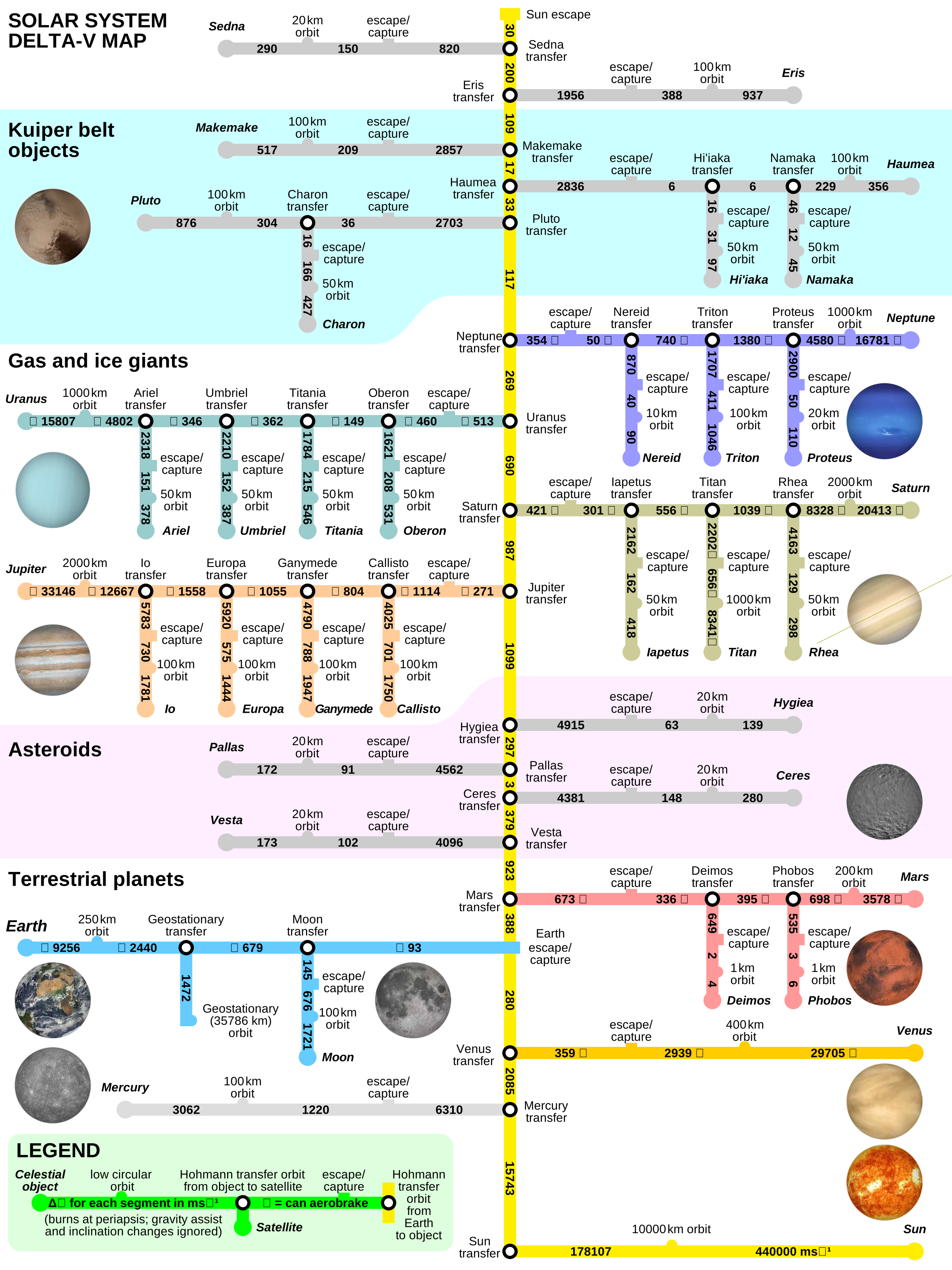
Also there is some water on the moon so you can make rocket fuel, though how much exactly remains an open question
Questionable.
> but it's so thin you still have to land propulsively using rockets
You have to do the same on earth. Starship sized vehicles have to land on earth propulsively too.
Sure, you can do somewhat larger payloads to Orbit without engines but for large things you need to have real engines.
> You definitely need to sacrifice less spacecraft mass to land on the moon
On the moon you can't aerobrake, that is far worse.
> Also there is some water on the moon so you can make rocket fuel, though how much exactly remains an open question
There is a huge difference. Water on the moon has to be mined from permanently shadowed craters. The water is frozen and incredibly hard, its more like mining stone on earth.
On Mars there are places where you can literally land, drill down and make yourself an underground lake pretty easily. Or land basically right on an ice sheet.
On the moon you need to figure out how to get energy down into the crater, you need sophisticated mining equipment, all that equipment needs to handle incredibly low temperatures.
Mars comparatively is not so far away from earth in terms of temperature for your equipment.
In summation, in-situ for rocket fuel/water is far, far easier on Mars.
Ice is 0.5 Mpa stong in the freezer and 2 Mpa at absolute zero.
Thats tensile strenght of chalk and limestone - you can get that with a shovel. Tensile strength of rock is measured in Hundreds of MPA.
The smallest, wimpiest digger you can find can handle it.
So you need to create excavator that operate inside a creator that can operate at extrem temperatures.
On Mars you can literally do what we already do at the South Pole, drill a hole and make it warm.
Its multiple orders of magnitude easier.
https://everydayastronaut.com/raptor-engine/ (scroll down to the text immediately above the RP1/Methane/Hydrogen chart)
1. No atmosphere means no weathering, so all of the moon dust is incredibly sharp and easily coats equipment when it gets kicked up. This dust quickly wears out joints and contact surfaces.
2. The Moon's low gravity and lack of atmosphere mean that you have to carry extra propellant to land.
3. Lack of easily extractable resources. It is comparatively easier to extract water and CO2 on Mars to generate methane for a return trip. A trip to the moon requires carrying all of the fuel for a return trip as well.
Nuclear-powered ships built in orbit would drop transit times significantly but I wonder if they'd significantly reduce Mars <-> Earth costs (you'd still need Starships to shuttle payloads through the atmosphere). They are probably required for mining the asteroid belt though...