Any pointers on where I can read more?
The Northrop patents are probably the most interesting. IIRC, if you trace the prior art, you’ll find some patents from the early days of WWII.
How they work:
* Telescope on an alt-az mount, preferably on the ground or a gimbaled platform linked to an INS.
* Optical wedge (prism) behind a telescope to nutate the image around the optical axis
* A rotating shutter behind the wedge, centered on the telescope’s optical axis (often a starburst pattern, but several of the patents propose different shutter patterns to mitigate the effect of background luminosity gradient). The shutter is phase locked to the prism.
* Ground glass screen at the telescope’s focal point
* Single-pixel optical sensor (PMT in the 1960’s, but you’d use a photodiode today) sensitive to the entire screen
* lock-in amplifier synced to the shutter (note, however, that the patents do not describe it as such)
The lock-in senses the output from the PMT. Phase and magnitude from the lock-in operate the azimuth and altitude servos of the telescope to center on the tracked star.
When the tracked star is centered in the telescope, it makes a circular pattern on the screen, modulated by the shutter. When the star is off-axis the circular path is offset, so the instantaneous modulation frequency depends on the phase of the prism (it helps to see the figures in the patents).
They also put an IR-pass filter somewhere in the system to cut down on scattered light from the atmosphere, which helps to improve the SNR. I’m not sure the filter is strictly necessary because the LIA should give you dozens of dB of processing gain and navigation stars are visible to the eye in a telescope during daytime—but it seems like “free” SNR.
1: http://petermasek.50megs.com/starplot.jpg (mirror: https://images.app.goo.gl/9xAn7ATPMSKYLEHs8)
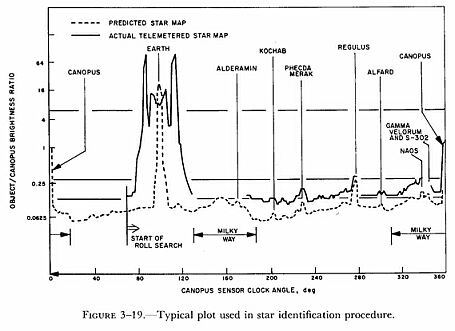
As the sensor(or sometimes the whole satellite) rotates, there’s wide blanking period where sensor is registering the Earth, then there will be series of peaks with specific known range of intensities, like ping ping pause ping ... that ends with sensor registering strobe from the Sun. Either the time from one peak to another or time from end of blanking to some peaks can be measured and “correlated against database”, in reality added and multiplied with just few int values, and positions as well as angular velocity can be calculated.
Being familiar with PC culture, I feel like I tend to overestimate complexity of then-classified military technologies. It’s pleasantly surprising how simple and elegant those classical systems can be.