Instinctively I agree with you, but: does that yellow color remind you of the Simpsons? On that show, the white people are yellow but the brown people are brown. The yellow isn’t really neutral.
This would also help with hair colors and bunch of other stuff that has separate code points at the moment. I have a feeling we'll end up with an approximation of this at some point, maybe a decade from now.
To be fair, the asians are yellow in the Simpsons :) [1].
[1] https://tokyofox.net/2015/02/13/japan-related-references-in-...
I'm truly disappointed the woke haven't pursued this.
Have you ever noticed how in The Simpsons all the “white” characters have an unrealistic skin tone in a primary color as well as often unrealistic hair textures and colors but all the other races have realistic skin tones and hair textures and colors for their races?
There's also a rather interesting cultural difference in this. U.S.A. viewers often wonder why Japanese cartoon characters look what they consider “white”, whereas Japanese viewers consider them what they consider “yellow”.
The lesson to be learned from this is that a not insignificant number, perhaps majority, of viewers replaces “nonrealism” with what it considers to be the default, unmarked expectation of the world. For U.S.A.-men, that is “white”, for Japanmen, that is “yellow”. It doesn't so much seem to be one's own “race” but the “race” one most frequently encounters in life, as U.S.A.-men of all “races” seem to do so.
The end result is that for many, the amber skin tone is not true neutral territory, even though objectively speaking it is, for they perceive it as replaceable with whatever race is the most frequent in their milieu.
https://pbs.twimg.com/media/Ek5MqILXIAEdC3k.jpg
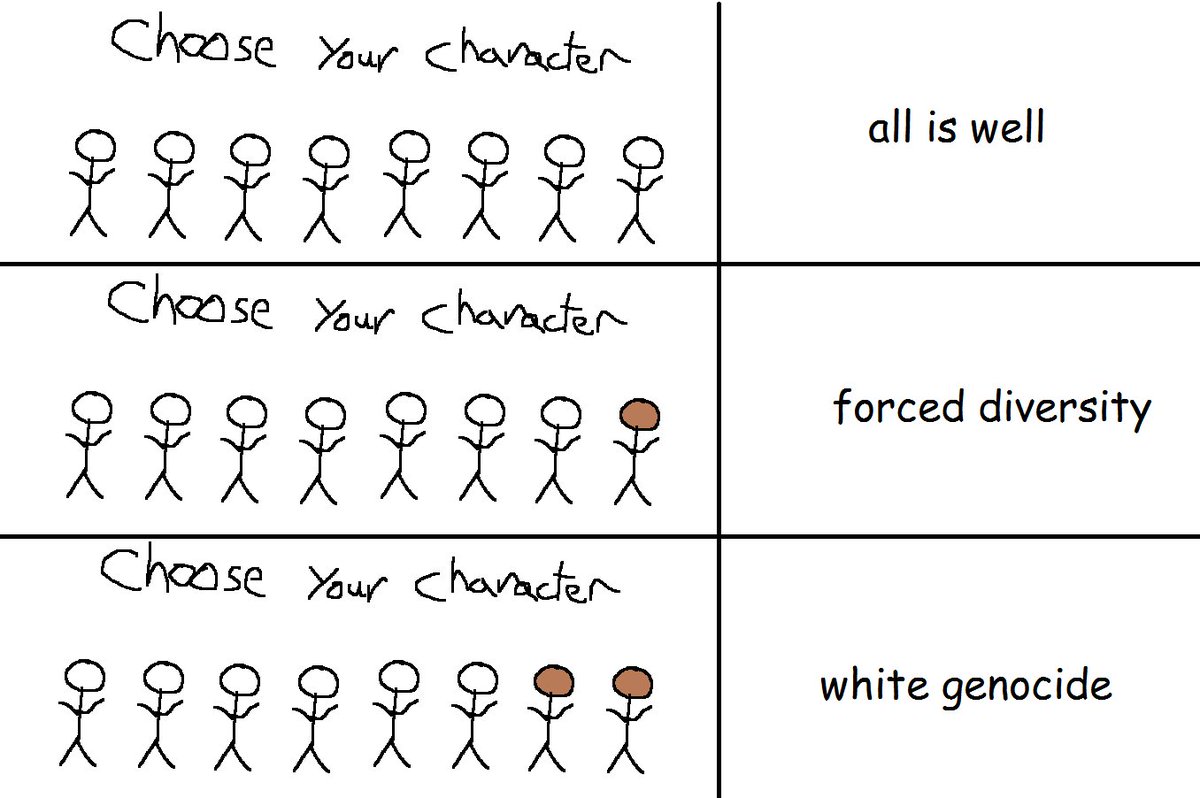
This image is most interesting and ironic to me. The auctor of said image seems to strongly imply that the stick figures that has the same color as the background are “white”, but it is not even clear whether they are transparent or simply the same, unnatural color as the background, whereas the other characters have a realistic, plausible human skin tone rather than a primary color such as perfect black. The “white” characters are not a realistic hue of beige, for instance. — I find such to have an interesting influence on the discussion, in that I often see that some people seem to perceive fictional characters that are raceless, due to for instance being of alien origin, to essentially have the “race” they consider the unmarked default of their milieu.
In particular, I had a discussion once where there was complaint about “changing the race” of the character of Tyrael. This character is a angel, who like all angels in that universe is faceless, nothing of his body but a vague humanoid shape clad in full body armor was ever shown, but when he was given human form, he had to be given such human features as a gender and a race, so they choose a “black adult male”, and some complaint that his “race was changed”; it seems to me that the character that had no race, age, or gender was consider a “white adult male” by them, which is the unmarked default in their milieu, that which they most frequently see and interact with.
Is it possible that some other explanation for the discrepancy in perception is correct, and that it has nothing to do with "default substitution"?
Regardless of what the explanation is; I'm merely remarking upon the asymmetry and the fact that many persons seem to not perceive the unnatural, amber-colored emoji as neutral territory, but I don't believe this ia a universal human trait either.
I often encounter that various cognitive defects are suggested to be universal in the literature and research that investigates them, and notes it exists, but the research's methodology can often not discriminate between that, because there is no possible negative effect. — it's entirely possible that only half of persons has the asymmetric perception, but that's enough to create an average positive measurable effect.
I'm all for inclusion, but it's not like anyone's skin is the yellow color of the default faces.