Re:Volkswagen launches its first all-electric SUV, the ID.4
by clouddrover on Friday April 23, 2021 @11:18PM
(#26921971)
Lithium sulfur batteries are also interesting. They're cheaper, lighter, and the cells don't use cobalt, manganese, or nickel.
The problem to date has been poor cycle life but people are working on it:
- https://oxisenergy.com/technology/
- https://oxisenergy.com/wp-content-uploads-2020-11-press-rele...
- https://theconversation.com/batteries-made-with-sulfur-could...
Re:Volkswagen launches its first all-electric SUV, the ID.4
by runeks on Saturday April 24, 2021 @01:29AM
(#26922497)
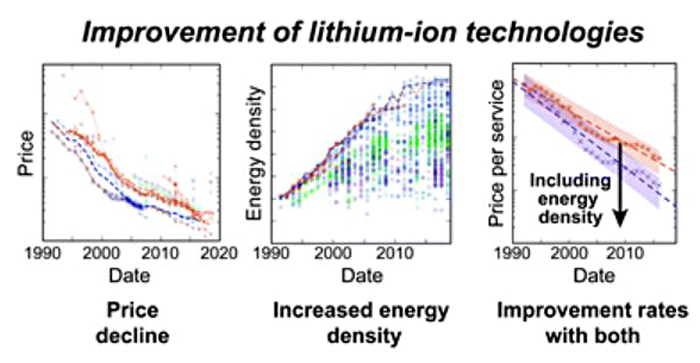
Here’s the chart of interest: https://img.electronicdesign.com/files/base/ebm/electronicde...
Re:Volkswagen launches its first all-electric SUV, the ID.4
by Reason077 on Saturday April 24, 2021 @08:58AM
(#26924548)
Cobalt is not considered a rare-earth metal. It's actually relatively common. Lithium-ion battery cells do not typically contain any rare earths, but permanent magnet motors in EVs do.
I've seen this same figure for current EVs. But it's important to look at the trend. Lithium-ion battery prices have decreased by 97% since their introduction in 1991. The price decrease curve is amazing [0]. Teslas were at least $80K in 2015; today a Tesla with similar range (Model 3) can be had for $40K. That decrease is largely the result of Tesla and Panasonic improving battery energy density and battery production economies of scale. There is every reason to believe this trend will continue, especially if solid-state batteries can be scaled up.
As for rare-earth metals, cobalt is the worst one w.r.t. rarity and human labor. Tesla's next generation of batteries (starting in late 2021) eliminate cobalt and substitute nickel and manganese, which are far more plentiful and don't require child labor.
Not trying to sanctify Tesla here; I just follow them more closely than other battery manufacturers. The others are probably working toward similar goals.
https://pubs.rsc.org/en/content/articlelanding/2021/EE/D0EE0...